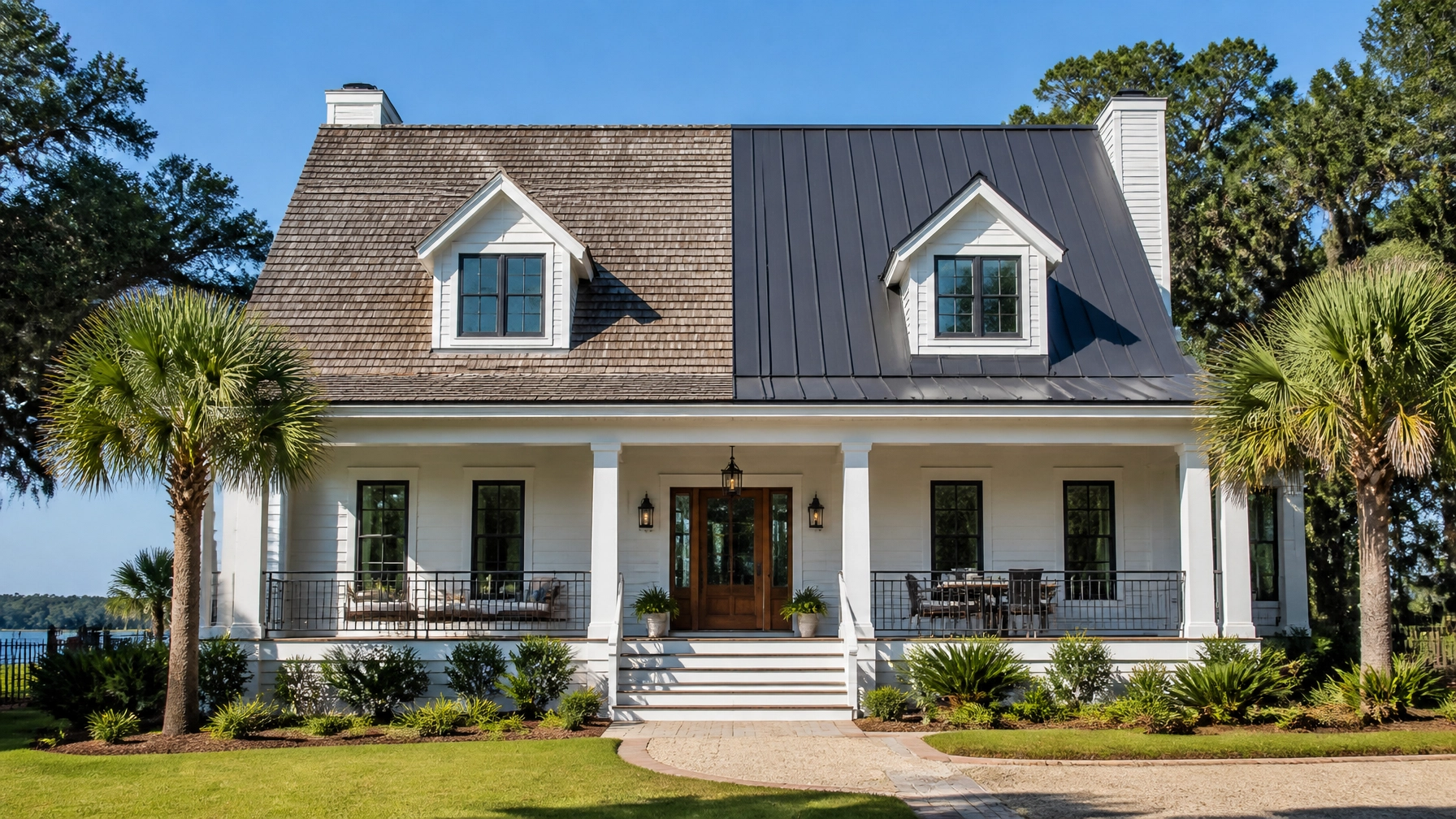
For homeowners in the "Holy City," a roof is more than just a structural necessity: it is the first line of defense against the relentless coastal elements. As we move through the 2026 hurricane season, Charleston residents face a unique set of challenges that differ significantly from inland markets. While a roofing contractor in Columbia, SC might focus on heat and occasional storms, Charleston homeowners must navigate 150 mph wind zones, salt spray corrosion, and the strict aesthetic oversight of the Board of Architectural Review (BAR).
This "Material Showdown" breaks down the two heavyweights of the Lowcountry roofing market: Architectural Shingles (Budget/Popular) and Standing Seam Metal (Premium/Resilient). Whether you are preparing for a South Carolina roof insurance claim in 2026 or proactively upgrading for the next big storm, here is what you need to know about cost, code, and coastal chemistry.
The Cost Reality: 2026 Pricing in the Charleston Metro
In the current 2026 market, material shortages have stabilized, but labor remains premium in high-demand coastal zones. Below are the current installed price ranges for a standard 1,800-square-foot Charleston home.
- Architectural Shingles (Budget-Friendly/Popular):
- Unit Price: $4.85–$8.65 per sq ft installed.
- Total Project Cost: $11,000–$20,000.
- Value Proposition: Lowest upfront cost with a 25- to 30-year lifespan under ideal conditions.
- Standing Seam Metal Roofing (Premium/Long-Term):
- Unit Price: $10.50–$15.50 per sq ft installed.
- Total Project Cost: $24,000–$45,000+.
- Value Proposition: Highest durability, salt-spray resistance, and a 50+ year potential lifespan.
While Columbia, SC roofing prices 2026 tend to be 5-10% lower due to reduced wind-load requirements, Charleston’s costs reflect the specialized engineering needed to satisfy the 2021 International Residential Code (IRC). You can see exactly where your home falls on this spectrum in under 60 seconds using our Instant Roof Cost Calculator.
The Resilience Factor: Facing the 150 MPH Wind Zone
Charleston’s geography dictates its building codes. Most of the peninsula and surrounding islands (James Island, Johns Island, Mt. Pleasant) fall within a 140–150 mph design wind zone.
The recent storms of July 2026 served as a stark reminder of this necessity. On July 10, gusts hit 64 mph, followed by 60 mph on July 11 and another 50 mph surge on July 26. These weren't even named hurricanes, yet they caused significant shingle uplift on older, non-compliant roofs.
Technical Requirements for Charleston Roofs:
- ASTM D7158 Class H: This is the gold standard for shingles in wind zones up to 150 mph. If your shingle isn't Class H, it’s not built for Charleston.
- The Six-Nail Pattern: Standard 4-nail patterns are insufficient here. Codes require a six-nail fastening pattern to prevent blow-offs.
- Self-Adhering Underlayment: Code-compliant roofs must use polymer-modified bitumen underlayment at eaves and valleys to stop wind-driven rain.
- Continuous Load Path: The roof must be tied into the walls and foundation using specialized clips and straps to ensure the entire structure resists uplift.

Coastal Chemistry: Salt Spray vs. Gloeocapsa Magma
Coastal environments are chemically aggressive. The material you choose determines which "enemy" you'll be fighting.
Metal's Enemy: Salt Spray Corrosion
If you live within a mile of the Atlantic or the harbor, salt spray is your primary concern. Standard galvanized steel roofs can rust prematurely in this environment.
- The Solution: For standing seam metal, we recommend aluminum or stainless steel substrates. Aluminum does not rust; it creates its own protective oxide layer, making it the "Premium" choice for oceanfront properties.
Shingle's Enemy: Gloeocapsa Magma (Algae)
The high humidity of the Lowcountry encourages the growth of black algae. This doesn't just look bad; it absorbs heat and can degrade the shingle's limestone filler.
- The Solution: Look for shingles with copper-infused granules that offer 10- to 15-year "StainGuard" warranties. This keeps your roof looking new and maintains the Columbia, SC home value new roof standards that investors look for across the state.
The "Holy City" Factor: Navigating the BAR
If your home is in the Old and Historic Charleston District or Harleston Village, you don't just answer to the building inspector: you answer to the Board of Architectural Review (BAR).
The BAR generally requires in-kind replacement. This means if you have a historic standing seam metal roof, you likely cannot switch to architectural shingles without a significant (and often unsuccessful) fight. They prioritize traditional materials like slate and terne metal or high-quality modern substitutes that replicate the historic form.

Financial Incentives: SC Safe Home & Insurance Discounts
Replacing a roof in Charleston is a major investment, but the state of South Carolina offers some of the best mitigation incentives in the country.
- SC Safe Home Grants: Homeowners can receive up to $7,500 in grant money to retrofit their roofs to "FORTIFIED" standards. This program is specifically designed for coastal residents to help bridge the gap between a standard roof and a high-wind resilient one.
- Insurance Savings: By law, SC insurers must offer a 10% to 35%+ discount on the wind portion of your premium if you install a roof that meets specific mitigation standards (like a metal roof or a 6-nail architectural shingle system with a sealed roof deck).
Investing in a high-quality roof significantly impacts the roof ROI in Columbia, SC and Charleston alike. In the competitive Columbia, SC real estate market 2026, a new, resilient roof can increase home value by up to 10%, often recouping over 60% of its cost at the time of sale.
The Verdict: Which is Right for You?
Choose Architectural Shingles (Popular) if:
- You are looking for the best new roof cost in Columbia, South Carolina or Charleston and want to stay under the $20k mark.
- Your home is in a modern subdivision (like those in Summerville or Goose Creek) where shingles are the standard aesthetic.
- You plan to sell the home within 5–10 years and want the immediate boost of a "new roof" label.
Choose Standing Seam Metal (Premium) if:
- You live within 1,000 feet of salt water and need maximum corrosion resistance.
- You want a "forever roof" that will likely be the last one you ever buy.
- You live in a historic district where BAR approval is mandatory for metal-to-metal replacement.
- You want the maximum possible South Carolina roof insurance claim protection for future hurricane seasons.

Final Thoughts for Charleston Homeowners
Whether you opt for the cost-effective reliability of architectural shingles or the impenetrable defense of standing seam metal, the key is the quality of the installation. A 150 mph-rated shingle is only as good as the sixth nail driven into it.
Don't wait for the next "Big One" to find out if your roof is up to code. Whether you need a roof replacement in Columbia, SC or a historic restoration in downtown Charleston, our satellite-powered estimates give you the data you need to make an informed decision in seconds.
Ready to see your numbers? Get your instant, 60-second roof estimate now.
Leave a Reply