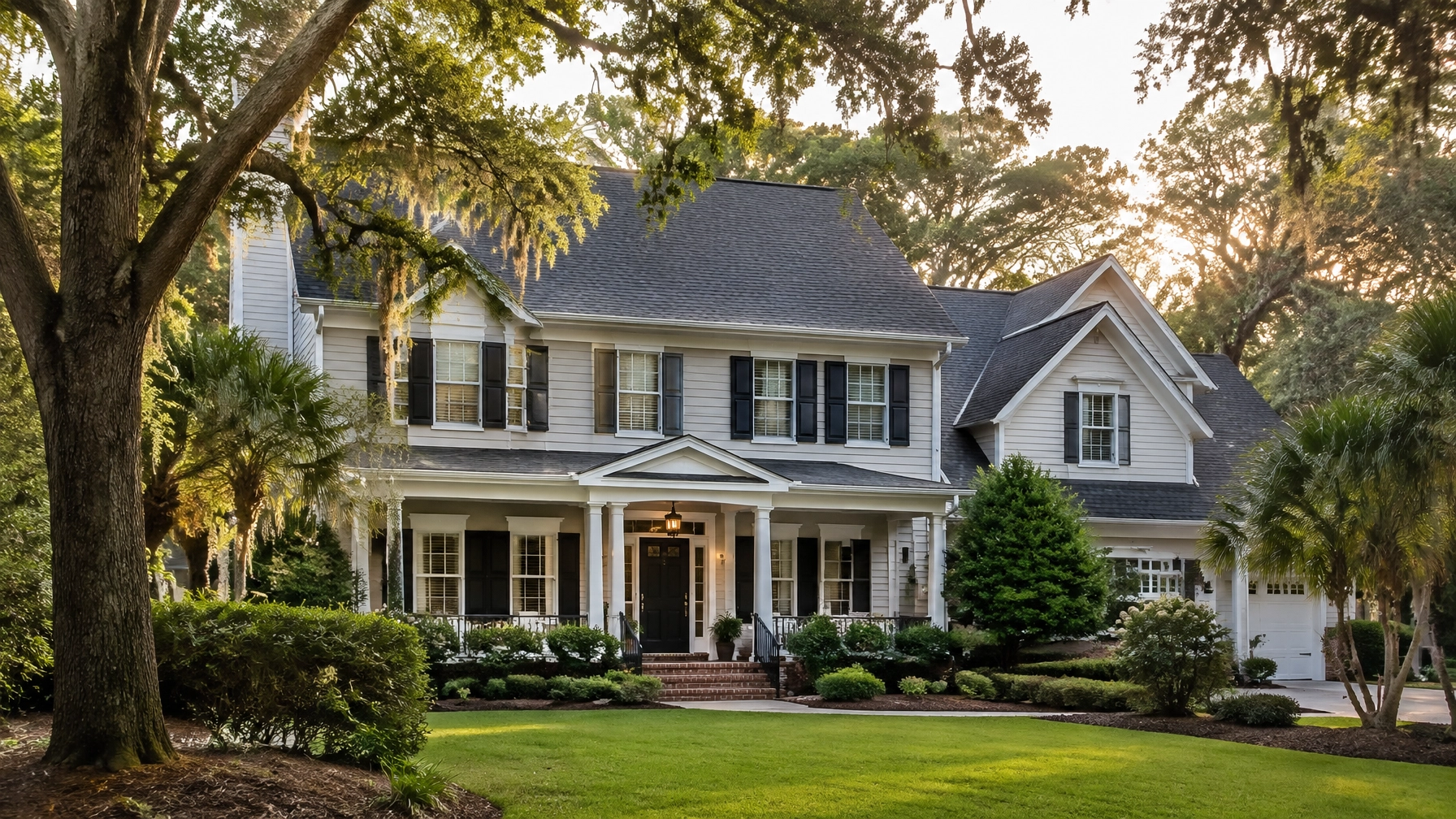
Columbia homeowners planning a roof replacement in 2026 should budget approximately $4.30–$10.00 per square foot installed for architectural shingles and $6.65–$21.00 per square foot for standing-seam metal. For a typical 2,000-square-foot home, that commonly translates to:
- Architectural shingles (Popular): approximately $8,600–$25,000
- Standing-seam metal (Premium): approximately $18,000–$40,000
- Typical Columbia home size: 1,600–2,600 square feet
The final price depends on the actual roof area: not just living space: plus pitch, valleys, dormers, penetrations, tear-off requirements, material selection, and local labor.
For homeowners in ZIP codes such as 29201, 29203, 29204, 29205, 29206, 29209, 29210, 29212, 29223, and 29229, satellite-based measurement offers a faster way to establish a realistic planning range.
Get a free satellite roof estimate in about 60 seconds.
Why satellite technology fits Columbia roofing
A roof replacement estimate starts with measurement. Roofing contractors calculate projects in squares, with one roofing square equal to 100 square feet of roof surface.
A home with 2,000 square feet of living space may have considerably more roof area because of:
- Roof pitch
- Overhangs
- Multiple roof sections
- Hips and valleys
- Dormers
- Attached garages
- Skylights, chimneys, and vents
- Difficult access
Satellite imagery helps identify these elements before a homeowner schedules multiple preliminary visits. Get My Roof Estimate Now uses satellite-powered measurements to estimate roof size, pitch, and complexity with approximately 90–95% accuracy, with measurements designed to be accurate to within inches.
The result is not a final contractor bid. It is a fast, useful budget benchmark that helps you decide whether to repair, replace, compare materials, or request detailed inspections.

Columbia’s local geospatial technology edge
Columbia is becoming a strong environment for practical geospatial innovation.
The City of Columbia Office of GIS launched the Columbia Map, a cloud-based platform designed to combine parcel boundaries, utility lines, zoning information, real-time transit data, refreshed high-resolution imagery, 3D modeling of the central business district, open APIs, and public access through a web portal and mobile app.
The platform incorporates municipal drone surveys and commercial satellite data. Elena Rodriguez, Chief of GIS for the City of Columbia, described the goal this way:
“The goal was to move from static PDFs and outdated surveys to a living, breathing digital canvas.”
Marcus Thorne, senior project manager with the City Infrastructure Division, added:
“This has cut our preliminary survey time by nearly 40%.”
That same shift: from static information to frequently updated visual data: has clear value in roofing. Accurate aerial information can help homeowners understand roof geometry before a contractor performs a close inspection.
Columbia’s technology ecosystem also includes the University of South Carolina Satellite Oceanography Laboratory, housed in the School of the Earth, Ocean & Environment. The lab researches remote sensing, satellite oceanography, ocean circulation, climate change, sea-level change, and air-sea interaction.
In 2026, USC-related satellite research is also connecting NASA NISAR and SWOT mission data with coastal and salt-marsh resilience questions along the South Carolina coast, including the North Inlet–Winyah Bay area. The Molinaroli College of Engineering and Computing continues to support student technology development, including CubeSat prototyping and NASA-supported research.
Columbia also hosted the third annual South Carolina Interagency Drone Users Consortium symposium in July 2026. The event focused on public-sector drone applications, infrastructure inspection, emergency response, public safety, and responsible geospatial innovation, with participation from the South Carolina Department of Environmental Services.
The lesson for homeowners is simple: geospatial technology is no longer limited to laboratories and public agencies. It is becoming a practical tool for home planning.
Columbia’s 2026 storm pattern deserves attention
The Midlands has a humid subtropical climate. Roofs must handle:
- Hot, humid summers
- Severe thunderstorms
- Hail
- Hurricane-season wind and rain
- Heavy downpours
- Algae staining, including dark Gloeocapsa magma growth in shaded areas
On September 5, 2026, hail near the Columbia warning area reached approximately 1.00 inch, with more than 15,000 properties potentially impacted according to event-impact estimates.
On September 6, 2026, storm summaries reported hail up to 2.5 inches, with nearly 36,000 properties potentially affected in the KCAE warning area. NWS Columbia warnings for the event included central Richland County and cited quarter-size hail, 70-mph wind gusts, and possible roof damage.
Property-impact totals can vary by mapping provider and methodology. They should be treated as screening data: not proof that a particular roof is damaged.
After a storm, document conditions and arrange a professional inspection.
How satellite roof measurement works
A satellite estimate typically follows four steps:
-
Enter the property address.
The system identifies the correct home and roof footprint. -
Analyze roof geometry.
Imagery helps identify roof sections, approximate pitch, ridges, valleys, hips, and attached structures. -
Calculate roof squares.
The estimated surface area is converted into roofing squares for material and labor calculations. -
Apply local pricing.
Regional labor rates, material costs, roof complexity, and selected materials produce low, middle, and high ranges.
Get My Roof Estimate Now provides estimates for architectural shingles, metal, synthetic roofing, and roof coatings. There is no credit card requirement, and results are typically available in about 60 seconds.
2026 Columbia roof replacement cost table
| Roofing option | Installed cost range | Typical 2,000-square-foot home | Best fit |
|---|---|---|---|
| Architectural shingles (Popular) | $4.30–$10.00 per sq. ft. | Approximately $8,600–$25,000 | Balanced cost, appearance, and resale appeal |
| Standing-seam metal (Premium) | $6.65–$21.00 per sq. ft. | Approximately $18,000–$40,000 | Long-term durability and premium curb appeal |
| Synthetic roofing (Premium alternative) | Varies by product and roof design | Request a property-specific estimate | Specialty appearance and performance |
| Roof coating (Maintenance option) | Varies by roof type | Inspection required | Certain low-slope or compatible systems |
These are planning ranges. A contractor’s final proposal may change because of decking repairs, flashing replacement, ventilation upgrades, permit costs, historic-district requirements, disposal, or concealed damage.
The City of Columbia requires a building permit for roof replacement. Requirements and fees can vary elsewhere in Richland County, so verify with the local building official or permitting department.
Which roofing material is best for home value?
For many Columbia homeowners, architectural shingles are the strongest choice when the goal is a practical balance of cost and resale appeal.
Architectural shingles (Popular)
Architectural shingles can improve:
- Roof appearance
- Buyer confidence
- Weather protection
- Curb appeal
- Inspection results before a sale
National Cost vs. Value data commonly places asphalt roof replacement ROI around 60–70%, although actual results vary by market, project quality, and timing.
Standing-seam metal (Premium)
Metal roofing generally costs more upfront but can offer:
- Longer service life
- Strong wind and weather performance
- Modern curb appeal
- Lower long-term maintenance
- A premium exterior feature
Immediate resale ROI is often lower as a percentage than architectural shingles because the initial investment is higher. However, metal may make sense for long-term owners or homes where premium durability and design are important.
The best roof for home value is usually the material that fits the neighborhood, the home’s architecture, the local climate, and the owner’s time horizon.

Columbia storm-damage checklist
After hail or high winds:
- Photograph the roof from the ground.
- Record the storm date and address.
- Check gutters and downspouts for granules.
- Look for dents on vents, flashing, gutters, and outdoor equipment.
- Check ceilings and attic areas for leaks.
- Do not climb onto a wet or damaged roof.
- Contact your insurer if damage appears likely.
- Schedule an inspection with a licensed, insured roofing professional.
- Avoid signing high-pressure contracts before reviewing the scope and price.
A satellite estimate can help establish a replacement budget, but it cannot replace a hands-on inspection after a storm.
Roof replacement ROI and home value
A new roof can protect value in three ways:
-
It improves curb appeal.
A clean, proportionate roof can make the entire exterior look newer. -
It reduces buyer uncertainty.
A failing roof may trigger inspection objections, repair credits, or delayed financing. -
It supports resale positioning.
Buyers are more likely to view a recently replaced roof as one less major expense.
For the strongest roof replacement ROI, prioritize:
- Accurate measurements
- Durable materials suited to Columbia’s climate
- Professional installation
- Proper ventilation and flashing
- A style that matches nearby homes
- Clear documentation, warranties, permits, and inspection records
Start with an instant estimate, then use the range to compare qualified local contractors.
Calculate your Columbia roof replacement cost.
Frequently asked questions
How much does a new roof cost in Columbia, SC, in 2026?
Architectural shingle replacement commonly ranges from approximately $8,600 to $25,000 for a 2,000-square-foot home. Standing-seam metal commonly ranges from approximately $18,000 to $40,000. Actual pricing depends on roof size, pitch, complexity, materials, labor, and repairs.
Can satellite imagery measure my roof accurately?
Satellite-powered estimates can measure roof dimensions, pitch indicators, and complexity with approximately 90–95% accuracy. They are useful for budgeting but should be followed by a professional inspection and final proposal.
Is a permit required for roof replacement in Columbia?
Yes. The City of Columbia requires a building permit for roof replacement. Richland County requirements can vary by jurisdiction, so confirm with the applicable building official.
What is the best roof for home value in Columbia?
Architectural shingles often provide the strongest immediate value balance because they cost less and are familiar to most buyers. Metal can provide premium curb appeal and long-term durability but usually requires a larger upfront investment.
Does a new roof increase resale value?
It can. A new roof improves curb appeal, reduces inspection concerns, and may help prevent negotiation credits. National benchmarks commonly show asphalt roof replacement recouping approximately 60–70% of cost, though Columbia-specific results vary.
Sources
- Get My Roof Estimate Now Roof Cost Calculator
- Get My Roof Estimate Now
- City of Columbia GIS
- University of South Carolina Satellite Oceanography Laboratory
- South Carolina Department of Environmental Services: 2026 Government Drone Symposium
- NWS Columbia Severe Thunderstorm Warning, September 6, 2026
- 2025 Cost vs. Value Report
Categories: Roofing Costs, Roofing Technology, South Carolina Roofing, Home Improvement
Tags: Columbia SC roof replacement cost, new roof cost Columbia SC, satellite roof estimate, South Carolina roofing, roof cost calculator, hail damage Columbia SC, Midlands roofing, architectural shingles, metal roofing, roof replacement ROI, Columbia home value
Leave a Reply