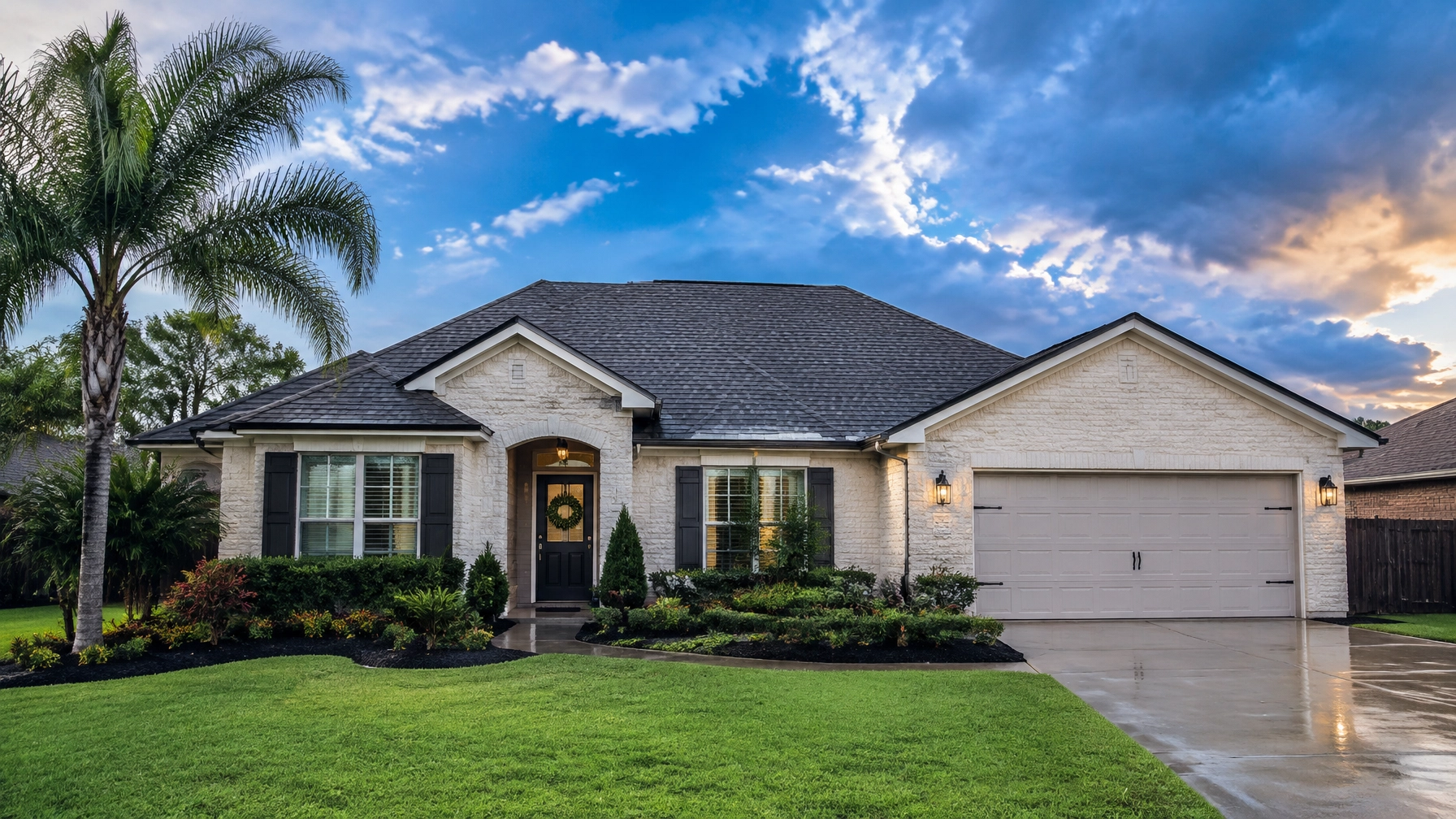
Houston is used to big missions.
From NASA’s Johnson Space Center to hurricane tracking and storm forecasting, Space City has always relied on advanced technology to solve difficult problems. Now, that same data-driven approach is changing how Houston homeowners plan roof replacements and document storm damage.
Satellite imagery and AI computer vision can measure a residential roof in minutes: without an initial contractor visit. For many Houston homes, the result is a practical starting point for budgeting, comparing materials, and preparing an insurance claim.
That matters after the 2026 hail events on June 2 and August 28, both identified on HailTrace Texas storm maps. Gulf Coast homeowners do not have to wait weeks for multiple contractors to provide basic pricing information.
Houston Roof Replacement Costs in 2026
A typical Houston roof replacement costs approximately:
- $8,000–$25,000 for many residential projects
- $8,500–$22,000 for a typical local replacement
- Around $14,000 for architectural shingles on a 2,000-square-foot roof
Your actual price depends on several measurable factors:
- Roof size, usually between 1,500 and 3,000 square feet
- Number of roof planes and sections
- Pitch or steepness
- Valleys, dormers, chimneys, and roof penetrations
- Existing roof removal
- Material selection
- Labor and material costs in the Houston region
- Hidden decking or structural repairs
A simple ranch roof may cost considerably less than a large colonial or multi-level home with multiple valleys. Regional labor demand, storm activity, and material availability can also move Houston pricing higher or lower.
The fastest way to establish a property-specific range is to start with an accurate measurement.

How 30–50 Centimeter Satellite Imagery Measures a Roof
Modern commercial satellite imagery can reach approximately 30–50 centimeters of ground resolution. That means each pixel represents a small area on the property: detailed enough to identify major roof outlines, ridges, valleys, dormers, vents, and nearby obstructions.
AI computer vision then processes the imagery to detect roof geometry.
The system can help estimate:
- Total roof area
- Roof perimeter
- Individual roof planes
- Ridge and valley lines
- Pitch or slope categories
- Roof complexity
- Approximate roofing squares
- Material quantities for different replacement options
Roofing contractors commonly measure in squares, with one square equal to 100 square feet of roof area. A 2,000-square-foot roof contains approximately 20 roofing squares before accounting for waste and installation details.
Satellite-powered measurement is especially useful because homeowners can receive a consistent starting point before inviting contractors to the property. It reduces the guesswork involved in collecting a basic budget range.
However, satellite imagery has limits. At 30–50 centimeters, it is excellent for roof geometry and major visible changes. It is not a substitute for a close inspection of individual shingles, small hail bruises, granule loss, flashing, or hidden decking damage.
For a disputed insurance claim, use satellite measurements as part of a larger documentation package that may include ground photos, contractor inspection reports, higher-resolution aerial imagery, and adjuster findings.
Why Houston’s 2026 Hail Events Make Better Documentation Important
Houston roofs face more than ordinary wear.
The region combines:
- Gulf Coast humidity
- Heavy rainfall
- High winds
- Tropical storms and hurricanes
- Intense summer heat
- Seasonal hail
- UV exposure that accelerates shingle aging
The June 2, 2026 storm affected parts of the Houston area with reported hail and strong wind conditions. HailTrace mapping identified impacted properties across Texas, while weather warnings cited the potential for roof and siding damage.
The August 28, 2026 event also affected the Houston region. HailTrace’s August 28 Texas map includes Houston among the impacted areas. Independent radar-based storm products reported hail in the Houston and Harris County area that day.
If your roof was exposed to either event, do not assume that a lack of an indoor leak means there is no damage. Hail damage can affect shingles, vents, gutters, ridge caps, skylights, and other roof components before water enters the home.
Start with safe, ground-level photos. Then arrange a professional inspection. Do not climb onto the roof yourself.
Historical Imagery Can Help Establish a Damage Timeline
One of the most useful applications of satellite and aerial imagery is historical comparison.
A homeowner, adjuster, contractor, or expert may compare imagery from before and after a storm to identify visible changes such as:
- A missing roof section
- A new tarp
- Roof debris
- A changed roof color or pattern
- Damaged or displaced rooftop equipment
- Fallen trees or large objects
- Repairs completed after the storm
Historical imagery can help answer an important insurance question: Was the condition present before the reported date of loss?
Google Earth imagery has also been used in legal proceedings. In United States v. Lizarraga-Tirado, a federal appeals court treated Google Earth imagery similarly to a photograph, while emphasizing the importance of authenticating markers, coordinates, and other overlays. You can read a summary of the decision through FindLaw’s discussion of Google Earth evidence.
That does not mean a screenshot automatically proves a hail claim. Historical imagery must be properly documented. Preserve:
- The property address
- Image source
- Capture date or date range
- Resolution
- Original files where possible
- Any report explaining the analysis
- Supporting ground photos and inspection records
Also remember that 30–50 centimeter imagery usually cannot prove small shingle-level damage by itself. It is strongest for geometry, major changes, and timeline context.
Texas Insurance Deadlines: Do Not Wait
Texas homeowners should separate three different concepts:
- The deadline to notify the insurer
- The deadline to submit a claim under the policy
- The deadline to pursue legal action if the claim is denied or underpaid
The often-referenced two-year window generally relates to legal action or policy-based suit limitations in certain insurance disputes. It should not be treated as a universal two-year deadline for reporting every hail claim.
Your policy may require notice much sooner: sometimes within 90 days, 180 days, or one year. For wind and hail coverage through the Texas Windstorm Insurance Association, the standard filing deadline is generally one year from the date of damage, subject to applicable exceptions.
The Texas Department of Insurance consumer guide recommends notifying your insurance company as soon as possible and checking your policy for the exact deadline.
Check these policy details now
- “Duties After Loss”
- “Notice of Claim”
- Wind and hail exclusions
- Proof-of-loss requirements
- Suit limitation language
- Whether your coverage is through TWIA
- The applicable wind/hail deductible
How Wind and Hail Deductibles Affect Your Budget
Houston policies commonly use a percentage deductible for wind and hail losses. Typical percentages range from 1% to 5% of the dwelling coverage limit.
The deductible is generally based on the insured value of the dwelling: not the repair estimate.
For example, with a $300,000 dwelling limit:
- 1% deductible: $3,000
- 2% deductible: $6,000
- 5% deductible: $15,000
That makes a realistic roof replacement estimate essential. A homeowner may have a roof project within the $8,000–$25,000 range but still need to account for a substantial out-of-pocket deductible.
Do not begin repairs or sign an assignment of benefits agreement without understanding your policy, deductible, and contractor documentation.
Houston Roofing Materials: Budget, Popular, and Premium
Satellite measurement allows homeowners to compare materials using the same roof geometry.
Architectural shingles (Popular)
Architectural shingles are widely used in Houston because they balance cost, appearance, and performance. They typically cost less than metal or tile and are available in many colors.
Impact-resistant shingles (Storm-focused)
Impact-resistant products may provide better protection against hail. Ask your insurer whether qualifying materials could affect your premium or deductible. Requirements vary by carrier and policy.
Metal roofing (Premium)
Metal roofing commonly costs more upfront but can last 40–70 years. It may also reflect more solar heat and provide strong wind performance when properly installed.

Tile roofing (Premium)
Clay or concrete tile can complement Spanish, Mediterranean, and other architectural styles. Tile is durable but heavier and may require specific structural and installation considerations.
Compare additional material options through the Get My Roof Estimate Now roofing materials guide.
Get a Free Houston Roof Estimate in Under 60 Seconds
Get My Roof Estimate Now uses satellite-powered technology to estimate your roof’s size, pitch, and complexity.
The process is simple:
- Enter your Houston property address.
- Let the platform analyze the roof using satellite imagery.
- Review a low-to-high replacement cost range.
- Compare material options.
- Use the estimate to plan a contractor inspection or insurance discussion.
The platform provides estimates with approximately 90–95% measurement accuracy, typically in under 60 seconds. There is no contractor visit required upfront, no credit card, and no charge.
It is a planning tool: not a final construction contract or insurance determination. A licensed roofing professional should still inspect the roof before work begins, particularly after hail, wind, or hurricane damage.

Conclusion: Houston Homeowners Can Plan With Better Data
Houston’s Space City identity is not just about rockets. It is also about using better information to make faster, more informed decisions.
For roof replacement planning, satellite imagery and AI can provide a reliable starting point based on the actual property: not a generic neighborhood average. For storm documentation, historical imagery can add useful timeline and property context when combined with professional inspections and complete records.
If your Houston roof may have been affected by the June 2 or August 28, 2026 hail events, act promptly. Check your policy, document visible conditions, verify your deductible, and start with a free satellite-powered estimate at Get My Roof Estimate Now.
Leave a Reply