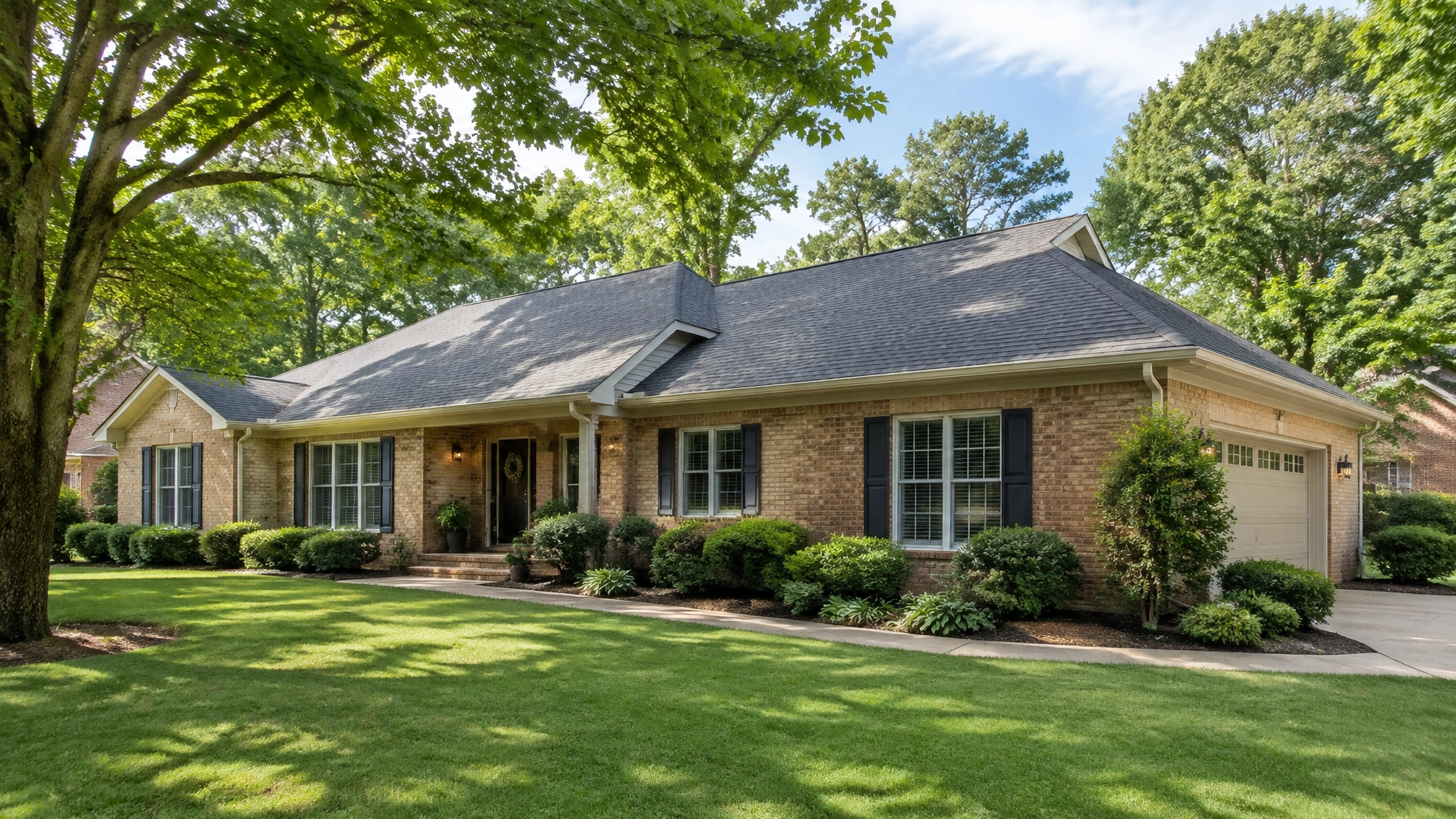
Charlotte homeowners researching roof replacement may encounter the term AEO in business or shipping documents. But AEO does not mean a roofer is licensed, approved, certified, or authorized to work on a Charlotte home. For roofing decisions, focus on North Carolina licensing rules, Mecklenburg County permits, insurance requirements, contractor credentials, and a clear written estimate.
Charlotte Roofing FAQ: Quick Reference
| Question | Short answer |
|---|---|
| What does AEO mean? | Authorized Economic Operator, a global customs and supply-chain trusted-trader concept. |
| Is AEO a roofing credential? | No. It is unrelated to roofing licenses, permits, warranties, or product certifications. |
| When is an NC general contractor license required? | For projects costing $40,000 or more. |
| Is a permit required for every Charlotte roof replacement? | No. A qualifying like-for-like replacement costing $40,000 or less may be exempt. |
| What does a Charlotte roof replacement cost in 2026? | About $4.50–$7.00 per square foot for architectural shingles installed. |
| What should I do after hail damage? | Photograph damage from the ground, protect leaks, contact your insurer, and arrange a professional inspection. |
| Can a roofer waive my deductible? | No. North Carolina law does not allow contractors to waive, pay, or absorb your insurance deductible. |
What Does AEO Mean?
AEO means Authorized Economic Operator. It is a global customs and supply-chain security concept established under the World Customs Organization SAFE Framework.
An AEO is generally a business involved in the international movement of goods that has been approved by a national customs administration as meeting supply-chain security and compliance standards.
In the United States, the comparable program is CTPAT, or Customs Trade Partnership Against Terrorism, administered by U.S. Customs and Border Protection.
AEO is not related to roofing
AEO is not:
- A roofing contractor license
- A building permit
- A roofing product certification
- A manufacturer warranty
- Proof of insurance
- Approval to perform work on a Charlotte home
A Charlotte roofer cannot use AEO or CTPAT status to satisfy a North Carolina licensing or Mecklenburg County permitting requirement.
Why Charlotte businesses may encounter AEO or CTPAT
Charlotte companies involved in international air cargo through Charlotte Douglas International Airport (CLT), Foreign Trade Zone #57, or shipping through the Port of Wilmington or Port of Morehead City may encounter AEO or CTPAT requirements.
Those programs concern cargo security, customs compliance, and international trade. They have nothing to do with residential roofing.
Customs requirements can change. Confirm current information directly with CBP.gov or a qualified customs professional.
Does a Charlotte Roofer Need an NC General Contractor License?
For 2026, North Carolina requires a general contractor license when the total project cost is $40,000 or more. This threshold increased from $30,000 effective October 1, 2023.
Licensing is handled by the North Carolina Licensing Board for General Contractors. The Board also provides a public contractor license search.
Roofing work may fall under:
- Building classification
- Residential classification
- S(Roofing) specialty classification
Most single-family roof replacements below $40,000 do not require an NC general contractor license. However, that does not eliminate the need for careful contractor screening.
Before hiring a Charlotte-area roofer, verify:
- General liability insurance
- Workers’ compensation coverage
- Written references from recent projects
- A detailed written contract
- Material and workmanship warranties
- Local experience with storm damage and roof replacement
AEO or CTPAT status does not satisfy any NC contractor licensing requirement.

Does a Charlotte Roof Replacement Need a Permit?
For a single-family home in Mecklenburg County, a permit is generally not required for a like-for-like roof covering replacement when:
- The project costs $40,000 or less
- There is no structural work
- The replacement uses a like-grade fire-resistance material
- The roof assembly is not being changed
A permit is required when the project:
- Exceeds $40,000
- Includes structural repairs
- Replaces decking, rafters, or trusses
- Changes the roof assembly
- Changes the fire classification
- Involves materials or work outside the applicable exemption
When a permit is required, applications are handled through Mecklenburg County’s permitting information page and the Accela Citizen Access portal.
County rules and code interpretations can change. Confirm requirements with Mecklenburg County Code Enforcement before work begins.
How Much Does a Roof Replacement Cost in Charlotte in 2026?
Architectural shingle roofs in Charlotte typically cost approximately $4.50–$7.00 per square foot installed. Premium materials, steep slopes, difficult access, multiple roof sections, extensive tear-off, or hidden damage can push pricing toward $10 per square foot.
For a 2,000-square-foot roof, a typical range is approximately $9,000–$14,300. Complex or premium projects can reach about $20,000.
Charlotte cost breakdown for a 2,000-square-foot roof
| Level | Approximate installed cost | Typical scope |
|---|---|---|
| Budget | $9,000–$10,000 | Basic materials, simple roof design, limited complexity |
| Popular | $10,000–$14,300 | Architectural shingles with standard removal and installation |
| Premium | $14,300–$20,000 | Designer materials, steep or complex roof, premium upgrades, or repairs |
Your actual Charlotte price depends on roof size, pitch, complexity, material choice, local labor, tear-off requirements, ventilation, flashing, and decking condition.
Use the free satellite roof estimate from Get My Roof Estimate Now to see low, middle, and high replacement ranges in about 60 seconds. The service measures roof size, pitch, and complexity from satellite imagery, typically with 90–95% accuracy. No credit card is required.
For a material comparison, review the roofing materials guide.
What Should Charlotte Homeowners Do After Hail Damage?
Charlotte experienced several hail-producing storm events in 2026, including:
- June 26, 2026
- July 28, 2026, with reported hail up to 1.75 inches in the broader Charlotte region
- August 6, 2026
Hail damage is not always visible from the ground. Granule loss, bruising, cracked shingles, damaged flashing, and dented vents may require a professional inspection.
Follow these steps after a storm
- Document visible damage from the ground. Take photos of shingles, gutters, siding, windows, and downspouts.
- Do not climb on the roof. Wet or damaged roofing is dangerous.
- Protect interior leaks. Place containers under active leaks and move valuables away from water.
- Notify your insurer within the policy’s required window.
- Arrange a professional roof inspection.
- Request written estimates before authorizing work.
- Do not sign under pressure. Be cautious with door-to-door contractors demanding an immediate decision.
A satellite estimate can help you understand potential replacement costs before comparing Charlotte-area contractors, but it does not replace an in-person inspection for storm damage or structural conditions.

Can a Charlotte Roofer Waive My Insurance Deductible?
No. North Carolina law does not allow roofing contractors to waive, pay, absorb, or improperly rebate a homeowner’s insurance deductible.
Offers such as:
- “We will cover your deductible.”
- “You will pay nothing out of pocket.”
- “We will increase the insurance invoice to cover the deductible.”
may create serious legal and insurance problems. Both the contractor and homeowner could become involved in an insurance fraud scheme if invoices or claim information are manipulated.
North Carolina’s Session Law 2024-11, also known as the S124 predatory roofing and insurance rebate reform, updated residential roofing contract rules. It did not authorize deductible waivers.
You remain responsible for paying your policy deductible. Ask your insurer how the claim will be handled, and report suspected fraud to the appropriate North Carolina authorities.
Charlotte ZIP Codes Covered by This Guide
This Charlotte-area FAQ applies to homeowners in:
Charlotte: 28202, 28203, 28204, 28205, 28206, 28207, 28208, 28209, 28210, 28211, 28212, 28213, 28214, 28215, 28216, 28217, 28226, 28227, 28262, 28269, 28270, 28273, 28277, 28278
Nearby communities: 28027 Concord, 28031 Cornelius, 28036 Davidson, 28078 Huntersville, 28105 Matthews, 28134 Pineville, 28173 Waxhaw
Charlotte Roofing FAQ Recap
| FAQ | Answer |
|---|---|
| Does AEO mean a roofer is approved? | No. AEO concerns international customs and supply-chain security, not residential roofing. |
| What is the U.S. equivalent of AEO? | CTPAT, administered by U.S. Customs and Border Protection. |
| When is an NC contractor license required? | When the project cost is $40,000 or more. |
| Is a like-for-like roof replacement under $40,000 exempt from a permit? | Generally yes, if there is no structural work and the replacement uses like-grade fire-resistance material. |
| What does a 2,000-square-foot Charlotte roof cost? | Approximately $9,000–$14,300 for common architectural shingles; complex work can reach $20,000. |
| What should I do after hail? | Photograph from the ground, protect leaks, contact your insurer, obtain an inspection, and compare written estimates. |
| Can a contractor pay my deductible? | No. Homeowners remain responsible for their insurance deductible. |
Rules and requirements can change. Confirm current details with the NCLBGC, Mecklenburg County Code Enforcement, CBP, and your insurer before starting work.
Before comparing licensed Charlotte-area contractors, get your free satellite roof estimate at getmyroofestimatenow.com. Receive low-middle-high pricing for your home in about 60 seconds( free, with no credit card required.)
Leave a Reply