Blog

  • Daily FAQ Blitz – Slot 7: AEO FAQ Quick Answers for Savannah, GA

    Daily FAQ Blitz – Slot 7: AEO FAQ Quick Answers for Savannah, GA

    Meta Description: Get expert answers on AEO certification Savannah GA, customs compliance, and Port of Savannah trade compliance. Essential FAQ guide for Georgia logistics and import-export businesses.

    As one of the busiest and fastest-growing container ports in the United States, the Port of Savannah (Garden City Terminal) serves as the economic heartbeat of coastal Georgia. For importers, exporters, customs brokers, and logistics providers operating in the region, navigating international trade rules requires absolute precision.

    With global supply chains facing increasing regulatory scrutiny, understanding Authorized Economic Operator (AEO) standards and U.S. customs frameworks is critical. Whether you are expanding your import operations or streamlining local warehousing, this comprehensive FAQ guide addresses the most pressing questions regarding AEO certification Savannah GA, customs compliance Savannah, and Port of Savannah trade compliance.


    1. What is AEO Certification, and How Does It Apply in Savannah, Georgia?

    An Authorized Economic Operator (AEO) is an international standard established by the World Customs Organization (WCO) under the SAFE Framework. It designates businesses involved in the international movement of goods: such as manufacturers, importers, exporters, freight forwarders, and warehouse operators: as secure and compliant partners.

    While the term "AEO" is widely used across the European Union, Asia, and Latin America, the United States implements its equivalent trusted trader framework through Customs-Trade Partnership Against Terrorism (CTPAT) administered by U.S. Customs and Border Protection (CBP).

    For businesses operating in Savannah, Georgia, achieving AEO-equivalent status means your supply chain security and customs records meet rigorous federal standards, reducing cargo hold times at the Garden City Terminal and facilitating smoother cross-border logistics.

    Modern logistics office in Savannah Georgia with trade compliance experts reviewing international shipping documents


    2. How Does CTPAT Serve as the U.S. Equivalent to Foreign AEO Programs?

    Many international shippers unfamiliar with U.S. nomenclature often ask whether they can obtain a direct "AEO certificate" in the United States.

    • The U.S. Standard (Essential): In the United States, CTPAT is the official trusted trader program that fulfills the exact same strategic function as foreign AEO programs.
    • Global Recognition (Popular): CBP treats CTPAT as its direct counterpart to global AEO programs. When U.S. companies participate in CTPAT, they receive prioritized treatment and reduced inspections at ports nationwide, including the Port of Savannah.
    • Dual Benefits (Strategic): If your business imports goods from overseas partners who hold foreign AEO status, mutual recognition agreements allow those benefits to translate directly into streamlined entry processing at U.S. ports of entry.

    3. What Are the Core Requirements for Achieving Customs Compliance in Georgia?

    Securing AEO Georgia or CTPAT-equivalent status involves a thorough internal assessment and adherence to stringent security and compliance pillars. Customs authorities evaluate applicants across several key areas:

    • Customs Compliance History (Mandatory): Importers must demonstrate an unblemished or well-managed record of accurate tariff classification, valuation, and timely duty payments.
    • Supply Chain Security (Rigorous): Physical security of facilities, container integrity, personnel background checks, and IT cybersecurity protocols must meet federal benchmarks.
    • Financial Solvency (Essential): Businesses must prove long-term financial stability to ensure they can meet all commercial and regulatory financial obligations.
    • Record-Keeping & Traceability (Standard): Maintaining transparent audit trails for every bill of lading, commercial invoice, and entry summary is non-negotiable.

    4. How Do Mutual Recognition Arrangements (MRAs) Benefit Savannah Importers?

    For Savannah-based companies engaged in transatlantic or transpacific trade, Mutual Recognition Arrangements (MRAs) between the U.S. and foreign customs administrations provide massive operational advantages.

    When a foreign customs authority validates an overseas supplier as an AEO, and CBP recognizes that program through an MRA, your inbound shipments benefit from coordinated security standards. This linkage reduces duplicate security audits, lowers the statistical profile of cargo for random physical exams, and ensures faster clearance through the Port of Savannah.

    Cargo ships and container cranes operating efficiently at the Garden City Terminal in Savannah Georgia


    5. What Operational Advantages Do Trusted Trader Statuses Provide at Garden City Terminal?

    Operating out of the Port of Savannah requires speed and predictability. Delays at the terminal can cascade through your entire warehousing and distribution network. Holding AEO Georgia / CTPAT status delivers tangible operational benefits:

    • Reduced Inspection Rates (Popular): Certified low-risk importers experience significantly fewer random Container Security Initiative (CSI) and intensive compliance exams.
    • Front-of-the-Line Priority (Advanced): During periods of high port congestion or supply chain disruptions, trusted traders often receive priority processing and expedited cargo release.
    • Dedicated Account Support (Premium): Members gain direct access to CBP Supply Chain Security Specialists and local port liaisons who can assist in resolving entry bottlenecks quickly.

    6. How Can Savannah Freight Forwarders and Custom Brokers Streamline Compliance?

    Logistics service providers in Chatham County: including custom house brokers, drayage truckers, and warehouse operators: play a vital role in regional trade. To maintain peak efficiency:

    • Partner Vetting (Essential): Utilize automated screening tools to vet foreign suppliers, carriers, and subcontractors against restricted party lists.
    • Digital Integration (Recommended): Integrate your enterprise resource planning (ERP) systems directly with Automated Commercial Environment (ACE) portals for real-time cargo status tracking.
    • Continuous Training (Standard): Conduct periodic internal audits on HTS code classification and valuation to prevent costly customs penalties and delays at Savannah checkpoints.

    Next Steps for Savannah Trade Leaders

    Navigating international trade compliance and securing customs compliance Savannah credentials requires expert preparation and ongoing dedication. Whether you are expanding your distribution footprint near the Port of Savannah or modernizing your commercial facilities, staying ahead of federal standards protects your bottom line.

    For property owners and logistics businesses looking to optimize their commercial warehouses and facilities while planning ahead, visit our main platform at Get My Roof Estimate Now or explore our latest insights on our Blog.

    Professional business executives in Savannah GA reviewing supply chain security and compliance reports


  • Impact-Resistant Shingles vs. Synthetic Slate Roofing: The 2026 Myrtle Beach SC Grand Strand Material Showdown

    Impact-Resistant Shingles vs. Synthetic Slate Roofing: The 2026 Myrtle Beach SC Grand Strand Material Showdown

    Choosing the right roof along the Grand Strand: from Myrtle Beach down to Pawleys Island, and extending across the state line into Wilmington, NC: demands more than just picking a color. Coastal environments punish exteriors with high humidity, relentless salt spray, severe seasonal storms, and hurricane-force wind uplift. For homeowners weighing a replacement in 2026, two top contenders frequently top the list: Class 4 Impact-Resistant Asphalt Shingles (Popular) and Synthetic Slate Roofing (Premium).

    Evaluating these materials requires looking at performance, local building codes, insurance incentives, and 2026 cost data for a standard 2,000-square-foot home.


    The Coastal Reality: Why Material Choice Matters in the Carolinas

    Whether you are planning a coastal roof replacement North Carolina project near Cape Fear or upgrading in Horry County, SC, your roof is your home’s primary defense. Standard 3-tab shingles simply do not survive prolonged exposure to tropical storm bands and high salt concentration.

    Homeowners researching Wilmington NC roof replacement cost 2026 or evaluating coastal roof replacement North Carolina and South Carolina standards face unique challenges:

    • Wind Uplift & Horry County Codes: Building codes along the Grand Strand enforce strict wind-load requirements, often mandating six-nail installation patterns, enhanced underlayment, and rated starter strips.
    • Salt Spray & Corrosion: High humidity and salt air accelerate fastener rust and material degradation.
    • Impact Hazards: Hailstorms and wind-borne debris during hurricane season make impact ratings critical for mitigating storm damage.

    Contender 1: Class 4 Impact-Resistant Shingles (Popular)

    Class 4 impact-resistant architectural shingles are engineered with a rubberized polymer blend (typically SBS-modified asphalt) that allows the shingle to flex rather than crack when struck by hail or debris.

    Close-up of Class 4 impact-resistant architectural shingles on a residential roof

    Performance & Durability

    Class 4 is the highest UL 2218 impact rating available. These shingles withstand simulated steel-ball drops designed to mimic severe hail. For coastal homeowners, they offer excellent wind resistance when paired with high-adhesion sealants and proper nailing schedules.

    2026 Cost Data (2,000 Sq Ft Home)

    • Per Square Foot Installed: $6.72 – $13.44 / sq ft (reflecting coastal labor and upgraded underlayment).
    • Total Project Estimate (2,000 sq ft): $10,800 – $19,400.
    • Value & ROI: Beyond immediate protection, installing an impact-rated roof directly influences roof replacement ROI Wilmington NC and Horry County markets by boosting curb appeal and securing potential insurance premium discounts of 15% to 30% from participating coastal carriers.

    Contender 2: Synthetic Slate Roofing (Premium)

    Synthetic slate: molded from advanced virgin resins, polymers, and limestone composites: replicates the majestic, high-end look of natural quarried slate without the extreme weight or prohibitive cost.

    Premium synthetic slate roofing on a coastal luxury home

    Performance & Durability

    Synthetic slate is virtually impervious to moisture, freeze-thaw cycles, and salt spray. It typically boasts a Class 4 impact rating and Class A fire rating, with wind resistance exceeding 110–130 mph when installed correctly. Weighing a fraction of natural stone, it eliminates the need for expensive structural roof reinforcement.

    2026 Cost Data (2,000 Sq Ft Home)

    • Per Square Foot Installed: $8.96 – $16.80 / sq ft.
    • Total Project Estimate (2,000 sq ft): $17,920 – $33,600.
    • Value & ROI: While carrying a 25–35% higher upfront investment than Class 4 asphalt shingles, synthetic slate dramatically enhances new roof Wilmington NC home value and luxury coastal properties, lasting 40 to 50+ years with minimal maintenance.

    Head-to-Head Comparison Table

    Feature Class 4 Impact-Resistant Shingles (Popular) Synthetic Slate Roofing (Premium)
    Installed Cost (2,000 sq ft) $10,800 – $19,400 $17,920 – $33,600
    Expected Lifespan 25 – 30 Years 40 – 50+ Years
    Wind Resistance Up to 110–130 mph (with proper fastening) Up to 110–130+ mph
    Impact Rating UL 2218 Class 4 UL 2218 Class 4
    Aesthetic Appeal Clean, dimensional architectural look High-end natural stone appearance
    Insurance Benefit High potential for wind/hail premium discounts Moderate to high (carrier dependent)

    Aerial Perspective & Neighborhood Standards

    Evaluating roofing upgrades across the Grand Strand involves looking at regional architectural trends. Neighborhoods from North Myrtle Beach down to Murrells Inlet feature everything from traditional coastal ranch homes to sprawling Lowcountry estates.

    Aerial drone view of a residential neighborhood roof in the Grand Strand area

    When reviewing Wilmington NC roofing tips and coastal South Carolina guidelines, experts recommend checking your HOA bylaws and local building jurisdiction rules before finalizing material selections. While impact-resistant shingles blend seamlessly into most subdivisions, synthetic slate provides an elite architectural statement for custom coastal builds.


    Making Your Decision: Which Material Wins?

    • Choose Class 4 Impact-Resistant Shingles if: You want an optimal balance of cost-efficiency, robust storm protection, and rapid installation. It is the pragmatic choice for homeowners seeking reliable insurance savings without breaking the budget.
    • Choose Synthetic Slate if: You are investing in a long-term or forever coastal home where premier architectural aesthetics, a 50-year lifespan, and maximum property valuation are top priorities.

    Get Your Instant Coastal Roof Estimate Today

    Navigating a roof replacement along the coast doesn't require endless scheduling hassles or waiting weeks for a contractor visit. Use our advanced satellite technology to measure your roof instantly.

    Head over to our Roof Cost Calculator to get accurate, transparent pricing tailored to your exact address in under 60 seconds: no credit card required.

  • New Roof ROI in Lafayette, LA: How Much Value Does a Roof Replacement Add to Your Home in 2026?

    New Roof ROI in Lafayette, LA: How Much Value Does a Roof Replacement Add to Your Home in 2026?

    For homeowners across Acadiana, your roof is far more than weather protection: it is your home's frontline defense against severe Gulf Coast storms and one of the single most influential factors in property valuation. If you are preparing to list your property or dealing with storm-weary shingles in Lafayette, understanding the financial impact of a roof replacement is critical.

    In this 2026 guide, we break down current local pricing, resale return on investment (ROI), crucial Louisiana insurance incentives, and how advanced technology lets you bypass traditional contractor wait times to get precise pricing instantly.


    1. Lafayette, LA Real Estate and Roof Value Context (2026)

    With Lafayette's median home price hovering between $215,000 and $255,000, every major capital improvement carries significant weight in a home's equity. Buyers in Lafayette: spanning neighborhoods from River Ranch to Oil Center and St. Streets: are increasingly risk-conscious when evaluating roof age and condition.

    When a roof is nearing the 15-to-25-year mark or shows storm wear, buyers immediately factor potential replacement costs into their offers. Conversely, a brand-new roof signals immediate peace of mind, transforming an aging property into a turnkey listing that commands top dollar.


    2. Typical Roof Replacement Costs in Lafayette

    Before calculating your return, it helps to establish baseline project expenses. In Lafayette and surrounding Acadiana parishes, a standard roof replacement typically ranges from $8,000 to $15,000, depending on home square footage, pitch, and material selection.

    To help you categorize your options without deep industry background knowledge, consider these standard tiers:

    • Asphalt 3-Tab Shingles (Budget): Economical baseline option, though increasingly phased out in storm-prone regions due to lower wind ratings.
    • Architectural Asphalt Shingles (Popular): The local standard, offering multi-dimensional aesthetics, enhanced durability, and strong wind resistance (typically ranging in the middle price tier).
    • Impact-Resistant & Metal Systems (Premium): Class 4 shingles and standing-seam metal roofs designed to withstand severe Louisiana winds and hail.

    Close-up of durable impact-resistant roofing shingles


    3. The Financial Return: New Roof ROI at Resale

    Real estate data consistently shows that a new roof delivers an impressive 60% to 80% ROI at resale.

    However, looking strictly at the percentage recouped only tells half the story. The true financial penalty of not replacing a failing roof is often much harsher:

    • The Buyer Discount Penalty: A failing or heavily weathered roof can easily reduce a home's final sale price by $10,000 to $20,000 as buyers demand repair credits.
    • Financing Hurdles: Today's mortgage underwriters frequently flag roofs with less than 3 to 5 years of remaining life expectancy, causing potential buyers to walk away entirely or demanding immediate escrow holdbacks.

    By investing in a replacement proactively, you eliminate inspection friction, protect your asking price, and capture substantial equity retention.


    4. The Hurricane Factor: FORTIFIED Roofs and Insurance Savings in Louisiana

    Lafayette's position in hurricane-prone southern Louisiana means standard roofs face extreme atmospheric pressures. Because of this, fortified and impact-resistant roofing carries immense value far beyond standard curb appeal.

    Louisiana Fortify Homes Program Grants

    Homeowners upgrading to fortified standards can tap into state-backed initiatives like the Louisiana Fortify Homes Program, which provides grants of up to $10,000 to retrofit roofs against severe wind events.

    Mandatory Insurance Premium Discounts (Effective January 2027)

    Louisiana homeowners face some of the nation's highest property insurance premiums. However, structural hardening offers massive financial relief:

    • Starting in January 2027, mandatory insurance premium discounts ranging from 16% to 49% take effect for qualifying fortified and wind-mitigated roofs.
    • Pairing your new roof installation with a wind-mitigation inspection allows you to immediately capture steep annual savings that offset initial upgrade costs over time.

    Clean aerial satellite imagery view of a suburban residential neighborhood


    5. Skip the Contractor Runaround: Get Instant, Satellite-Accurate Pricing

    Traditionally, getting an accurate roof estimate meant scheduling multiple sales visits, waiting days for callbacks, and sitting through high-pressure sales pitches.

    Modern technology has entirely transformed this process. Using high-resolution satellite imagery, systems can measure your exact roof dimensions, pitch, and complexity with 90-95% accuracy: all without a contractor stepping foot on your property.

    Professional roofing contractor inspecting a roof installation

    Through platforms like Get My Roof Estimate Now, Lafayette homeowners can enter their address and receive transparent, zero-obligation pricing tailored to local material and labor costs in under 60 seconds. With no credit card required and zero hidden fees, you get instant clarity on material options: from architectural shingles to metal: so you can budget effectively before ever speaking to a contractor.


    6. Bottom Line: Is a Roof Replacement Worth It in Lafayette?

    If your Lafayette home has a roof older than 15 years, or if you are planning to sell within the next few years, a roof replacement is one of the smartest financial maneuvers you can make. Between recapturing 60-80% at the closing table, avoiding $10K–$20K buyer walkaways, accessing up to $10,000 in state grant money, and securing massive insurance discounts starting in 2027, the numbers speak for themselves.

    Ready to see exact figures for your specific property? Head over to Get My Roof Estimate Now to get your instant, satellite-powered estimate in 60 seconds.

  • How Lafayette’s Summer Heat and Humidity Affect Your Roof : What Homeowners Need to Know

    How Lafayette’s Summer Heat and Humidity Affect Your Roof : What Homeowners Need to Know

    If you live in Lafayette, Louisiana, you already know summer isn't just a season: it’s an endurance test. While you crank your AC and look for shade, your roof takes the brunt of South Louisiana's brutal combination of scorching sunshine and relentless humidity.

    Roofing materials in Lafayette face some of the harshest conditions in the United States. Surface temperatures on dark asphalt shingles can easily surpass 150°F during peak afternoon heat, while relative humidity routinely hovers above 70%. Over time, this punishing environment accelerates wear, reduces lifespans, and leads to costly structural stress if homeowners aren't proactive.

    Understanding how heat and humidity degrade your roofing system empowers you to plan ahead, budget accurately, and protect your home investment. Whether your roof is approaching 15 years of age or you are preparing for storm season, here is what Lafayette homeowners need to know about climate-driven roof wear and how to manage it.


    1. The Science of Summer Heat: Thermal Shock and UV Degradation

    When outdoor air temperatures hit the mid-90s, the heat absorbed by your roof is far more extreme. Asphalt shingles rely on a delicate matrix of asphalt, fiberglass reinforcement, and protective ceramic granules. Extreme solar radiation and high temperatures trigger two major destructive processes:

    • Extreme Thermal Expansion: Shingles expand dramatically under intense daytime sunlight and rapidly contract when evening temperatures drop. This daily thermal cycling places relentless mechanical stress on shingle edges, adhesives, and nail penetrations, leading to warping, cupping, and split tabs.
    • Volatilization of Oils: High heat bakes the essential waterproofing oils right out of asphalt shingles. As these oils evaporate, the shingles become brittle, lose flexibility, and crack under minor pressure or foot traffic.

    Close-up of durable architectural shingles on a residential roof showing texture and high-grade finish

    Furthermore, UV rays strip away the protective mineral granules that shield the asphalt from direct sunlight. Once granule loss begins, deterioration accelerates exponentially, leaving bald patches on your roof that absorb even more heat.


    2. Humidity, Moisture Cycling, and Attic Stress

    While heat bakes your roof from the outside, humidity attacks it from every direction: and from the inside out. Lafayette's humid subtropical climate means moisture is a constant companion in the atmosphere.

    • Moisture Absorption and Release: High humidity causes porous roofing components to absorb moisture during cool nights and release it rapidly during hot days. This microscopic moisture cycling breaks down the bonding agents in standard roofing materials.
    • Attic Condensation and Heat Trapping: If your attic lacks balanced intake and exhaust ventilation, superheated, humid air becomes trapped directly beneath your roof deck. In extreme heat, this trapped moisture creates a localized "steamer" effect. It causes plywood decking to warp, rots roof rafters from the inside, and causes shingle blistering: where trapped moisture expands into steam bubbles that eventually pop and leave thin spots.

    To get an immediate, data-driven look at your roof's current dimensions without waiting for a salesperson, you can use our instant roof cost calculator to get accurate estimates based on satellite measurements in under 60 seconds.


    3. Algae, Mold, and Biological Growth: The Lafayette Battle

    That distinct black streak running down your neighbor's roof isn't just dirt: it’s Gloeocapsa magma, a type of blue-green algae that feeds on the limestone filler used in modern asphalt shingles.

    Lafayette’s warm, humid environment provides the ultimate breeding ground for algae, moss, and mildew. While algae is primarily aesthetic at first, it retains moisture on the shingle surface for longer periods. Over years of stagnation, this moisture eats away at the shingle's mineral surface, creates soft spots, and shortens the overall lifespan of the roof.

    Signs Your Roof Is Suffering from Heat and Humidity Damage

    • Curled or cupped shingle edges caused by thermal expansion and moisture loss.
    • Granules accumulating in gutters or washing out of downspouts in large quantities.
    • Dark streaks or green moss patches holding moisture against the roof surface.
    • Blistered, bubbled, or cracked shingles resulting from trapped heat and humidity.
    • Interior ceiling stains or sagging roof decking indicating compromised underlayment.

    A modern suburban home with a sleek metal roof and proper attic ventilation setup


    4. What Replacing Your Roof in Lafayette Actually Costs

    Because Lafayette's climate shortens standard shingle lifespans: dropping a typical 25-year roof down to 18–22 years: budgeting for eventual replacement is a reality every South Louisiana homeowner faces. Material choice plays a massive role in both upfront cost and long-term climate resistance.

    Here is a transparent breakdown of typical replacement costs for a standard 2,000-square-foot Lafayette home:

    • 3-Tab Asphalt Shingles (Budget): Ranging from $8,000 to $12,000, these traditional shingles have a lower wind and heat tolerance, making them more susceptible to curling and wind uplift in humid climates.
    • Architectural Shingles (Popular): Ranging from $11,000 to $16,500, architectural laminated shingles feature multiple layers for enhanced durability, wind resistance up to 130 mph, and better resistance to thermal distortion. Many options now include algae-resistant copper granules.
    • Standing Seam Metal Roofing (Premium): Ranging from $22,000 to $38,000+, metal roofs reflect solar radiant heat brilliantly, withstand hurricane-force winds effortlessly, and do not degrade under extreme heat or humidity, offering a 40+ year lifespan in Southern conditions.

    Want a customized price range for your specific home address? Visit our homepage to generate accurate pricing instantly.


    5. Smart Defense Strategies for Lafayette Homeowners

    You cannot change Lafayette's weather, but you can fortify your home against it. Implementing these targeted defense strategies will extend your roof's lifespan and protect your investment:

    Upgrade Your Attic Ventilation

    Balanced ridge vents combined with soffit intake vents are non-negotiable in South Louisiana. Lowering attic temperatures by even 15°F to 20°F dramatically reduces the thermal stress acting on the underside of your shingles.

    Choose Climate-Resilient Materials

    When it's time for a replacement, invest in algae-resistant architectural shingles or high-reflectivity "cool roof" technology. These materials reflect more solar radiation, keeping your home cooler and reducing summer cooling bills.

    A professional roofing contractor inspecting a residential roof for thermal wear and humidity damage

    Maintain Clean Drainage and Clear Debris

    Keep your gutters free of leaves and pine needles to prevent standing water. Trim overhanging tree branches to maximize airflow across your roof surface, allowing morning dew and humidity to evaporate quickly.

    Schedule Proactive Inspections

    Inspect your roof twice a year: ideally in spring before peak heat arrives and in late autumn after hurricane season. Catching a lifting tab, cracked flashing, or failing seal early prevents minor heat damage from turning into interior water leaks.


    Plan Your Roof Replacement with Confidence

    Lafayette's summer heat and humidity are tough on residential roofs, but knowing what to look for puts you firmly in control. Instead of guessing your roof's condition or dealing with high-pressure sales visits, harness modern technology to get precise, data-driven answers instantly.

    Head over to Get My Roof Estimate Now and enter your address to receive your free, instant satellite roof estimate in 60 seconds: complete with accurate square measurements and transparent cost breakdowns for your home.

  • Is a New Roof Worth It? Lafayette Homeowners See 60-70% ROI + Insurance Perks

    Is a New Roof Worth It? Lafayette Homeowners See 60-70% ROI + Insurance Perks

    When staring down a residential roof replacement, the initial price tag can give any homeowner pause. For single-family homes in Lafayette, Louisiana, investing in a new roof typically ranges from $7,500 to $22,000, depending on home size, pitch, and material selection. Naturally, the immediate question is: Is it actually worth the financial outlay?

    The short answer is yes. When you factor in direct home resale equity, Louisiana’s aggressive FORTIFIED roof incentives, and steep recurring insurance premium discounts, a roof replacement is rarely just an expense: it is one of the highest-yield structural investments a property owner can make.

    Whether you are preparing to sell, recovering from storm damage, or simply replacing a 20-year-old shingle system, understanding the hard numbers will help you budget with confidence. Using advanced satellite measurement technology, modern roofing tools allow you to get precise pricing in under a minute without scheduling a single upfront contractor visit. Let's break down the true return on investment (ROI) for Lafayette homeowners in 2026.


    1. Upfront Costs: What to Expect in Lafayette

    Before calculating returns, you need a clear baseline of what materials cost in the Lafayette market. Project totals vary based on square footage (most local homes sit between 1,500 and 3,000 square feet) and selected roofing tiers:

    • Asphalt Shingles (Popular): Ranging from $7,500 to $18,000, standard architectural shingles offer a reliable balance of durability, aesthetic appeal, and budget-friendly installation.
    • Impact-Resistant Shingles (Durable): Ranging from $11,500 to $21,000, UL 2218 Class 4 shingles provide superior protection against severe hail and wind while unlocking additional carrier discounts.
    • Standing-Seam Metal (Premium): Ranging from $18,000 to $32,000+, metal roofing commands a higher initial price point but delivers unmatched longevity (40–50+ years) and exceptional weather resistance.

    Close-up of high-grade architectural roof shingles showing clean textures


    2. Direct Resale Value: Recovering 50% to 70% at Closing

    Data from national real estate studies and regional appraisal metrics consistently show that a brand-new roof is a major selling point. In Lafayette, homeowners typically recoup 50% to 70% of their total roof investment directly in increased home equity and resale value.

    • Immediate Equity Boost: For a $18,000 shingle roof replacement, you can expect an estimated $9,000 to $12,600 direct addition to your home's appraised market value.
    • Eliminating Buyer Hesitation: Old or damaged roofs are the #1 deal-breaker during home inspections. A new roof eliminates buyer demands for repair credits, lowers days-on-market, and prevents low-ball offers.
    • Curb Appeal Impact: First impressions matter. Crisp, clean rooflines instantly elevate the overall architectural aesthetic of colonial, ranch, and modern homes alike.

    3. The Louisiana Advantage: FORTIFIED Roofs and Insurance Perks

    Where Lafayette homeowners truly maximize their investment is through state-specific incentive programs and massive insurance premium reductions. Louisiana has become a national leader in wind-mitigation standards through the IBHS FORTIFIED program.

    State Grants and Tax Incentives

    • Louisiana Fortify Homes Program (LFHP): Lafayette Parish residents are eligible to apply for LFHP grants providing up to $10,000 toward upgrading a roof to FORTIFIED standards during replacement.
    • State Tax Credits: Act 404 provides nonrefundable state income tax credits of up to $10,000 for qualifying FORTIFIED installations, significantly lowering net out-of-pocket expenses.

    Recurring Insurance Discounts

    • Hurricane Premium Reductions: Louisiana insurance regulations mandate substantial premium discounts (ranging from 16% to 49% on the hurricane portion of your policy) for homes certified with a FORTIFIED designation.
    • Annual Savings: Statewide data indicates that homeowners with verified FORTIFIED roofs save a median of $1,250 per year on total homeowners insurance costs. Over a span of 5 to 8 years, these recurring savings alone can entirely offset your net out-of-pocket upgrade cost.

    Professional roofing contractors performing residential roof replacement


    4. Comparing Roofing Materials for Your Lafayette Home

    Choosing the right material dictates your upfront budget, maintenance schedule, and long-term savings. Here is how the top options compare:

    Material Option Average Cost Range Estimated Lifespan Primary Benefit
    Architectural Shingles (Popular) $7,500 – $18,000 25 – 30 Years Cost-effective, strong resale ROI, wide color selection
    Class 4 Impact Shingles (Durable) $11,500 – $21,000 30 – 35 Years High wind/hail resistance, qualifies for premium discounts
    Standing-Seam Metal (Premium) $18,000 – $32,000+ 40 – 50+ Years Maximum lifespan, superior energy efficiency, modern look

    5. Stop Guessing: Get Your Instant Roof Estimate in 60 Seconds

    Traditionally, obtaining a roof estimate meant waiting days for a contractor to visit, climbing ladders, and sitting through high-pressure sales pitches. Today, modern homeowners demand speed, transparency, and accuracy.

    Through advanced satellite imagery technology, platforms like Get My Roof Estimate Now measure your roof remotely with extreme precision: accurate to within inches (90–95% accuracy). By simply entering your home address, our system analyzes your roof's exact square footage, pitch, and complexity to generate a transparent low-middle-high price range in under 60 seconds.

    • Zero Cost & No Credit Card: Get instant pricing data with absolute privacy.
    • No Sales Pressure: Research your budget on your own terms before ever speaking to a contractor.
    • Verified Local Pros: Once you are ready, we connect you directly with licensed, bonded, and insured local roofing professionals in your area.

    Charming southern home with a durable metal roof reflecting sunlight


    Conclusion: Is It Worth It?

    For Lafayette homeowners, a new roof is much more than a cosmetic update. With a 50–70% resale ROI, access to $10,000 FORTIFIED grants, and annual insurance savings averaging $1,250, the numbers speak for themselves [2, 3, 9, 13]. The investment pays dividends in peace of mind, structural security, and long-term financial return.

    Ready to see what your project will cost? Head over to our Roof Cost Calculator to get your instant, satellite-powered estimate in under a minute.

  • Daily ROI Blitz #111: Charleston SC Storm-Ready Roofing & Home Value Guide (August 2026 Data)

    Daily ROI Blitz #111: Charleston SC Storm-Ready Roofing & Home Value Guide (August 2026 Data)

    For Lowcountry homeowners, protecting your greatest asset requires more than routine maintenance: it demands rigorous preparation. Whether you reside near the historic downtown battery or in the expanding suburban neighborhoods of Mount Pleasant and Summerville, weather extremes are a constant reality. As peak hurricane activity approaches, understanding the nuances of Charleston SC storm-ready roofing is critical for safeguarding your property and maximizing your financial return.

    Navigating a coastal roof replacement South Carolina project requires balancing upfront material investments with long-term durability. With August weather patterns bringing torrential downpours, high winds, and aggressive salt air corrosion, selecting the right materials and installation techniques protects your equity and lowers ongoing maintenance costs.


    Charleston SC Weather Forecast August 2026: Hurricane Season Realities

    The Charleston SC weather forecast August 2026 highlights peak tropical Atlantic activity, bringing heightened risks of heavy coastal downpours, saturated soils, and tropical storm-force gusts. Local contractor data indicates that August and September represent peak season for emergency calls, elevated labor demand, and potential scheduling bottlenecks.

    Key Climate Challenges in the Lowcountry:

    • High Wind Uplift: Coastal storms generate severe uplift pressures along roof edges and ridges, demanding superior fastening patterns and high wind-rated materials.
    • Driven Rain & Saturated Air: Persistent tropical downpours test underlayment integrity, making secondary water barriers non-negotiable.
    • Salt Air Corrosion: Proximity to the Atlantic Ocean accelerates the oxidation of standard steel flashings, nails, and gutter systems, necessitating marine-grade or corrosion-resistant alternatives.

    Investment Breakdown: Architectural Shingles vs. Standing Seam Metal Costs

    Evaluating current 2026 regional data reveals clear pricing benchmarks for homeowners planning a replacement. Total project costs depend heavily on square footage, roof pitch, complexity, and chosen materials.

    Professional roofing contractor installing standing seam metal roofing on a coastal South Carolina home

    1. Architectural Asphalt Shingles (Popular / Budget-Friendly Upgrade)

    • Cost Range: $9,000 – $18,000 for standard single-family homes (approx. 1,800 to 2,500 sq. ft.).
    • Characteristics: Double-layer construction providing enhanced wind resistance (typically rated up to 110–130 mph when paired with proper starter strips and six-nail installation). They balance aesthetic versatility with dependable storm performance.

    2. Standing Seam Metal Roofing (Premium / Maximum Durability)

    • Cost Range: $23,000 – $45,000+ depending on whether steel or marine-grade aluminum is selected.
    • Characteristics: The gold standard for coastal roof replacement South Carolina projects. Standing seam metal sheds high winds effortlessly, resists salt-air corrosion when coated properly, and offers a lifespan exceeding 40–50 years.

    How a New Roof Boosts Resale Value in Charleston

    In Charleston’s competitive real estate market: spanning historic downtown properties, classic single-family homes, and modern coastal developments: roof condition heavily influences buyer confidence.

    The Financial Return (ROI)

    • Typical ROI: 65% to 75% national and regional recovery at resale, which spikes significantly higher in storm-prone coastal regions where buyers actively seek peace of mind.
    • Eliminating Inspection Hurdles: A newly installed roof removes standard buyer contingencies regarding aging shingles, active leaks, or potential insurance uninsurability.
    • Boosting Equity in Historic/Coastal Neighborhoods: In districts like West Ashley, James Island, and Mount Pleasant, a crisp architectural shingle or sleek metal roof elevates immediate curb appeal and justifies premium asking prices.

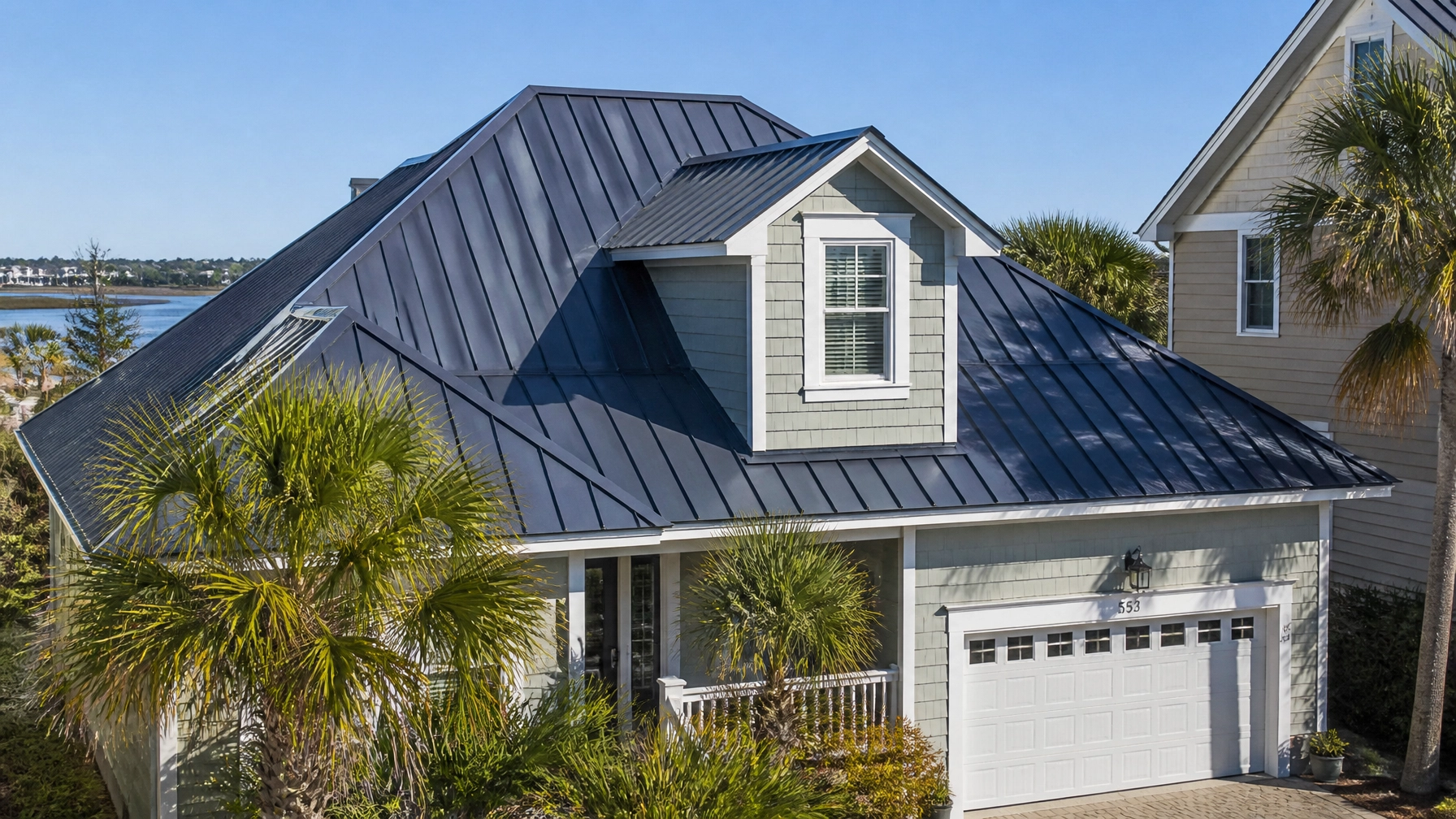
    Charleston SC coastal home featuring a modern, storm-resilient dark gray architectural shingle roof


    Essential Storm Resilient Roof Tips Charleston Homeowners Need

    Implementing specific, high-performance building practices ensures your roof withstands severe weather events without sustaining catastrophic failure:

    1. Class 4 Impact-Resistants Shingles: Choose shingles certified to withstand severe hail and flying debris, which frequently qualify homeowners for ongoing insurance premium discounts.
    2. Wind-Rated Fastening & Six-Nail Technique: Standard four-nail installations often fall short during severe gales. Mandate a six-nail installation pattern utilizing ring-shank nails that resist pull-through forces.
    3. Full Ice & Water Shield Underlayment: Rather than relying solely on standard felt paper, install a self-adhering polymer-modified bitumen underlayment across the entire roof deck (or vulnerable eaves and valleys) to act as a secondary waterproof barrier.
    4. Corrosion-Resistant Flashing: Insist on hot-dipped galvanized steel, aluminum, or copper flashings around chimneys, valleys, and wall tie-ins to prevent premature rust degradation caused by salt mist.

    Leveraging SC Safe Home Grants and Mitigation Incentives

    South Carolina homeowners undertaking Charleston SC storm-ready roofing upgrades can often tap into state-sponsored financial relief programs. The SC Safe Home Mitigation Grant Program provides matching and non-matching grants (up to $7,500 for qualifying projects meeting IBHS FORTIFIED ROOF™ standards) to offset upgrade expenses.

    Combining these grants with potential insurance policy credits substantially reduces your net out-of-pocket investment, making premium storm-resilient materials more accessible than ever.

    Professional roofing worker inspecting a newly installed roof with impact-resistant shingles


    Secure Your Home Today with Instant Satellite Estimates

    Waiting for traditional contractors to schedule an in-person inspection can delay your project during peak lowcountry roofing hurricane season. Modern technology lets you skip the wait entirely.

    At Get My Roof Estimate Now, we harness advanced satellite imagery accurate to within inches to measure your roof instantly. In under 60 seconds, you receive a transparent, data-driven cost breakdown: spanning low, middle, and high price tiers for architectural shingles, metal, and more: with zero upfront cost and no credit card required.

    Ready to plan your project with complete confidence? Get an instant, free roof replacement estimate in under 60 seconds using our satellite measurement tool today!


    Frequently Asked Questions

    1. What is the best roofing material for hurricane season in Charleston?

    Standing seam metal and heavy-duty architectural asphalt shingles (especially when installed to FORTIFIED standards) offer the highest resistance to high wind uplift, driving rain, and flying debris.

    2. How much does a storm-ready roof cost in Charleston, SC?

    Architectural shingle replacements typically range from $9,000 to $18,000, while premium standing seam metal systems range from $23,000 to $45,000 depending on home size and complexity.

    3. Can I get financial assistance for my roof upgrade in South Carolina?

    Yes. The SC Safe Home Mitigation Grant Program offers grants up to $7,500 for qualifying roof retrofits that adhere to wind-mitigation and FORTIFIED construction standards.

    4. How long does a satellite roof estimate take?

    With Get My Roof Estimate Now, your comprehensive, accurate cost estimate is generated in under 60 seconds by simply entering your property address online.

  • 2026 Roof Replacement Cost in Richmond, VA: Complete Price Guide for River City Homeowners

    2026 Roof Replacement Cost in Richmond, VA: Complete Price Guide for River City Homeowners

    Planning a roof replacement in the River City requires navigating local climate demands, historic district regulations, and current labor and material benchmarks. For Richmond homeowners looking at a full upgrade in 2026, understanding the financial scope upfront ensures a smoother project from start to finish.

    Whether your property is a classic craftsman in Northside, a historic row house in The Fan, or a sprawling colonial in Short Pump, this guide breaks down current pricing, material choices, local permit requirements, and how modern technology like satellite roof measurement is changing the quoting process.


    1. Overview of 2026 Roof Replacement Costs in Richmond, VA

    For a standard single-family home ranging from 1,500 to 3,000 square feet, the Richmond VA roof replacement cost in 2026 typically spans between $7,500 and $14,500, with many standard architectural shingle installations landing comfortably in the $9,000 to $13,000 sweet spot.

    Labor generally accounts for 40% to 55% of the total project cost in the Greater Richmond area, reflecting skilled contractor wages, rigorous Virginia DPOR licensing standards, and comprehensive liability insurance.

    Richmond Cost Breakdown by Material (Per Square / 100 Sq Ft)

    In roofing, measurements are calculated in "squares" (one square equals 100 square feet). Here is how pricing breaks down across popular roofing materials in Richmond for 2026:

    Roofing Material Cost Per Square Installed Total Cost (2,000 Sq Ft Roof) Lifespan & Category
    3-Tab Asphalt Shingles $325 – $450 / sq $6,500 – $9,000 15–20 years (Budget)
    Architectural Shingles $425 – $625 / sq $8,500 – $12,500 25–30 years (Popular)
    Standing Seam Metal $875 – $1,350 / sq $17,500 – $27,000 40–70 years (Premium)
    Synthetic Slate / Tile $1,200 – $2,200 / sq $24,000 – $44,000+ 50+ years (Luxury)
    Natural Slate $1,500 – $3,000 / sq $30,000 – $60,000+ 75–100+ years (Historic / Estate)

    (Note: Prices include complete tear-off, disposal, underlayment, flashing, and professional installation.)


    2. Key Factors Driving New Roof Costs in Richmond

    Roofing contractors installing high-grade architectural shingles

    When researching new roof cost Richmond VA, homeowners often wonder why quotes vary between contractors. Several localized and structural factors influence your final estimate:

    • Roof Pitch and Complexity: Steeply pitched roofs, multiple valleys, dormers, and complex angles require specialized safety equipment and extra labor time, driving up installation costs.
    • Tear-Off and Disposal: Removing multiple layers of old shingles or dealing with heavy wood shake tear-offs adds labor hours and disposal dump fees in local Henrico, Chesterfield, and City of Richmond landfills.
    • Decking Repairs: Richmond’s older housing stock often features aging plywood or plank decking that may have sustained moisture damage or wood rot, requiring board replacement prior to new underlayment installation.
    • Ventilation Upgrades: Proper ridge vents and soffit ventilation are critical for balancing attic temperatures and preventing premature shingle degradation during hot Virginia summers.

    3. Richmond Climate and Material Recommendations

    Richmond experiences a humid subtropical climate characterized by hot, humid summers, volatile winter ice storms, and occasional tropical storm remnants tracking up from the coast. These weather patterns demand specific protective measures:

    • Algae-Resistant Shingles: High humidity and heavy tree canopy coverage across Richmond neighborhoods (like Westhampton and Bon Air) encourage blue-green algae growth. Modern architectural shingles with copper-infused granules prevent unsightly streaks and extend roof aesthetics.
    • Ice & Water Shield: Crucial along roof eaves and valleys to prevent ice damming during freezing winter snaps.
    • Wind Resistance: Selecting shingles rated for winds up to 110–130 mph safeguards your home against sudden convective storm gusts common in Central Virginia.

    4. Historic Districts and Permitting in Richmond

    One of the unique aspects of undertaking a roof replacement Richmond VA is navigating local municipal guidelines, especially in designated historic districts:

    • Historic Properties (The Fan, Church Hill, Jackson Ward): If your home sits in a historic overlay district, replacing your roof often requires a Certificate of Appropriateness from the Commission of Architectural Review (CAR). You may be restricted to specific materials (such as slate, standing seam metal, or architectural shingles matching historic profiles) rather than standard modern options.
    • Building Permits: Standard building permits issued through Richmond City or surrounding counties generally cost $100 to $275, depending on total project valuation. Always ensure your chosen contractor pulls the necessary permits before work begins.
    • Contractor Licensing: In Virginia, roofing contractors must hold a valid license with the Virginia Board for Contractors (DPOR). Always verify that your contractor's license classification (e.g., Class A or B) matches your project's total cost.

    5. Seasonality and Booking Your Project

    Roofing demand in the Mid-Atlantic follows clear seasonal trends:

    • Peak Season (Spring & Fall): Mild weather brings peak demand. Contractors book out quickly during these windows.
    • Off-Peak (Summer & Winter): Summer brings high heat, while winter brings freezing temperatures that require cautious shingle sealing. However, flexible scheduling is often easier to secure.
    • Planning Ahead: It is strongly recommended to schedule your contractor consultations and book installations 2 to 3 weeks in advance during peak seasons.

    6. Skip the Sales Pitch: Instant Satellite Roof Estimates

    Historic Richmond home with pristine roof replacement

    Traditionally, getting a new roof estimate meant clearing your calendar for multiple sales representatives to climb onto your ladder, measure manually, and pitch high-pressure contracts over your kitchen table.

    Today, River City homeowners can bypass traditional friction entirely. By utilizing advanced satellite imagery technology, platforms like Get My Roof Estimate Now analyze your exact property dimensions from space. Within 60 seconds, you receive a transparent, data-driven cost estimate accurate to within inches: covering your exact square footage, material tiers (shingles, metal, synthetic), and regional labor rates with zero upfront cost and no credit card required.


    7. Actionable Checklist for Richmond Homeowners

    1. Verify Measurements: Use Get My Roof Estimate Now for an instant, accurate baseline estimate without waiting for a contractor visit.
    2. Check Historic Status: Confirm if your property is subject to CAR guidelines if you live in The Fan or Church Hill.
    3. Verify DPOR Licensing: Ensure your contractor is fully licensed and insured in Virginia.
    4. Compare Material Warranties: Look for manufacturer certified installer status (e.g., GAF Master Elite or CertainTeed SELECT) to secure 50-year non-prorated warranties.
    5. Review Ventilation & Flashing: Ensure step flashing, chimney flashing, and ridge vents are fully replaced, not reused.

    Frequently Asked Questions

    What is the average lifespan of an architectural shingle roof in Richmond?

    Quality architectural asphalt shingles typically last between 25 and 30 years in Central Virginia's climate when properly installed and ventilated.

    Do I need a permit to replace my roof in Richmond?

    Yes. Building permits are required by the City of Richmond and surrounding counties (Henrico, Chesterfield, Hanover) for full roof replacements. Licensed contractors typically handle permit acquisition on your behalf.

    How can I get a fast and accurate roof estimate without a salesman?

    You can use our Instant Roof Cost Calculator to generate an immediate, satellite-powered pricing breakdown tailored specifically to your Richmond address in under 60 seconds.


  • Daily Tech Blitz – Slot 5: Satellite Tech Edge in Wilmington, NC

    Daily Tech Blitz – Slot 5: Satellite Tech Edge in Wilmington, NC

    Wilmington, North Carolina, is widely recognized for its historic riverfront, vibrant arts scene, and proximity to Wrightsville Beach. However, beneath its charming coastal surface, the Port City is increasingly becoming part of a broader technological shift in geospatial data, remote sensing, and aerospace innovation. From academic research like UNCW’s SeaHawk-1 CubeSat ocean-color imaging to advanced remote sensing payloads, satellite technology is fundamentally redefining how we observe our environment and manage local infrastructure.

    Intriguingly, that same orbiting precision is now transforming everyday property management. For Wilmington homeowners, the days of waiting days or weeks for an in-person contractor visit just to get a ballpark estimate are rapidly becoming a relic of the past.


    Geospatial Evolution: From Orbiting Sensors to Coastal Resilience

    Satellite technology has advanced far beyond simple weather forecasting. Today's commercial and scientific earth-observation constellations capture high-resolution imagery capable of resolving objects down to sub-inch accuracy.

    In the Cape Fear region, institutions like the University of North Carolina Wilmington (UNCW) have long contributed to advanced remote sensing through initiatives such as the SeaHawk-1 CubeSat mission, studying coastal water quality and marine environments from orbit. This regional focus on data-driven Earth observation sets the stage for practical, consumer-facing tech innovations.

    By harnessing multi-spectral satellite imagery and advanced geospatial algorithms, modern platforms can analyze physical structures on the ground with surgical precision: calculating roof square footage, pitch angles, facet counts, and structural complexity without a single foot touching your lawn.


    Revolutionizing Roofing Estimation: Zero-Wait Satellite Precision

    For decades, getting a roof replacement estimate meant carving out a Saturday morning, enduring a high-pressure sales pitch, and waiting days for a formal quote. Today, property technology has streamlined this friction-heavy process.

    Through services like Get My Roof Estimate Now, homeowners can input their exact address and receive an instant, accurate roof replacement cost estimate in under 60 seconds. Powered by satellite imagery accurate to within inches, the technology evaluates your roof's exact dimensions and provides transparent, data-driven pricing ranges (Budget, Popular, Premium) before you ever speak to a contractor.

    Classic American colonial home in coastal North Carolina with a new standing seam metal roof


    Financial Benchmarks: Wilmington NC Roof Replacement Cost 2026

    Transparency is vital when planning a major home investment. Evaluating current economic benchmarks ensures you can budget effectively without guesswork.

    For a standard 2,000-square-foot single-family home in the Wilmington area, a complete roof replacement typically runs between $11,000 and $18,500 for high-quality architectural asphalt shingles. Broader project scopes across the coastal region generally span from $8,000 up to $24,000+, depending on material grade, roof pitch, and structural complexity.

    2026 Cost Breakdown by Material (Wilmington, NC)

    • 3-Tab Asphalt Shingles (Budget): $7,500 – $12,500 ($3.50 – $5.00 per sq ft)
    • Architectural Asphalt Shingles (Popular): $10,000 – $18,500 ($5.00 – $7.50 per sq ft)
    • Standing Seam Metal Roofing (Premium): $18,000 – $38,000+ ($9.00 – $15.00+ per sq ft)
    • Synthetic / Designer Shingles: $14,000 – $28,000+

    To get a tailored figure for your specific property instantly, utilize our online Roof Cost Calculator to factor in your exact zip code and roof dimensions.


    Maximizing Equity: New Roof Wilmington NC Home Value & Roof Replacement ROI Wilmington NC

    Living in coastal North Carolina means contending with intense seasonal humidity, tropical storm systems, and high wind events. Because of these environmental factors, prospective buyers and real estate appraisers place a heavy premium on roof integrity.

    Investing in a new roof Wilmington NC home value boost can significantly enhance marketability. Real estate data consistently shows that a modern, wind-resistant roof is one of the top selling points for coastal buyers who want peace of mind regarding storm readiness.

    Furthermore, analyzing roof replacement ROI Wilmington NC data reveals that homeowners typically recoup 60% to 75%+ of their total project investment upon resale. In competitive Wilmington neighborhoods (such as Landfall, Pine Valley, or historic downtown), a brand-new roof eliminates major inspection hurdles and accelerates closing times.

    Charming single-family home in Wilmington NC showing satellite mapping and aerial technology overlay aesthetics


    Essential Wilmington NC Roofing Tips for Coastal Roof Replacement North Carolina

    Executing a successful coastal roof replacement North Carolina project requires specific regional considerations. Follow these expert tips to protect your investment:

    1. Prioritize High Wind Ratings: Ensure your roofing materials (especially architectural shingles or metal panels) are rated for winds of 130 mph or higher to withstand Atlantic hurricane seasons.
    2. Upgrade Your Underlayment: Don't skimp on synthetic underlayment and high-temp ice-and-water shield. Coastal wind-driven rain can push past standard shingles if secondary water barriers are inadequate.
    3. Inspect Plywood Decking: Salt air and high humidity can accelerate wood rot over 15 to 25 years. Budget for minor decking repairs during the tear-off phase.
    4. Leverage Instant Tech First: Before calling multiple local contractors for bids, use satellite-powered estimation tools to secure an objective, baseline pricing model so you enter contractor discussions fully informed.

    Professional residential roofing contractor inspecting a pristine new roof in coastal North Carolina


    Conclusion: Streamlining Your Next Home Project in Wilmington

    Satellite technology has evolved from orbiting science missions into everyday practical tools that empower consumers. By merging advanced geospatial imagery with transparent cost modeling, Wilmington homeowners can bypass traditional sales friction and take immediate control of their home improvement planning.

    Whether you are preparing for hurricane season, planning a home sale, or simply upgrading an aging 20-year-old roof, starting with accurate data ensures confidence from day one. Ready to see what your project will cost? Enter your address today and get your instant, free estimate in under 60 seconds with Get My Roof Estimate Now.

  • Daily Weather Blitz: Charleston, SC – Storm-Ready Roofing & Weather Trends for August 2026

    Daily Weather Blitz: Charleston, SC – Storm-Ready Roofing & Weather Trends for August 2026

    Welcome to our daily weather blitz and roofing intelligence report for Charleston, South Carolina. As we step into August 2026, the Lowcountry climate presents a demanding combination of high heat, oppressive humidity, and peak summer thunderstorm activity. For homeowners managing aging roofs (typically 15 to 30 years old), August requires constant vigilance, proactive maintenance, and strategic planning.

    Whether you are preparing your property for potential tropical weather systems or replacing a roof that has weathered years of South Carolina sun and rain, understanding current regional conditions, local material pricing, and advanced estimation technology is essential. At Get My Roof Estimate Now, we leverage satellite imagery to deliver precise, instant roof replacement pricing without the hassle of scheduling multiple in-person contractor visits.


    1. Charleston August 2026 Climate & Weather Overview

    August in the Charleston coastal region is defined by three primary meteorological factors: extreme heat, high humidity, and frequent afternoon downpours.

    • Temperature & Heat Index: Daytime highs consistently hover between 87°F and 90°F (31–32°C), while nighttime lows stay warm in the mid-70s°F (23–24°C). When combined with relative humidity averaging around 76%, daily heat index values routinely exceed 100°F.
    • Rainfall & Storm Frequency: August is one of the wettest months of the year, averaging roughly 6.5 to 7 inches of rain distributed across 12 to 18 rainy days. Most precipitation arrives as rapid, intense afternoon thunderstorms accompanied by lightning and gusty winds.
    • Hurricane Season Awareness: As a core month in the Atlantic hurricane season, Charleston homeowners must maintain storm readiness. While not every August brings a major tropical system, background coastal risk demands resilient roofing materials and secure flashing details.

    These rigorous climate conditions mean that roofing installations and repairs require strict adherence to safety standards, moisture control, and thermal management.

    Professional roofing contractor inspecting high-performance shingles on a single-family home


    2. Charleston Roofing Costs & Material Benchmarks (August 2026)

    When planning a roof replacement in the Lowcountry, budgeting accurately saves time and protects your home investment. For a standard single-family home with a 2,000-square-foot roof, total project costs generally range from $8,000 to $25,000, depending on material selection, pitch complexity, and tear-off requirements.

    Here is how current regional pricing breaks down across popular roofing tiers:

    Architectural Asphalt Shingles (Popular)

    • Cost Range: $8,500 – $14,000 ($3.50 – $6.50 per sq. ft. installed)
    • Performance: Exceptional curb appeal with dimensional profile, excellent wind uplift resistance up to 110–130 mph when installed with proper starter strips and six-nail fastening.
    • Lifespan: 25 to 30 years.

    Standing Seam Metal Roofing (Premium)

    • Cost Range: $18,000 – $30,000+ ($9.00 – $15.00+ per sq. ft. installed)
    • Performance: The gold standard for coastal South Carolina. Metal sheds heavy rainfall instantly, reflects solar radiant heat to lower attic temperatures, and withstands hurricane-force winds with concealed fasteners.
    • Lifespan: 40 to 60+ years.

    Synthetic Composite & Impact-Resistant Shingles (Durable / Budget Balance)

    • Cost Range: $14,000 – $22,000 ($7.00 – $11.00 per sq. ft. installed)
    • Performance: Engineered to mimic natural slate or wood shake while offering Class 4 impact resistance against hail and windblown debris during severe thunderstorms.
    • Lifespan: 35 to 50 years.

    Note: Pricing includes complete tear-off of old layers, underlayments, flashing replacement, and debris disposal.

    Modern suburban home with a sleek standing seam metal roof designed for coastal storms


    3. Skip the Wait: Get an Instant Roof Estimate in 60 Seconds

    Traditionally, obtaining a roof replacement quote meant waiting days for a local contractor to schedule a physical inspection, climb your ladder, and pitch you high-pressure upgrade packages.

    Our advanced platform eliminates friction entirely. By utilizing high-resolution satellite imagery technology, Get My Roof Estimate Now measures your roof's exact square footage, pitch, and valley complexity to within inches: achieving 90% to 95% accuracy.

    How It Works:

    1. Enter Your Address: Input your Charleston property location into our Roof Cost Calculator.
    2. Satellite Analysis: Our technology scans your roof dimensions and pitch instantly.
    3. Review Transparent Pricing: Receive low-middle-high price ranges tailored to regional material costs within 60 seconds: completely free and with zero credit card required.
    4. Connect with Pros: When you are ready, get seamlessly connected with verified, licensed, and insured local roofing contractors in the Charleston area.

    4. Storm-Ready Roofing Strategies for Coastal South Carolina

    To protect your home against Charleston's intense summer storms and high humidity, specific construction and maintenance practices are non-negotiable.

    Advanced Attic Ventilation

    With summer ambient temperatures pushing 90°F, unventilated attics can trap heat exceeding 140°F, curling shingles prematurely and degrading roof decks. Ensure your installation includes a balanced system of continuous ridge vents and high-volume soffit vents to promote constant airflow.

    High-Performance Underlayment & Ice-Water Shield

    Because August brings sudden torrential downpours, relying solely on standard felt paper is insufficient. Modern building codes and best practices in coastal SC call for self-adhering polymer-modified underlayment (ice and water shield) across all eaves, valleys, and vulnerable roof penetrations to prevent wind-driven rain from infiltrating the decking.

    Hurricane Strapping & Edge Metal Reinforcement

    Wind uplift is the primary structural threat during severe coastal storms. Insist on heavy-gauge drip edges nailed securely to the deck, and verify that your local contractor reinforces gable ends and roof-to-wall connections.

    Classic Charleston residential home with a flawless new roof under golden hour lighting


    5. Scheduling Tips for August Roofing Projects

    If you are planning roof repairs or a full replacement this month, tactical scheduling minimizes weather-related delays:

    • Favor Early Morning Windows: Crews should begin at dawn (around 6:30 AM to 7:00 AM) to maximize productivity before afternoon thunderstorms and peak heat stress set in.
    • Build Weather Contingency Days: With roughly half of August days experiencing rainfall, add a 3-to-5-day buffer into project timelines to account for sudden downpours.
    • Monitor Local Forecasts Daily: Keep a close eye on National Weather Service advisories and short-term radar to protect exposed roof decks during active storm patterns.

    6. Take Control of Your Roof Replacement Today

    August 2026 weather in Charleston demands proactive home maintenance. Do not wait for a major leak or storm failure to inspect your property's first line of defense.

    Get accurate, data-driven pricing in under a minute without stepping outside into the humidity. Visit Get My Roof Estimate Now today to access instant satellite measurements and transparent cost estimates for your Charleston home.


  • Insurance Masterclass: How Louisville KY Homeowners Can Get Their Roof Replacement Covered in 2026

    Insurance Masterclass: How Louisville KY Homeowners Can Get Their Roof Replacement Covered in 2026

    Navigating a property insurance claim for a roof replacement can feel overwhelming. For homeowners across Louisville, Kentucky, severe spring storms, hail events, and aging roofs (15 to 30 years old) mean property insurance is more critical than ever in 2026. While national insurance markets face extreme turbulence, Kentucky's landscape presents unique opportunities and strict legal guardrails that favor informed policyholders.

    Whether you are dealing with recent storm damage in the Highlands, preparing to sell a home in St. Matthews, or planning ahead, this masterclass breaks down everything you need to know to secure full coverage, avoid legal pitfalls, and streamline your roof replacement project.


    1. The Kentucky Insurance Landscape in 2026 (Steady Yet Evolving)

    Property insurance rates across the United States have steadily climbed, and Kentucky is no exception. However, unlike coastal states battered by frequent hurricanes, Kentucky’s insurance market remains relatively stable. Premiums have ticked upward by roughly 6% to 10% statewide due to rising material costs and localized severe weather events.

    For Louisville homeowners, this underscores the importance of understanding your policy before disaster strikes. Knowing whether your policy is Actual Cash Value (ACV) or Replacement Cost Value (RCV) determines whether you walk away with a fully funded new roof or a hefty out-of-pocket bill.


    2. Kentucky’s Roof Matching Law: 806 KAR 12:095 Explained

    One of the most powerful tools in a Kentucky homeowner’s insurance arsenal is 806 KAR 12:095, the state administrative regulation governing unfair claims settlement practices.

    When a storm damages only one slope of your roof, finding identical replacement shingles can be difficult: especially if your current roof has faded over the years. Under Kentucky Department of Insurance guidelines, if repair materials cannot achieve a uniform appearance in quality, color, and size with undamaged sections, insurers must replace the entire roof area.

    Crucially, the Kentucky Department of Insurance interprets "area" as the entire continuous roof structure, strictly rejecting "line-of-sight" limitations that some out-of-state adjusters try to enforce. If a color mismatch makes your roof look patched together, your insurer is generally required to cover a full slope or total roof replacement.

    Suburban Louisville colonial home undergoing professional roof replacement


    3. Senate Bill 153: Protecting Homeowners Against Post-Disaster Fraud

    Signed into law on April 8, 2026, Senate Bill 153 (Acts Chapter 54) introduced major safeguards for Kentucky homeowners following severe weather events. While earlier drafts focused narrowly on contractor licensing, the final enacted legislation targets fraudulent operators and predatory storm chasers.

    Key protections under SB 153 include:

    • Post-Disaster Registry: Contractors offering roof repair, siding, water mitigation, or tree removal after a declared disaster must register and carry certification proof at job sites.
    • 90-Day Solicitation Ban: A strict 90-day ban on in-person door-to-door solicitation in declared emergency areas, unless specifically requested by the property owner.
    • Fraud Penalties: Deliberate property vandalism intended to manufacture an insurance claim is classified as a severe criminal offense, with the Kentucky Attorney General given concurrent jurisdiction to prosecute.

    4. KRS 367.628: Deductibles, Rebates, and Public Adjusters

    When filing an insurance claim, financial compliance is paramount. Under KRS 367.628, Kentucky law establishes strict boundaries for roofing contractors:

    • No Deductible Waivers: It is strictly illegal for a roofing contractor to offer to pay, rebate, absorb, or discount your insurance deductible. Offering a discount to offset your deductible or providing more than $100 in referral bonuses/gifts tied to an insurance job violates state law.
    • Public Adjuster Restrictions: Roofing contractors are legally prohibited from negotiating insurance claims on your behalf. Only a licensed public adjuster (regulated under KRS Chapter 304) or an attorney may legally negotiate claim scope and settlement amounts with your insurance carrier.

    5. Actual Cash Value (ACV) vs. Replacement Cost Value (RCV)

    Insurance payout types dictate your out-of-pocket financial exposure:

    • Replacement Cost Value (RCV) (Comprehensive): Pays the actual cost to replace your roof with materials of like kind and quality, minus your deductible. (Note: Depreciation is initially withheld but released once the work is completed by your contractor).
    • Actual Cash Value (ACV) (Budget/Older Policies): Factors in depreciation based on the roof's age. If your 20-year-old roof has 80% depreciation, the initial check covers only 20% of the replacement value.

    Important Note: Kentucky’s matching requirement (806 KAR 12:095) applies to the overall claim scope regardless of whether your policy is ACV or RCV. However, with an ACV policy, you must cover the depreciation amount out of pocket unless you carry specific endorsements.


    6. Building Codes and Ordinance Coverage

    While Kentucky does not have a blanket "25% rule" requiring total replacement if a quarter of the roof is damaged (unlike some coastal states), local building codes dictate mandatory upgrades.

    If Louisville building codes require the installation of ice-and-water shields, drip edges, or specific ventilation upgrades during a replacement, your policy's Law and Ordinance coverage is vital. Ensure your policy includes this endorsement so code-mandated upgrades don't drain your personal savings.

    Close-up detail of architectural shingles being installed on a roof in Kentucky


    7. Louisville Permit Requirements & Historic Districts

    Before any work begins, ensure your contractor pulls the correct permits:

    • Standard Replacements: Full roof replacements and structural deck repairs require a permit through the Louisville Metro Office of Construction Review. Minor repairs typically do not.
    • Historic Districts (e.g., Old Louisville): If your home is located in a designated preservation or historic district, you must obtain a Certificate of Appropriateness from the Louisville Landmarks Commission before altering exterior materials or roof colors.

    8. Typical Louisville Roof Replacement Costs

    Before filing a claim or budgeting for a project, it helps to understand baseline local pricing. Standard Louisville roof replacements range between $3.50 and $11 per square foot, with typical residential projects costing $9,000 to $18,000.

    Material tiers break down as follows:

    • Asphalt Shingles (Popular): $9,000 – $16,000 (Durable, cost-effective, 20-30 year lifespan).
    • Metal Roofing (Premium): $18,000 – $35,000+ (Exceptional longevity, storm resistant).
    • Architectural Shingles (Mid-Range): $11,000 – $19,000 (Enhanced wind resistance and dimensional aesthetics).

    To get an immediate, data-driven pricing baseline for your exact property without waiting for a contractor visit, use our Free Roof Cost Calculator.


    9. Statute of Limitations and Suit-Limitation Clauses

    Many homeowners assume they have years to dispute an insurance claim. In Kentucky, the default statute of limitations for written contracts is 15 years; however, property insurance policies almost universally contain a "Suit Against Us" clause.

    These clauses typically require policyholders to file a lawsuit or legal challenge within 1 to 2 years of the date of loss if a claim is denied or underpaid. Always review your policy declarations page immediately following storm damage.


    10. Avoid Storm Chasers: Best Practices for Louisville Homeowners

    Following severe spring storms in Jefferson County, door-to-door contractors frequently flood local neighborhoods. Protect yourself by adhering to these guidelines:

    1. Verify Licensing & Registry: Ensure any contractor is properly insured, locally verified, and compliant with Kentucky's post-disaster registry rules under SB 153.
    2. Never Sign Over Your Insurance Check: Avoid signing Assignment of Benefits (AOB) forms that surrender control of your claim.
    3. Get Instant Estimates First: Know your numbers before speaking to anyone. You can get an instant estimate in under 60 seconds using satellite imagery by visiting Get My Roof Estimate Now.

    Historic Victorian home in Old Louisville, KY with pristine architectural roof


    11. Practical Checklist for Louisville Homeowners

    Use this step-by-step checklist to navigate your roof replacement and insurance claim with confidence:

    • Document Everything: Take high-resolution photos and videos of roof damage, fallen limbs, and interior leaks immediately after a storm.
    • Measure First: Use satellite measurement tools to determine your roof's exact square footage and pitch.
    • Review Your Policy: Check your deductible amount, RCV vs. ACV status, and suit-limitation clauses.
    • Get an Independent Estimate: Obtain a transparent, instant estimate online to establish a fair baseline before adjuster meetings.
    • Check SB 153 Compliance: Ensure any hired contractor is registered, insured, and respects Kentucky's 90-day solicitation guidelines.
    • Confirm Permits: Verify that your contractor secures necessary approvals from the Louisville Metro Office of Construction Review (and Landmarks Commission if historic).

    Conclusion

    Getting your roof replacement covered by insurance in Louisville doesn't have to be a guessing game. By leveraging Kentucky's robust matching regulations (806 KAR 12:095), staying protected against predatory practices under SB 153, and knowing your baseline numbers through modern satellite technology, you can take full control of your home investment.

    Ready to get started? Visit Get My Roof Estimate Now to receive your free, instant satellite roof estimate in under 60 seconds: no salesperson required.