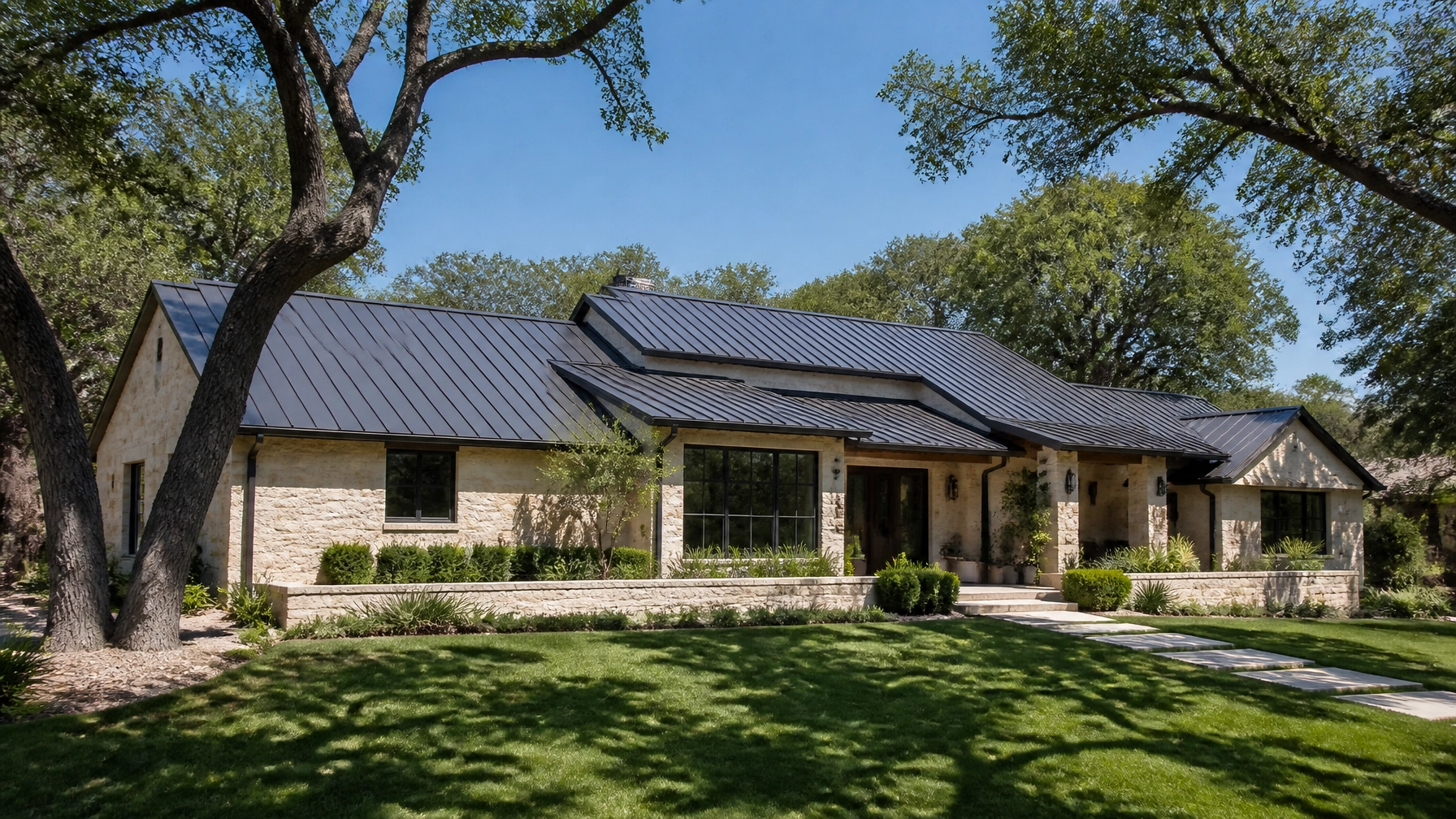
Replacing a roof in Austin has changed significantly in 2026. Beyond the blistering Texas heat and the perennial threat of spring hailstorms, new state-level legislation and local fire-hardening codes have shifted the landscape for homeowners. As of June 1, 2026, the Texas Department of Licensing and Regulation (TDLR) has begun issuing a mandatory reroofing license, a direct result of HB 3344.
For Austin homeowners, this means "business as usual" is no longer enough. Whether you live in a limestone ranch in Allandale or a hilltop estate in West Lake Hills, vetting your contractor is now a legal and financial necessity to ensure your investment is protected.
This guide outlines the five critical questions you must ask every roofing contractor before signing a contract in 2026.
2026 Roof Replacement Cost Austin: The Price of Precision
Before vetting a contractor, you need a baseline for the Austin roofing cost 2026. Prices in Central Texas have stabilized after the volatility of the early 2020s, but regional labor demand and material-specific fire codes (WUI) keep Austin’s averages slightly higher than the national median.
| Material Type | Price per Square Foot (Installed) | Typical Project Range (2,500 sq. ft.) | Category |
|---|---|---|---|
| Architectural Shingles | $5.50 – $8.00 | $13,750 – $20,000 | (Popular) |
| Standing Seam Metal | $11.00 – $17.00 | $27,500 – $42,500 | (Premium) |
| Stone-Coated Steel | $10.00 – $14.50 | $25,000 – $36,250 | (Durable) |
| Concrete/Clay Tile | $12.00 – $19.00 | $30,000 – $47,500 | (Luxury) |
Note: These are 2026 roof replacement cost Texas averages for the Austin metro area. Your specific roof pitch, height, and "Wildland-Urban Interface" (WUI) requirements will dictate your final quote.
1. "Are you a TDLR-licensed 'Reroofing Contractor' under HB 3344?"
As of June 1, 2026, the state of Texas has officially introduced the TDLR Reroofing Contractor License. While the industry was previously unregulated at the state level, HB 3344 now requires contractors who perform repairs, recovery, or replacements on existing roofs to hold this specific credential.
Why it matters: A licensed contractor has passed a background check, proved financial responsibility, and carries a minimum of $300,000 in general liability insurance. By September 1, 2026, this requirement becomes fully enforceable for anyone advertising roofing services in Texas. We previously covered the details of the TDLR license mandate here. If a contractor cannot provide their state license number, they are operating outside the new legal framework.

2. "Does this project require an 'Express Roof Permit' under the Austin WUI 50% rule?"
Austin’s permitting process in 2026 is highly dependent on your home's location and the scope of work. Specifically, the City of Austin has strict triggers for what they call an Express Roof Permit.
The Vetting Point: Ask your contractor if your home falls within the Wildland-Urban Interface (WUI) zone. If it does, and you are replacing 50% or more of your roof, a permit is mandatory. Even outside WUI zones, if the contractor needs to replace more than 128 square feet of decking (roughly 4 sheets of plywood), a permit is required. If a contractor tells you "permits aren't needed for shingles," they may be ignoring these 2026 thresholds, which can lead to stop-work orders and fines.
3. "How does this material meet the 2026 Austin WUI 'Class A' assembly standards?"
If your home is in a WUI area: common in neighborhoods like Steiner Ranch, West Lake Hills, and Jester Estates: the building code changed significantly in 2025 and 2026. Most of these areas now mandate a Class A roof assembly.
Technical Requirement: A "Class A" rating isn't just about the shingle; it's the entire assembly, including the underlayment and the decking.
- Wood Shingles: Prohibited in WUI zones.
- Asphalt Shingles: Must be verified as a non-combustible assembly.
- Metal Valleys: 2026 Austin code requires metal valley flashing (minimum 26-gauge) or specific closed-valley details.
Ask your contractor for the manufacturer's spec sheet showing the Class A fire rating. This is non-negotiable for insurance compliance in high-risk fire zones.

4. "What is your experience with Austin's 'WUI-Hardening' and hail-resistant upgrades?"
Austin experiences some of the highest hail frequencies in the United States. In 2026, many homeowners are opting for UL 2218 Class 4 Impact Resistant materials to secure insurance discounts and longevity.
Ask for Specifics:
- "Can you show me a recent project in a WUI zone like West Lake Hills?"
- "Do you install non-combustible gutters and ember-resistant vents (per the 2024 IWUIC)?"
A contractor who is "WUI-aware" will understand that "hardening" the home involves more than just the roof: it's about the gutters, the eaves, and the vents that prevent ember intrusion.
5. "Can you provide a 'Square-Based' quote with 2026 regional adjustments?"
Transparency in Austin roof replacement prices is only possible if you understand the "Square" (100 square feet of roof area). Avoid contractors who give a lump-sum "ballpark" figure without a detailed breakdown.
The Math: A professional 2026 quote should specify:
- Total squares of the roof (determined by satellite measurement).
- Waste factor (typically 10-15%).
- Cost of permit fees (roughly $150–$750 in Austin).
- Regional labor surcharge (Austin's high cost of living often adds a 5-8% premium compared to other Texas cities).
Using Get My Roof Estimate Now, you can generate a satellite-powered estimate in 60 seconds that uses these exact variables, giving you a baseline to compare against any contractor's bid.

Local Spotlight: Steiner Ranch & West Lake Hills
While the City of Austin has adopted the 2024 International Wildland-Urban Interface Code, neighboring jurisdictions differ:
- West Lake Hills: While often perceived as part of Austin, it is an incorporated city with its own building department. They have not universally adopted the same WUI mandates as the City of Austin, meaning Class A assemblies may be recommended but not always required.
- Steiner Ranch: This area is heavily governed by HOA Design Guidelines. All roofs must be pitched (no flat roofs), and colors must be non-reflective and earth-toned. Wood shakes are strictly prohibited by the HOA, regardless of city code.
Conclusion: Take Control of Your Austin Roof Replacement
The 2026 roof replacement cost Austin homeowners face is an investment in safety and compliance. By asking these five questions, you filter out "storm chasers" and "tailgate contractors" who haven't adapted to the TDLR licensing or WUI code changes.
Don't wait for a contractor to visit your home just to get a ballpark number. Use our instant roof estimator to see your roof’s size and potential cost based on current 2026 Texas market data. It’s fast, accurate, and provides the transparency you need to start your project with confidence.
Leave a Reply