Author: James Turner

  • 2026 Roof Replacement Cost in Tampa, FL: Complete Price Guide for Bay Area Homeowners

    2026 Roof Replacement Cost in Tampa, FL: Complete Price Guide for Bay Area Homeowners

    Planning a roof replacement in the Tampa Bay area requires understanding local pricing, rigorous state building codes, and material performance against Florida's unique coastal climate. For homeowners navigating a roof upgrade in 2026, costs fluctuate based on square footage, material selection, and code compliance standards.

    Whether you are dealing with storm wear after severe summer thunderstorms or preparing a 20-year-old roof for sale, this guide breaks down current Tampa roof replacement cost 2026 data, regional requirements, and budgeting strategies.


    1. Quick Overview: Average Tampa Roofing Prices in 2026

    For a typical single-family home ranging from 1,500 to 2,500 square feet, total project costs vary significantly depending on the material you choose. Most homeowners investing in a new roof Tampa FL 2026 can expect the following totals:

    • Architectural Asphalt Shingles (Popular): $9,000 – $19,000
    • Standing Seam Metal (Premium): $20,000 – $40,000
    • Concrete Tile: $15,000 – $32,000
    • Clay Tile: $18,000 – $38,000

    When broken down per square foot, material and installation costs span $3.50 to $21.00 per sq ft across the board.

    Close up of a standing seam metal roof on a clean modern house in Florida


    2. Cost Breakdown by Roofing Material

    Choosing the right material balances upfront investment with long-term durability in Hillsborough and Pinellas counties. Here is how individual options stack up:

    Architectural Shingles ($4.50 – $9.00 / sq ft)

    Asphalt architectural shingles remain the most popular choice across Tampa Bay. They offer a strong balance of wind resistance, aesthetic curb appeal, and affordability. For a standard 2,000 sq ft roof, total costs typically land between $11,000 and $17,000.

    Standing Seam Metal ($10.00 – $25.00 / sq ft)

    Metal roofing is experiencing massive growth in Florida due to its superior wind uplift resistance and longevity (often 40 to 50+ years). Total project costs for a standard home run $20,000 to $40,000. Homeowners close to Tampa Bay or coastal zones should account for a salt-air-rated metal premium ($1,500 – $2,500) to prevent premature corrosion.

    Concrete Tile ($8.00 – $19.00 / sq ft) and Clay Tile ($10.00 – $21.00 / sq ft)

    Tile roofs deliver timeless Mediterranean and Spanish aesthetics common throughout Florida neighborhoods. While exceptionally durable, they are heavy and require proper framing inspection. Total costs range from $16,000 to $42,000.

    Flat Roofing / TPO ($4.00 – $10.00 / sq ft)

    For modern low-slope additions or Florida room extensions, TPO (Thermoplastic Polyolefin) membranes provide excellent UV reflection and waterproofing, typically costing $4,000 to $10,000 depending on square footage.


    3. Labor, Permits, and Component Costs

    Beyond the primary material, a complete Tampa FL roof replacement includes several underlying structural and regulatory line items:

    • Labor Rates: Professional roofing labor in the Tampa market ranges from $42 to $58 per hour.
    • Permits: City of Tampa and Hillsborough County residential reroof permits run between $150 and $500, covering mandatory building inspections.
    • Decking Replacement: If rotted plywood sheathing is discovered during tear-off, replacing damaged wood averages $80 to $150 per sheet.
    • Peel-and-Stick Underlayment: Upgrading to a self-adhered secondary water barrier membrane costs $600 to $2,500 depending on roof size.

    Professional roofing contractors installing underlayment and shingles in Florida


    4. Crucial Regional Factors for Tampa Bay Homeowners

    Roofing in West-Central Florida is governed by strict regulatory frameworks designed to withstand extreme weather. When evaluating Tampa roofing prices, keep these regional mandates in mind:

    Wind-Borne Debris Region & Building Codes

    Tampa is classified as a Wind-Borne Debris Region under the Florida Building Code. Roof replacements must comply with enhanced uplift and fastening schedules. This includes using 8d ring-shank nails on an enhanced fastening pattern and securing all edges against high-velocity gusts.

    Secondary Water Barrier Requirement

    State building codes mandate a fully sealed roof deck (secondary water barrier). Installers must use either a self-adhered polymer-modified bitumen sheet (peel-and-stick) or apply approved tape over all roof deck joints before laying the primary shingles or metal panels. This prevents interior water intrusion even if shingles are blown off during a severe squall.

    High Humidity & Afternoon Thunderstorms

    Tampa’s subtropical climate delivers intense solar radiation and torrential summer downpours. Proper attic ventilation and high-grade underlayments are essential to prevent moisture buildup and thermal degradation.

    Note: Unlike South Florida, Tampa is not in the High-Velocity Hurricane Zone (HVHZ), meaning Miami-Dade Notice of Acceptance (NOA) approvals are not strictly required, though statewide Florida Product Approvals are mandatory.


    5. Get an Instant, Accurate Estimate for Your Tampa Home

    Traditional contractor quoting can take days or weeks of scheduling in-person home visits. If you are researching roof replacement cost Tampa Bay, you can skip the wait.

    Use our advanced satellite technology to measure your roof and receive transparent, data-driven pricing in under 60 seconds: no salesperson required.

    👉 Get your free instant roof replacement estimate now!

    Stunning Florida home with a tiled roof in an upscale Tampa Bay neighborhood


    Frequently Asked Questions

    How long does a roof replacement take in Tampa?

    Most residential roof replacements in Tampa take between 1 to 3 days once work begins, depending on roof size, material complexity, and whether structural decking repairs are needed.

    Does homeowners insurance cover roof replacement in Tampa?

    Insurance policies in Florida frequently require roofs to be under 15 years old for full coverage, or they may require a policy endorsement. If your roof suffered documented wind or hail damage from a severe thunderstorm, filing a claim with the help of a licensed local contractor may cover a portion of the replacement.

    Can I install a metal roof over existing shingles in Tampa?

    While a recover (lay-over) is sometimes permitted under specific conditions, current Florida Building Codes generally limit shingle layers to a maximum of two. Complete tear-off is strongly recommended in Tampa to inspect decking for moisture rot and ensure proper installation of peel-and-stick underlayment.
  • Myrtle Beach, SC Roof Replacement FAQ: What Every Coastal Homeowner Should Know

    Myrtle Beach, SC Roof Replacement FAQ: What Every Coastal Homeowner Should Know

    Living along the Grand Strand in Myrtle Beach, South Carolina comes with incredible coastal perks, but it also subjects your home to unique environmental pressures. From high humidity and relentless salt air to sudden summer squalls and hurricane risks, local roofs work harder than almost anywhere else in the country.

    If you are planning a roof replacement or want to know how to budget for your home in Horry County, you likely have questions about pricing, materials, insurance claims, and local regulations. To help you navigate the process efficiently, we have compiled the definitive Answer Engine Optimization (AEO) guide answering the top questions Myrtle Beach homeowners ask in 2026.


    1. How Much Does a Roof Replacement Cost in Myrtle Beach, SC in 2026?

    (Budget / Standard Investment): For a typical single-family home in Myrtle Beach in 2026, expect a roof replacement to run roughly $9,000 to $20,000, with most homeowners paying around $13,000 to $15,000 for standard architectural asphalt shingles on a 2,000-square-foot roof.

    However, exact pricing depends heavily on your roof's size, pitch, and proximity to the ocean:

    • Small Homes (1,500 sq. ft.): $9,500 – $17,500
    • Medium Homes (2,000 sq. ft.): $12,500 – $23,000
    • Large Homes (2,500 sq. ft.): $15,500 – $28,500
    • Beachfront / Elevated Properties: $18,000 – $35,000+ due to salt exposure, extra height, and complex scaffolding requirements.

    Quick tip: Want an instant price range tailored specifically to your exact address without waiting for a contractor visit? Try our Instant Roof Cost Calculator to get accurate estimates in under 60 seconds.

    Modern coastal home with a sleek metal roof in South Carolina


    2. Does Homeowners Insurance Cover Roof Damage from Hurricanes or Storms in Myrtle Beach?

    (Conditional / Insurance): Homeowners insurance in South Carolina only covers roof replacement when damage is caused by a sudden, accidental event, such as a named hurricane, severe windstorm, or falling tree limbs.

    • What Is Covered: Wind-ripped shingles, structural punctures from debris, or severe hail damage that compromises shingle integrity.
    • What Is Not Covered: Normal wear and tear, granule loss from aging (roofs 20+ years old), poor attic ventilation, or deferred maintenance.

    Because coastal policies frequently feature separate wind and hurricane deductibles (often 2% to 5% of your home's insured value), you will still have a notable out-of-pocket responsibility even on approved claims. If your roof is simply reaching the end of its natural lifespan after 25 years, expect to fund the replacement out of pocket.


    3. What's the Best Roofing Material for Myrtle Beach's Coastal Climate?

    (Popular / Premium / Durable): Choosing the right material can mean the difference between a roof that lasts 15 years and one that withstands 30 years of coastal elements. Here are the top choices for Myrtle Beach homes:

    • Architectural Asphalt Shingles (Most Popular): Affordable and versatile, offering strong wind resistance (up to 130 mph with high-wind installation packages) and costing $12,000 to $22,000 for typical homes.
    • Standing Seam Metal Roofs (Premium Durable): Exceptional resistance to high winds, salt air corrosion (with aluminum or coated steel), and heavy rain. Costs range from $18,000 to $45,000, but they offer superior longevity (40–50+ years).
    • Synthetic / Tile Roofs (Luxury): Extremely heavy and durable, though less common on standard residential properties due to structural weight requirements and higher price tags ($24,000 to $50,000+).

    Professional roofing contractors inspecting a shingle roof


    4. Do I Need a Permit for a Roof Replacement in Myrtle Beach?

    (Regulatory / Mandatory): Yes. While minor patching may not require official sign-off, a full roof replacement in the City of Myrtle Beach or surrounding Horry County requires a building permit to ensure compliance with local coastal wind codes.

    • Permit Fees: Generally range from $150 to $450 depending on the project valuation.
    • Who Pulls It: Reputable, licensed local contractors will pull the permit on your behalf as part of their service package, ensuring your installation meets strict South Carolina wind-mitigation standards.
    • HOA Approvals: If you live in a managed community or beachfront subdivision, verify your architectural review board's guidelines regarding shingle color and material approval before starting work.

    5. How Often Should I Inspect My Roof in a Coastal Area Like Myrtle Beach?

    (Preventative Maintenance): In a humid subtropical climate battered by tropical storms and salt fog, you should have your roof professionally inspected at least once a year, as well as immediately following any major tropical storm or hurricane.

    Key items local inspectors check for include:

    • Flashing Integrity: Salt air accelerates corrosion around chimneys, skylights, and valley flashings.
    • Granule Deposition: High UV exposure speeds up asphalt breakdown.
    • Sealed Edges: Ensuring starter strips and wind-mitigation fasteners remain secure against gusts.

    6. How Do I Choose a Licensed Roofer in Myrtle Beach?

    (Expert Guidance): Navigating contractor selection after a storm or during routine replacement can be stressful. Protect your investment by following these simple benchmarks:

    1. Verify State Licensing: Ensure they hold a valid South Carolina residential builder or specialty roofing license through the SC Department of Labor, Licensing and Regulation (LLR).
    2. Confirm Insurance: Always ask for certificates of general liability insurance and workers' compensation coverage to protect yourself from liability.
    3. Check Local Track Record: Look for established local contractors with physical offices in Horry County rather than "storm chasers" who drift in after major weather events.
    4. Get Written Warranties: Ensure you receive both a manufacturer material warranty and a workmanship warranty (ideally 5 to 10 years).

    Residential roof in a beach town after a storm


    7. Should I Repair or Replace My Roof After Storm Damage?

    (Decision Guide): Deciding between a repair and a full replacement comes down to age, extent of damage, and remaining roof life:

    • Choose Repair If: The damage is localized to a small area (e.g., a few lifted shingles from a minor gust), your roof is less than 10 years old, and matching shingles are readily available.
    • Choose Replacement If: Your roof is over 15 to 20 years old, damage is widespread across multiple slopes, or underlying roof decking shows signs of moisture rot or sagging. Repairing an aging roof is often throwing good money after bad.

    Plan Your Myrtle Beach Roof Replacement Today

    Replacing your roof is one of the most important financial investments you will make as a homeowner. By understanding local costs, regulatory permits, and climate demands, you can approach your project with complete confidence.

    Skip the hassle of scheduling multiple sales visits. Use our satellite-powered technology to get an instant, accurate estimate for your Myrtle Beach home in under 60 seconds: completely free and with zero credit card required. Visit Get My Roof Estimate Now to get started today!

  • Daily FAQ Blitz – Slot 8: Wilmington NC Roofing FAQs Answered

    Daily FAQ Blitz – Slot 8: Wilmington NC Roofing FAQs Answered

    Navigating roof replacement along the North Carolina coast requires specialized knowledge. From aggressive Atlantic hurricane winds and salt-air corrosion to strict New Hanover County permit regulations, Wilmington homeowners face unique roofing challenges that inland communities never encounter. Whether you are dealing with storm-weary shingles on a home near Wrightsville Beach or planning ahead for routine maintenance in midtown Wilmington, understanding local codes, timelines, and material requirements is essential to protecting your investment.

    To help you navigate your upcoming project with total confidence, we have compiled the definitive set of answers to Wilmington's most frequently asked roofing questions. For instant budgeting, you can also check our roof cost calculator to get accurate estimates in under 60 seconds using satellite measurements.


    How Long Does a Roof Replacement Take in Wilmington, NC?

    For the vast majority of standard single-family residential homes in Wilmington (typically ranging between 1,500 and 3,000 square feet), a complete roof replacement takes one to two days on-site.

    However, the total project timeline involves several distinct phases:

    • Initial Planning & Material Delivery (1–3 Days): Ordering specialized coastal-grade materials, selecting shingle or metal profiles, and scheduling delivery.
    • Tear-Off and Inspection (Day 1 – Morning): Removing old layers of asphalt shingles, checking the underlying 7/16-inch plywood (or thicker) roof deck for rot or storm damage, and replacing compromised wood.
    • Underlayment and Installation (Day 1–2): Installing high-wind underlayment, enhanced starter strips, ice-and-water shield in vulnerable valleys, and your chosen roof covering (such as architectural shingles or standing-seam metal).
    • Final Cleanup & Inspection (Day 2 – Afternoon): Magnetic nail sweeps, debris haul-away, and final county inspection sign-off.

    Complex roof designs featuring multiple steep pitches, dormers, or heavy tile materials can extend the on-site timeline to three or four days. Furthermore, coastal rain showers: frequent during Wilmington summers: can occasionally pause work temporarily, making weather-tight synthetic underlayment installation critical during the process.

    Coastal home in Wilmington NC featuring a sleek standing-seam metal roof


    What Are the Coastal Wind-Resistance Requirements for Wilmington Roofs?

    Wilmington sits squarely in one of North Carolina’s most rigorous wind-risk zones. Depending on your exact proximity to the coast, building codes require roof systems to withstand design wind speeds ranging from 130 mph to 150 mph.

    Key structural and material requirements for Wilmington wind compliance include:

    • Wind-Uplift Classification: Shingles must carry ASTM D7158 Class F or Class H ratings (capable of resisting winds up to 110–150 mph) or homeowners should consider standing-seam metal roofing, which naturally exceeds 140+ mph wind uplift.
    • Enhanced Fastening Schedules: While standard inland building codes often permit 4 nails per shingle, coastal NC codes mandate 6 nails per shingle to prevent high-wind blow-offs.
    • Continuous Load Path: Roof-to-wall connections utilizing hurricane straps or clips (such as Simpson Strong-Tie connectors) tie the roof framing securely to the wall studs and foundation, preventing catastrophic roof lift during severe tropical storms.
    • Corrosion-Resistant Fasteners: Due to heavy salt-air exposure within miles of the Atlantic, hot-dip galvanized G-90 or stainless steel fasteners are required to prevent premature fastener failure.

    Do I Need a Building Permit in New Hanover County for Roof Replacement?

    Yes. In Wilmington and throughout New Hanover County, a building permit is required for full roof replacements and any structural repairs involving decking, trusses, or framing.

    Homeowners should note the following permit considerations:

    • Permit Application: Reputable local contractors will typically pull the permit on your behalf as part of their service package. Permit application fees generally range from $150 to $500 depending on the total project valuation.
    • Inspection Process: Once the new roof is installed, a county building inspector will review the work to ensure compliance with coastal wind codes, proper flashing installation, and fastener density.
    • Special Coastal Overlay Districts: If your property is located within a designated CAMA (Coastal Area Management Act) zone or environmental oversight area near marshlands or the Intracoastal Waterway, additional environmental permits may apply before major exterior structural renovations begin.

    Professional roofers installing high wind-rated architectural shingles in North Carolina


    How Do I Verify a Wilmington Roofer Is Fully Licensed and Insured?

    Working with an unqualified contractor on the coast can leave you legally and financially exposed if storm damage occurs or installation defects lead to leaks. Before signing any contract in Wilmington, verify the following credentials:

    1. NC Licensing Board for General Contractors: In North Carolina, any residential roofing project exceeding $30,000 requires a licensed General Contractor. However, even for smaller projects, verify that your roofer holds an active state license or specialty trade classification. You can verify licenses directly through the NC Licensing Board for General Contractors.
    2. General Liability Insurance: Request a certificate of insurance (COI) directly from the insurance carrier: not just a photocopy from the contractor. Ensure they carry active general liability coverage (typically at least $1,000,000) to protect your property during construction.
    3. Workers' Compensation: Verify that all workers on your roof are covered by active workers' compensation insurance. If an uninsured worker is injured on your property, you could face severe legal liability.
    4. Local Reputation & Physical Address: Look for established local contractors with a verifiable physical brick-and-mortar office in New Hanover, Brunswick, or Pender County, alongside strong local reviews.

    What Are Deposit and Payment Best Practices After Storms?

    Following a major hurricane or severe nor'easter, door-to-door "storm chasers" often flood coastal areas. Protect your finances by following strict payment protocols:

    • Beware of Large Upfront Deposits: In North Carolina, reputable contractors rarely ask for more than 1/3 down (or standard material deposits) before work begins. Never pay a contractor 50% to 100% upfront in cash.
    • Never Pay in Cash: Always pay via check, credit card, or financing through a verified company account. Credit cards offer built-in dispute protections if work is abandoned.
    • Tie Final Payment to Completion: Never issue final payment until the roof installation is fully completed, the job site is cleaned, and (where applicable) the New Hanover County building inspector has signed off on the permit.
    • Insurance Claim Guidance: If filing an insurance claim for wind or hail damage, ensure your contractor works transparently with your insurance adjuster rather than asking you to sign over your entire insurance check blindly before an agreement is reached.

    Single-family home with new roof in Wilmington NC showing clean rooflines


    Should I Repair or Replace My Roof After Hurricane Season?

    Deciding between a targeted repair and a full roof replacement depends on the age of your roof, the extent of the storm damage, and your material type:

    • Age Factor: If your architectural shingle roof is over 15–20 years old and has sustained widespread wind-creasing or granule loss across multiple slopes, a repair is often just a temporary band-aid. Investing in a full replacement provides modern wind-uplift protection.
    • Localized vs. Widespread Damage: Missing a few shingles after a severe coastal squall is often easily repaired if the surrounding decking and underlayment remain sound. However, if water intrusion has reached interior drywall or structural rafters, a full replacement with a sealed roof deck is recommended.
    • Insurance Deductibles: Review your policy's hurricane or windstorm deductible. If storm damage qualifies for an insurance claim, replacing the entire roof system often makes more financial sense than paying high out-of-pocket deductibles for multiple minor repairs over successive seasons.

    Plan Your Wilmington Roof Replacement Today

    Planning a roof replacement in Wilmington doesn't have to be stressful. By understanding local wind ratings, permit requirements, and verifying contractor credentials, you can protect your coastal home for decades to come.

    Ready to see what your Wilmington roof replacement will cost? Visit Get My Roof Estimate Now to get instant, satellite-powered pricing in under 60 seconds with zero upfront hassle.

  • Daily FAQ Blitz – Slot 7: AEO FAQ Quick Answers for Greenville, SC

    Daily FAQ Blitz – Slot 7: AEO FAQ Quick Answers for Greenville, SC

    Greenville, South Carolina has rapidly evolved into one of the Southeast’s premier powerhouses for international trade, advanced manufacturing, and supply chain logistics. Anchored by the state-of-the-art Inland Port Greer, Foreign Trade Zone (FTZ) warehousing, and a dense network of Tier-1 suppliers for global giants like BMW and GE, Upstate businesses move billions of dollars in goods across borders every year.

    For local manufacturers, freight forwarders, and logistics operators competing on a global stage, mastering customs compliance is no longer optional: it is a critical operational advantage. In this edition of our Daily FAQ Blitz, we answer the top questions surrounding AEO certification Greenville SC, authorized economic operator South Carolina standards, and how regional companies streamline international trade through robust customs compliance Greenville strategies.


    1. What is AEO certification and why does it matter for Greenville, SC logistics?

    An Authorized Economic Operator (AEO) is an internationally recognized status that certifies a business as a secure, reliable partner in the global supply chain. Administered by customs authorities worldwide under World Customs Organization (WCO) guidelines, AEO status signals that a company maintains impeccable customs compliance, rigorous physical and IT security, and financial solvency.

    For businesses operating in Greenville, SC, understanding AEO standards is essential for international competitiveness. While foreign jurisdictions issue formal AEO certificates, Upstate exporters and importers frequently align their operations with AEO and U.S. trusted trader benchmarks (such as CTPAT) to ensure seamless cross-border movements, faster transit times, and enhanced credibility with international buyers.


    2. How does AEO-level compliance interact with the Greer Inland Port and U.S. Customs?

    Greer inland port container yard with cranes and freight containers in Greenville South Carolina

    The Inland Port Greer acts as a direct intermodal conduit connecting Upstate South Carolina to the Port of Charleston via overnight rail. Because containers are cleared efficiently and moved rapidly through inland terminal infrastructure, maintaining strict supply chain security and documentation accuracy is paramount.

    While there is no standalone "Greer Inland Port AEO certificate," companies utilizing the terminal benefit immensely from adopting AEO-level compliance practices:

    • Streamlined Intermodal Transfers: Pre-vetted container tracking and secure loading minimize terminal dwell times.
    • Alignment with U.S. Customs and Border Protection (CBP): Local operators aligning with trusted trader frameworks experience fewer border delays at coastal gateways.
    • Mutual Recognition: U.S. programs maintain mutual recognition arrangements with international AEO schemes, ensuring your South Carolina-originated shipments receive expedited treatment abroad.

    3. What are the core pillars required to achieve Authorized Economic Operator status?

    Achieving and maintaining AEO or equivalent trusted trader status requires satisfying stringent regulatory criteria across multiple operational domains. Customs authorities evaluate applicants against several core pillars:

    • Demonstrated Customs Compliance: A verifiable history of adherence to customs, tax, and trade regulations with zero history of serious economic offenses.
    • Robust Internal Controls & Record-Keeping: An efficient accounting and logistical tracking system that allows customs authorities to audit transaction trails effortlessly.
    • Financial Solvency: Proven economic stability to meet all financial commitments and potential customs liabilities.
    • Supply Chain & Facility Security: Comprehensive physical security (perimeter fencing, access control, surveillance) and digital security protocols protecting cargo integrity.

    4. What are the primary benefits for South Carolina importers, exporters, and 3PLs?

    Modern automated warehouse interior with high pallet racks and supply chain management

    Implementing AEO-level standards delivers measurable operational and financial returns for Upstate logistics providers, manufacturers, and distribution hubs:

    • Reduced Inspection Rates: Certified compliant operators experience significantly fewer physical cargo and documentation holds at ports of entry.
    • Priority Processing: When shipments are selected for examination, trusted operators receive priority handling, minimizing supply chain bottlenecks.
    • Lower Administrative Overhead: Simplified customs procedures, reduced data requirements on summary declarations, and streamlined clearance workflows save valuable hours.
    • Global Market Advantage: International customers and European partners prefer working with AEO-certified or verified compliant suppliers, strengthening export pipelines from Greenville.

    5. What does the typical certification and self-assessment process look like?

    Preparing for AEO-level certification is a structured, multi-phase undertaking that requires cross-departmental collaboration within your organization:

    1. Internal Self-Assessment: Conduct a comprehensive review of existing customs, tax, record-keeping, and facility security procedures against international benchmarks.
    2. Gap Analysis & Remediation: Identify vulnerabilities in warehouse access control, cargo handling, classification, and valuation, implementing corrective policies.
    3. Formal Application Submission: File documentation and compliance questionnaires through the designated national customs portal or relevant trade authority.
    4. On-Site Validation Audit: Customs officials or certified auditors inspect physical facilities, interview personnel, and review sample entry summaries.
    5. Certification & Continuous Monitoring: Upon approval, maintain ongoing compliance standards subject to periodic reviews and recertification cycles.

    6. How do international supply chain partners in Greenville leverage mutual recognition?

    For manufacturers in Greenville shipping components to European or Asian markets, mutual recognition agreements (MRAs) between the U.S. and foreign customs administrations are game-changers.

    An MRA ensures that security measures and trusted trader credentials recognized in one country are acknowledged by partner nations. By maintaining top-tier security and compliance at your Greenville facilities, your international consignees enjoy reciprocal benefits abroad, cutting down clearance times across global distribution networks.


    7. What are the common pitfalls in customs compliance to avoid during an audit?

    International trade shipping documentation and customs compliance review on a modern office desk

    During customs audits or AEO validations, authorities look closely at data integrity and operational consistency. Local companies frequently encounter preventable hurdles, including:

    • Inconsistent Harmonized System (HS) Classification: Mismatched product codes leading to valuation discrepancies and duty underpayments.
    • Incomplete Audit Trails: Inability to link a specific bill of lading or purchase order directly to customs entry summaries and inventory logs.
    • Lax Facility Access Logs: Failing to maintain up-to-date visitor and contractor logs at warehousing and distribution facilities.
    • Siloed Communication: Lack of coordination between procurement, logistics, and customs brokerage teams regarding origin and tariff changes.

    Conclusion & Actionable Next Steps

    Navigating international trade from Greenville, SC requires proactive investment in supply chain security, precise record-keeping, and uncompromised customs compliance. Whether you are expanding your footprint near Inland Port Greer or supplying global automotive lines, aligning your business with AEO-level standards safeguards your operations against costly delays.

    To begin optimizing your compliance framework:

    • Schedule an Internal Compliance Review: Audit your current tariff classifications, record retention systems, and facility security measures.
    • Engage Licensed Customs Brokers: Partner with experienced logistics professionals in the Upstate who understand regional port operations and federal trade regulations.
    • Plan for Trusted Trader Programs: Explore U.S. CBP supply-chain security initiatives to secure long-term operational resilience and global market access.

    For homeowners and local property professionals planning commercial or residential upgrades in the Upstate, remember to also explore resources like our instant roof replacement cost calculator for efficient property planning.

  • Wilmington NC Roof Replacement Cost 2026: Coastal Pricing & Code Guide

    Wilmington NC Roof Replacement Cost 2026: Coastal Pricing & Code Guide

    Planning a Wilmington NC roof replacement cost 2026 project requires navigating unique regional challenges. Positioned squarely in North Carolina's coastal wind zone, Wilmington homes face severe weather elements, rigorous building codes, and saltwater exposure. With a 4% to 8% cost hike factored into current construction material and labor markets, property owners need clear, data-driven pricing benchmarks to budget accurately.

    Whether you are preparing to sell your home, recovering from storm wear, or simply replacing a 20-year-old shingle system, understanding local pricing and code mandates is essential. You can also bypass the traditional wait for contractor visits by utilizing our instant roof cost calculator to get satellite-powered estimates in under 60 seconds.


    1. 2026 Wilmington Roof Replacement Cost Breakdown

    For a standard 2,000 square foot single-family home in Wilmington, total project pricing generally spans from $10,500 to $32,000+, depending heavily on material selection, roof pitch, and structural complexity.

    Contractors across New Hanover County have adjusted rates to reflect ongoing supply chain shifts and stricter building mandates. Here is the tier-by-tier breakdown for a typical 2,000 sq ft home:

    Budget Option: 3-Tab Asphalt Shingles

    • Estimated Cost: $7,500 – $12,500
    • Lifespan: 15 – 20 years
    • Overview: While initially the most affordable route, standard 3-tab shingles offer lower wind resistance ratings. In coastal North Carolina, insurers and contractors increasingly discourage 3-tab systems due to their vulnerability to high winds and heavy storm gusts.

    Popular Option: Architectural Asphalt Shingles (Most Common)

    • Estimated Cost: $10,500 – $18,500
    • Lifespan: 25 – 30 years
    • Overview: Architectural (dimensional) shingles are the industry standard for Wilmington homeowners. They feature heavier dual-layer construction, better wind uplift ratings, and enhanced curb appeal that directly supports property appraisal values.
      High-grade architectural asphalt shingles on a coastal roof

    Premium Option: Standing-Seam Metal & Specialty Systems

    • Estimated Cost: $18,000 – $38,000+
    • Lifespan: 40 – 50+ years
    • Overview: Standing-seam metal roofs represent the pinnacle of coastal durability. They lock out wind uplift effectively, shed driving rain, and reflect solar heat: significantly lowering summer cooling bills in coastal NC.

    2. Coastal Wind-Zone & Building Code Requirements

    Wilmington and surrounding New Hanover County fall under stringent coastal wind zones. The North Carolina Residential Code enforces rigorous structural standards designed to withstand hurricanes and tropical systems.

    When budgeting for a coastal roof replacement North Carolina project, remember that code compliance is non-negotiable. Skipping these upgrades means failing municipal inspections and facing potential insurance denials.

    Key Coastal Code & Installation Mandates:

    • 140–150 mph Wind Ratings: Shingles and underlayment must carry high-wind certifications capable of resisting severe coastal gusts.
    • Six-Nail Shingle Pattern: Standard four-nail installation is insufficient; local codes mandate enhanced six-nail fastening to prevent shingle blow-offs.
    • Self-Adhering Underlayment (Ice & Water Shield): Required across entire eaves, valleys, and vulnerable deck areas to stop wind-driven rain penetration.
    • Hurricane Straps & Structural Connectors: Ensuring secure roof-to-wall ties that maintain structural integrity under extreme uplift pressures.
    • Corrosion-Resistant Fasteners: Hot-dipped galvanized or stainless steel nails and flashing to withstand aggressive salt-air corrosion.

    These mandatory enhancements typically add $1,400 to $3,600 in specific material and labor line items compared to inland installations. Many reputable Wilmington contractors include these specifications directly in their base proposals.


    3. How a New Roof Impacts Wilmington Home Value

    Investing in a resilient roofing system is one of the highest-return home improvements in coastal markets. Homebuyers in Wilmington are acutely aware of storm history and insurance premiums.

    • Instant Equity: A professional roof replacement yields an average national cost-recoup of 60% to 70%, but in coastal areas like Wilmington, a high-wind-rated roof can be a decisive selling point.
    • Lower Insurance Premiums: Upgrading to impact-resistant or FORTIFIED™ roof standards often qualifies homeowners for significant windstorm insurance discounts through the NC Insurance Underwriting Association (NCIUA).
    • Eliminated Inspection Hurdles: Buyers frequently walk away or demand steep credits if an aging roof shows granule loss or wind damage. A brand-new roof provides a clean slate for real estate transactions.

    Using advanced technology like satellite imagery provided by Get My Roof Estimate Now, you can measure your roof accurately and plan your budget before listing your home or hiring a contractor.
    Modern coastal home with standing-seam metal roof in Wilmington NC


    4. Practical Tips for Planning Your Wilmington Roof Project

    Navigating a major exterior renovation in coastal North Carolina goes smoother when you follow a structured timeline:

    1. Get Instant Digital Measurements First: Avoid waiting weeks for a salesperson to visit. Use instant tools to review your exact roof square footage, pitch, and estimated material costs in 60 seconds.
    2. Request Itemized Coastal Proposals: Ensure your contractor specifically lists 130–150 mph wind-rated shingles, self-adhering underlayment, and permit fees.
    3. Verify Local Licensing & Insurance: Confirm that your roofing partner is fully licensed, insured, and experienced with New Hanover County building codes.
    4. Time Your Project Wisely: Spring and early summer are peak booking seasons ahead of hurricane season. Planning your replacement during shoulder months can secure faster scheduling.
      Local roofing contractor reviewing satellite estimates with a homeowner

    Summary

    A roof replacement in Wilmington, NC for 2026 represents a vital investment in safety, durability, and property value. By budgeting between $10,500 and $18,500 for standard architectural shingles: or $18,000+ for premium metal systems: you protect your home against coastal storms while ensuring full code compliance.

    Ready to see exact pricing for your specific property? Head over to our roof cost calculator to get your free, instant satellite estimate right now.

  • How Satellite Technology Is Reshaping Wilmington, NC : From Coastal Protection to Ocean Science

    How Satellite Technology Is Reshaping Wilmington, NC : From Coastal Protection to Ocean Science

    As part of our Satellite Tech Edge series, today’s Daily Tech Blitz shines a spotlight on Wilmington, North Carolina: a vibrant coastal hub where cutting-edge geospatial innovation meets marine science. From the academic launchpads of the University of North Carolina Wilmington (UNCW) to advanced artificial intelligence initiatives safeguarding fragile wetlands, Wilmington has quietly transformed into an epicenter of satellite-driven environmental intelligence.

    For homeowners, builders, and technologists alike, understanding how orbit-based observation impacts our region reveals a powerful truth: precision remote sensing is no longer just for astronauts. Whether monitoring ocean ecosystems or assessing structural vulnerability against coastal storms, satellite technology protects our communities from the ground up.


    UNCW’s SeaHawk CubeSat: Pioneering Low-Cost Ocean Color Monitoring

    Space exploration used to require multi-billion-dollar budgets and massive satellite chassis. Today, nano-satellites are changing the game. Leading this charge is UNCW’s groundbreaking SeaHawk CubeSat mission, developed in partnership with NASA.

    A modern coastal home in Wilmington, NC with a durable metal roof

    The Technology Behind SeaHawk-1

    Measuring just 10 x 10 x 30 centimeters (a standard 3U CubeSat format), SeaHawk-1 carried the ultra-compact HawkEye ocean color sensor. Despite being hundreds of times smaller and lighter than traditional oceanographic satellites, HawkEye achieved a phenomenal ground resolution of 130 meters per pixel: roughly ten times finer than previous global ocean color missions.

    • NASA Partnership: Operating under a NASA Space Act Agreement, data was downlinked via NASA facilities and archived in NASA’s Ocean Biology Distributed Active Archive Center (OB.DAAC).
    • Coastal Focus: The sensor targeted estuarine dynamics, river plumes, and coastal water quality in regions like the Cape Fear River and local intracoastal waterways.
    • Open Science: By proving that sub-$1M nanosatellites could deliver research-grade ocean color data, SeaHawk set a new benchmark for accessible, sustained ecological monitoring.

    AI-Powered Coastal Protection: Natrx and the NC Coastal Federation

    Moving from deep-ocean color to terrestrial shorelines, Wilmington’s coastal defense strategy recently received a massive technological upgrade through an ambitious partnership between Natrx and the North Carolina Coastal Federation (NCCF).

    A high-tech geospatial analytics dashboard displaying AI satellite imagery

    Launched to analyze over 4,000 square miles of North Carolina coastline, this initiative merges artificial intelligence with over 15 years of historical satellite imagery.

    Key Components of the Project

    • Advanced Erosion Mapping: Natrx’s Assess toolset ingests decades of remote-sensing data to pinpoint exactly how salt marshes and wetlands have shifted over time.
    • Carbon Modeling: The platform calculates blue carbon stocks and natural vegetation dynamics, quantifying how well local wetlands sequester carbon.
    • Data-Driven Restoration: Instead of guessing where to reinforce shorelines, conservationists receive high-resolution vulnerability maps that prioritize restoration funding where it will yield the maximum protective benefit.

    Supported in part by major federal resilience grants, this partnership exemplifies how machine learning transforms raw pixels into actionable infrastructure defenses against rising tides and severe weather events.


    Community Benefits: Resilience, Adaptation, and Local Impact

    What do nanosatellites orbiting at 585 kilometers and AI-driven erosion models mean for everyday residents living in Wilmington and surrounding coastal counties? The benefits ripple across multiple sectors:

    • Enhanced Coastal Resilience: Precise data allows city planners and environmental groups to reinforce natural buffers (such as oyster reefs, living shorelines, and salt marshes) that protect inland neighborhoods from storm surges.
    • Proactive Property Protection: Just as environmental scientists rely on sub-meter satellite accuracy to study wetland degradation, modern property owners benefit from high-resolution aerial intelligence. For example, homeowners utilizing platforms like Get My Roof Estimate Now leverage satellite imagery to measure roof dimensions, pitch, and wear within 60 seconds: eliminating guesswork and ensuring local homes are fortified with materials suited for coastal climates.
    • Climate Adaptation: Accurate long-term tracking of sea-level rise and shoreline erosion ensures that municipal zoning, building codes, and insurance benchmarks evolve based on empirical science rather than reactive estimates.

    A single-family colonial style home in Wilmington, NC with a brand-new architectural shingle roof


    The Future of Satellite Intelligence in Coastal North Carolina

    Wilmington’s journey from a historic port city to a recognized leader in satellite technology proves that remote sensing is an indispensable tool for regional growth. By combining academic excellence from institutions like UNCW, innovative climate tech firms like Natrx, and community-focused conservation efforts, the Cape Fear region is setting a national standard for tech-enabled environmental stewardship.

    Whether you are tracking phytoplankton blooms in the Atlantic or planning structural upgrades to protect your home against coastal gales, satellite data provides the clarity, speed, and accuracy needed to thrive in a changing climate.

  • Daily Tech Blitz – Slot 4: Norfolk’s Satellite Tech Edge Is Launching Hampton Roads Into the Space Economy

    Daily Tech Blitz – Slot 4: Norfolk’s Satellite Tech Edge Is Launching Hampton Roads Into the Space Economy

    When most people think of Norfolk and the broader Hampton Roads region, historic naval yards, pristine coastal beaches, and vibrant maritime culture come immediately to mind. But look up past the Atlantic horizon, and you will find an entirely new frontier taking shape. Norfolk and its surrounding cities are rapidly emerging as a powerhouse in the commercial space and satellite technology sector.

    From defense-grade satellite communications (SATCOM) and NASA-backed lunar landing sensors to cutting-edge university CubeSats and advanced synthetic aperture radar (SAR) monitoring, Hampton Roads is officially part of the modern space economy.

    Even more exciting? The exact same orbital observation and satellite imaging technology driving these aerospace breakthroughs is transforming everyday convenience for local homeowners right here on the ground: especially when planning a coastal roof replacement Virginia project.


    1. Altagrove Expands in Norfolk: Advancing Defense SATCOM

    In August 2025, defense and space network integration leader Altagrove officially opened its new Norfolk office, featuring a state-of-the-art network lab and integration space. Altagrove specializes in end-to-end satellite, mobile wireless, and terrestrial network solutions designed for high-stakes environments.

    As a prime contractor supporting the U.S. Air Force’s Advanced Battle Management System (ABMS): highlighted by major delivery orders scaling up through March 2026: Altagrove leverages modern software-defined WAN (SD-WAN) and secure cross-domain solutions. By anchoring its technical expertise right in Norfolk, Altagrove ensures that Hampton Roads remains a critical anchor for military satellite communications and Joint All-Domain Command and Control (JADC2).


    2. Psionic: NASA Spinoff Innovation in Hampton

    Just down the road in Hampton, Psionic, Inc.: founded by former NASA engineers: is literally guiding humanity back to the Moon and beyond. Psionic developed Navigation Doppler Lidar (NDL) sensors that provide unprecedented precision navigation and velocity measurements, critical for landing spacecraft safely where GPS is unavailable.

    Selected for key NASA collaborations and a major $4 million NASA SBIR Phase II contract to advance its sensor design to a Class A human-rated navigation unit, Psionic is also partnering with commercial ventures like ispace Technologies for lunar south pole missions. Their groundbreaking lidar technology proves that Hampton Roads engineering is shaping interplanetary exploration.

    Modern single-family home with architectural shingle roof in Virginia


    3. Old Dominion University’s SeaLion 3U CubeSat Mission

    Higher education in Norfolk is playing a starring role in the region's space ascent. Researchers and students at Old Dominion University (ODU) are spearheading the SeaLion 3U CubeSat mission in partnership with the U.S. Coast Guard Academy and the Air Force Institute of Technology.

    Backed by Air Force grants for deployable thermoplastic carbon fiber composite booms, SeaLion is designed for very low Earth orbit (VLEO) operations. The mission tests advanced plasma impedance probes, deployable solar structures, and multi-tier communication systems, demonstrating ODU's growing prowess in small-satellite architecture.


    4. Synspective’s SAR Eye on Norfolk’s Maritime Infrastructure

    Orbiting far above the Chesapeake Bay, international Earth observation companies like Japan’s Synspective utilize advanced Synthetic Aperture Radar (SAR) satellites to capture high-resolution imagery of Norfolk’s naval port infrastructure and coastal waterways. SAR technology penetrates cloud cover and darkness, offering real-time monitoring of maritime activity, land subsidence, and environmental changes along Virginia's coastline.


    From Orbit to Your Roof: Practical Tech for Norfolk Homeowners

    While defense networks, lunar landers, and SAR satellites sound worlds away from home improvement, the underlying technology is surprisingly accessible. Earth observation, high-resolution geospatial imaging, and precise spatial algorithms are precisely what power Get My Roof Estimate Now.

    Professional roofing specialist reviewing digital satellite measurements on a tablet

    Traditionally, getting a roof replacement estimate meant waiting days for a contractor to schedule an in-person visit, climb a ladder, and manually measure your home's square footage. Today, leveraging advanced satellite data and high-definition aerial mapping, Norfolk homeowners can bypass the hassle entirely.

    By visiting our Virginia roof estimate page or using our instant roof cost calculator, you can receive an accurate, data-driven pricing report in under 60 seconds: with zero cost and no credit card required.


    Norfolk VA Roof Replacement Cost (2026 Data & Price Benchmarks)

    Coastal homes face unique environmental factors: from high humidity and salt air to heavy summer storms and hurricane-force winds. When evaluating a roof replacement, understanding current 2026 material costs helps you budget effectively.

    Here is a transparent breakdown of typical replacement costs for a standard 2,000-square-foot roof in the Norfolk and Hampton Roads area:

    • Asphalt Shingles (Budget): $8,000 – $12,000. Reliable, traditional, and cost-effective with a 20-to-25-year lifespan.
    • Architectural Shingles (Popular): $11,000 – $16,000. Dimensional profile offering superior wind resistance up to 130 mph and enhanced curb appeal.
    • Metal Roofing (Premium): $18,000 – $28,000. Exceptional durability against coastal storms, reflecting solar heat to lower energy bills.
    • Synthetic / Composite Slate (High-End): $22,000 – $35,000. High-end aesthetic mimicking natural slate with ultimate weather resilience.

    Charming colonial-style home in Norfolk with a durable metal roof


    Plan Your Roof Replacement with Confidence

    Norfolk's rapid rise as a space and satellite hub highlights a broader truth: advanced technology is here to make life simpler, faster, and more transparent. You don't need a degree in aerospace engineering to benefit from satellite innovation.

    Whether you're repairing storm damage, upgrading an aging 20-year-old roof, or preparing to sell your home, skip the sales pressure and get instant insights. Visit Get My Roof Estimate Now today to measure your roof from space, review accurate local pricing ranges, and connect with trusted, licensed roofing contractors in Hampton Roads in under 60 seconds.


  • Daily ROI Blitz #108: How a New Roof Boosts Home Value in Charlottesville, VA (2026 Data)

    Daily ROI Blitz #108: How a New Roof Boosts Home Value in Charlottesville, VA (2026 Data)

    For Charlottesville homeowners preparing to sell their property or dealing with an aging, weather-worn roof, understanding the financial impact of a roof replacement is critical. With Charlottesville's median home sale price sitting around $543,000 in 2026, major capital improvements like a new roof require careful budgeting and strategic planning.

    While a roof replacement is a significant financial commitment, typically ranging from $7,000 to $25,000 with an average cost of roughly $15,607 depending on materials and home size, its return on investment (ROI) extends far beyond raw equity gains. It eliminates buyer apprehension, passes strict home inspections on the first try, and protects your property against Virginia’s unpredictable seasonal storms.

    At Get My Roof Estimate Now, we leverage advanced satellite imagery technology to help homeowners instantly generate accurate, free roof replacement estimates in under 60 seconds, eliminating the need for upfront contractor visits. Below, we break down the latest 2026 data for Charlottesville, VA, and examine how a new roof maximizes your home value.


    1. Charlottesville, VA Housing Market & Roof Cost Benchmarks (2026)

    To evaluate whether a roof replacement makes financial sense, you must analyze it relative to local property values and regional contractor pricing.

    Current Market Valuation

    • Median Sale Price: Approximately $543,000 across the broader Charlottesville area (CAAR footprint), remaining remarkably stable year-over-year.
    • Median Listing Price: Citywide active listings often range between $570,000 and $625,000, reflecting strong buyer demand for well-maintained single-family homes.

    Typical Roof Replacement Costs

    For a standard single-family home in Charlottesville (typically 1,500 to 3,000 square feet of living space), replacement costs vary by material choice and roof complexity:

    • Asphalt Shingle (Popular / Standard): $12,000 – $22,000 for a full tear-off and replacement using architectural or dimensional shingles. This represents about 3% to 4% of a median home's value.
    • Metal Roofing (Premium / Durable): $30,000 – $50,000+ for standing-seam metal systems, prized for longevity and resistance to severe weather.
    • Specialty Materials (Budget to Luxury): Ranging from $7,000 for basic repairs or overlays on smaller footprints up to $25,000+ for high-end synthetic or designer slate alternatives.

    Using our instant roof cost calculator, Charlottesville residents can instantly drill down into these precise tiers based on their exact square footage and pitch.

    Professional roofing contractor reviewing satellite roof measurements and instant pricing estimate


    2. Understanding the ROI: What Can You Expect at Resale?

    Homeowners frequently ask whether a new roof pays for itself dollar-for-dollar. National remodeling data and local appraiser insights indicate that an asphalt shingle roof replacement delivers an average ROI of 60% to 70% at resale.

    Breaking Down the Numbers

    • Project Investment: $18,000 for a comprehensive architectural shingle replacement on a $543,000 home.
    • Estimated Value Increase: Approximately $10,800 to $12,600 added directly to the appraised market value.
    • Net Cost: While you don't recover 100% of the cash outlay in the immediate sale price, the intangible and secondary financial benefits bridge the gap entirely.

    Why the True Return Outperforms the Spreadsheet

    1. Zero Inspection Hurdles: In Charlottesville's competitive real estate market, home inspectors routinely flag curling, granule loss, or leaking roofs. A brand-new roof removes this obstacle entirely, preventing buyers from demanding steep escrow credits or walking away.
    2. Faster Time on Market: Homes with updated roofs sell significantly faster because buyers perceive zero near-term capital expenditure risks.
    3. Insurance Premiums: Many insurance providers offer discounts for impact-resistant architectural shingles or newly installed roofing systems.

    For more insights into regional property metrics, explore our dedicated Virginia roof estimate guide.


    3. Key Cost Drivers for Charlottesville Roofs

    No two roofs are identical. When evaluating estimates, keep these four primary cost drivers in mind:

    • Roof Size (Squares): Roofers measure in "squares" (one square equals 100 square feet). A typical 2,000 sq. ft. home often features roughly 20 to 25 squares of actual roof surface area due to overhangs and pitch.
    • Pitch and Steepness: Steeper roofs require specialized safety equipment and labor, increasing installation time and cost.
    • Tear-Off and Disposal: Removing multiple layers of old shingles adds labor hours and dump fees.
    • Decking and Flashing: Rotted plywood decking or damaged chimney flashing must be repaired before new materials are laid down.

    Charming Colonial-style residential home in Virginia featuring a newly installed dark charcoal roof


    4. How to Get an Instant Estimate in Under 60 Seconds

    Traditionally, obtaining a reliable roof replacement estimate required scheduling multiple in-home consultations, taking time off work, and enduring high-pressure sales pitches from local contractors.

    Get My Roof Estimate Now disrupts this outdated model using cutting-edge satellite imagery technology. Here is how our lightning-fast process works:

    1. Enter Your Address: Type your Charlottesville home address into our secure portal. No credit card or personal phone number is required upfront.
    2. Satellite Measurement: Our technology analyzes your roof via high-resolution satellite data, measuring its exact square footage, pitch, and complexity to within inches (achieving 90–95% accuracy).
    3. Transparent Pricing: Within 60 seconds, you receive a detailed, low-middle-high price range tailored to current 2026 material costs and regional labor rates in Virginia.
    4. Connect with Verified Pros: When you are ready to move forward, we connect you directly with licensed, bonded, and insured local contractors who respect your time and budget.

    5. Strategic Advice: Should You Replace Your Roof Now?

    Deciding whether to replace your roof depends on your timeline and property goals:

    • If Selling Within 1–2 Years: If your roof is past the 20-year mark or showing visible signs of wear, replacing it before listing is usually recommended in Charlottesville. It protects your asking price and guarantees a smooth closing.
    • If Staying Long-Term: Upgrading now protects your home's structural integrity against heavy rain, ice damming, and summer storms while locking in today's material pricing.
    • If Budget-Constrained: Use our blog to research financing options, compare shingle grades, and plan your project phase-by-phase without financial stress.

    Modern single-family home with a sleek standing-seam metal roof reflecting a clear blue sky


    Conclusion

    Investing in a new roof in Charlottesville, VA is one of the most reliable ways to protect your property, enhance curb appeal, and secure a strong return on investment. With median home prices holding steady around $543,000, maintaining top-tier structural health ensures your home remains competitive in any market condition.

    Skip the scheduling hassle and get your precise, data-driven valuation today. Visit Get My Roof Estimate Now to receive your instant, free satellite-powered roof estimate in under 60 seconds.

  • Daily Tech Blitz – Slot 7: How Satellite Tech Is Watching Over Wilmington, NC

    Daily Tech Blitz – Slot 7: How Satellite Tech Is Watching Over Wilmington, NC

    Welcome to today’s Daily Tech Blitz. In this briefing, we examine how advanced space-based infrastructure is revolutionizing local resilience, environmental science, and public safety in the Port City. For residents, business owners, and researchers alike, Wilmington NC satellite technology is no longer science fiction: it is the frontline defense protecting coastal infrastructure, marine ecosystems, and family homes.

    From cutting-edge CubeSats tracking Cape Fear water quality to emergency communication networks spanning the state, let's break down the satellite tech edge transforming southeastern North Carolina in 2026.


    1. UNCW’s COAST Lab and the SeaHawk-HawkEye CubeSat Legacy

    When talking about remote sensing leadership in North Carolina, the University of North Carolina Wilmington (UNCW) sits right at the center. The university’s renowned COAST Lab has been instrumental in evaluating high-resolution ocean color imagery using pioneering nanosatellite platforms.

    • The Nanosatellite Breakthrough: Utilizing data from the SeaHawk-HawkEye CubeSat mission, UNCW researchers have tracked coastal water dynamics, phytoplankton blooms, and estuary health in unprecedented detail.
    • Precision from Space: Operating at a fine spatial resolution (approximately 120 meters), these sensors allow marine scientists to monitor how pollutants, nutrient runoffs, and storm surges impact the Cape Fear river basin and surrounding tidal creeks.
    • Non-Government Innovation: UNCW’s active role in managing and analyzing orbital data highlights how academic institutions in Wilmington are directly translating aerospace data into actionable environmental intelligence.

    A modern university marine lab with scientists analyzing high-resolution satellite imagery on multi-screen displays


    2. June 2026 Fellowships: Fueling the Next Generation of Coastal Monitoring

    Investment in orbital monitoring is accelerating across the Tar Heel State. In June 2026, NC Sea Grant and NC Space Grant announced joint fellowship awards dedicated specifically to coastal monitoring satellite research and application.

    These prestigious fellowships fund graduate researchers and data scientists who are developing automated algorithms to detect shoreline erosion, wetland degradation, and water temperature anomalies before they impact local fisheries and tourism. By bridging marine science with aerospace engineering, these grants ensure that Wilmington remains a national hub for coastal resilience technology.


    3. The 2026 Hurricane Season Wake-Up Call: NOAA GOES-19 and Orbital Vulnerability

    While daily environmental monitoring showcases the benefits of space tech, recent events underscore our absolute reliance on it. In July 2026, the NOAA GOES-19 satellite: the primary eastern weather sentinel: briefly experienced critical telemetry anomalies during peak hurricane season.

    • The Stakes: GOES satellites provide real-time atmospheric tracking, cloud moisture mapping, and wind shear analysis that meteorologists rely on for accurate satellite hurricane tracking in 2026.
    • The Vulnerability: When primary weather birds experience outages, forecasters face immediate blind spots in the Atlantic basin.
    • The Takeaway for Wilmington: For a coastal community that braces for tropical storms and hurricanes annually, redundant orbital networks and multi-source satellite feeds are essential for timely evacuation orders and emergency management.

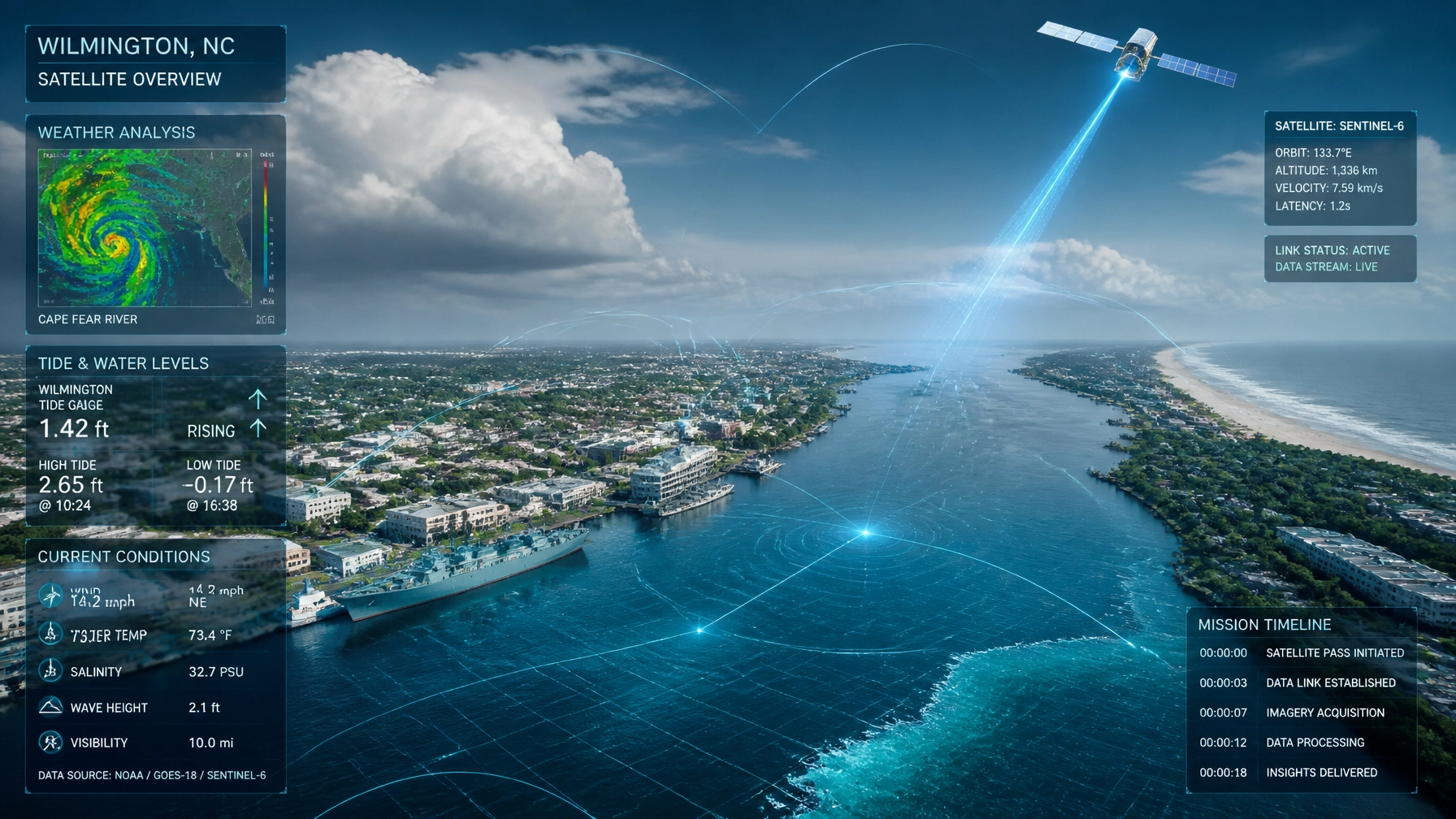
    Satellite weather map view of a hurricane approaching the North Carolina Atlantic coast with meteorological data overlays


    4. Expanding Resilience: Starlink Deployment Across North Carolina State Agencies

    Beyond environmental and weather monitoring, reliable communication in the immediate aftermath of a storm is a matter of survival. Following communications blackouts during past disasters like Hurricane Helene in western North Carolina, the state government took decisive action.

    North Carolina signed an expansive contract with SpaceX to deploy Starlink satellite internet terminals across emergency management agencies, DOT depots, and first-responder hubs statewide. For Wilmington and coastal counties prone to storm-induced fiber cuts and cellular tower outages, low-Earth orbit (LEO) satellite constellations guarantee unbroken command-and-control operations when local infrastructure fails.


    5. From Orbit to Your Roof: Practical Applications for Wilmington Homeowners

    Space-age technology isn't just orbiting hundreds of miles above us: it’s actively helping homeowners protect their greatest physical asset: their property.

    In a hurricane-prone coastal market like Wilmington, home maintenance starts with structural integrity, particularly your roof. High winds, torrential rain, and airborne debris test architectural shingles, metal roofs, and waterproof membranes every single season.

    This is where commercial space technology intersects with everyday convenience. Utilizing high-resolution satellite imagery and remote sensing algorithms, platforms like Get My Roof Estimate Now allow homeowners across North Carolina to measure their roofs instantly down to the inch: without needing an upfront contractor visit or physical inspection.

    • Accuracy Within Inches: Advanced satellite measurement tools calculate roof square footage, pitch, and complexity from orbit.
    • Instant Budgeting: Homeowners receive transparent, data-driven cost breakdowns for architectural shingles, metal roofing, or synthetic upgrades in under 60 seconds.
    • Pre-Storm Preparedness: Knowing your roof's condition and exact replacement cost ahead of storm season eliminates guesswork and helps you secure reliable local contractors before emergency demand surges.

    A beautiful modern coastal single-family home in Wilmington North Carolina with durable architectural shingle roofing and pristine landscaping


    Summary Table: Satellite Tech in Wilmington, NC

    Technology / Program Key Organization Primary Application Wilmington Impact
    SeaHawk-HawkEye CubeSat UNCW COAST Lab High-res ocean color & water quality Tracking Cape Fear estuary health
    NC Sea Grant Fellowships NC Sea Grant & Space Grant Satellite-based coastal monitoring Funding local research talent
    NOAA GOES-19 National Weather Service Atmospheric & storm tracking Hurricane early warning systems
    SpaceX Starlink NC Emergency Management Resilient LEO satellite broadband Unbroken emergency communications
    Satellite Roof Metrics Get My Roof Estimate Now Remote property measurement Instant, free roof replacement estimates

    Frequently Asked Questions

    How does satellite technology benefit Wilmington, NC residents directly?

    Satellite technology powers real-time hurricane tracking, environmental water quality assessments in the Cape Fear region, emergency broadband networks during natural disasters, and even property assessment tools like instant satellite roof estimates.

    Why is the SeaHawk-HawkEye CubeSat important for the Cape Fear region?

    Managed in part by UNCW's COAST Lab, SeaHawk provided high-resolution ocean color data that helps scientists monitor coastal biology, algae blooms, and water pollution in local estuaries.

    What happened with NOAA GOES-19 in July 2026?

    The satellite experienced technical anomalies during hurricane season, highlighting both the critical necessity of continuous meteorological feeds and the vulnerabilities involved when orbital weather assets face downtime.


    Ready to secure your home against coastal storms? Use our free roof cost calculator to get an instant, satellite-powered estimate in under 60 seconds.

  • Daily ROI Blitz #110: How a New Roof Boosts Home Value in Columbia, SC (2026 Data)

    Daily ROI Blitz #110: How a New Roof Boosts Home Value in Columbia, SC (2026 Data)

    For homeowners across the Midlands: from the historic neighborhoods of zip codes 29201 and 29205 out to the suburban communities of 29212: a aging roof is one of the single biggest financial liabilities a property can carry. With a vast number of single-family homes in the Columbia metro area crossing the 20-to-25-year threshold, roof replacements have transitioned from optional cosmetic updates to essential wealth preservation assets.

    If you are planning to sell your home, budgeting for major maintenance, or simply protecting your investment against South Carolina’s punishing climate, understanding the direct financial payoff of a new roof is vital. Backed by updated 2026 data and regional ROI benchmarks, this guide breaks down exactly what a roof replacement costs in Columbia, SC, how much value it adds to your appraisal, and how smart material choices maximize your return.


    1. The 2026 Cost Landscape for Columbia, SC Roofs

    Transparency starts with real numbers. For a standard single-family home in the Columbia metro area (typically measuring between 1,800 and 2,200 square feet), a full roof replacement featuring standard architectural asphalt shingles runs between $10,000 and $15,000 for complete tear-off, premium underlayment, flashing, and baseline decking repairs.

    Depending on your roof's pitch, complexity, and exact square footage, local pricing generally clusters into three main tiers:

    • Standard / Simple Roofs (Budget): $8,500 – $11,000 for straightforward gable roofs with minimal angles and standard architectural shingles.
    • Average Mid-Size Homes (Popular): $10,000 – $15,000 for standard 2,000 sq. ft. homes with standard architectural shingles, valleys, and standard penetrations.
    • Complex / Large Roofs (Premium): $15,000 – $22,000+ for multi-story homes, steep pitches, complex hip-and-valley designs, or premium standing-seam metal installations.

    Rather than waiting weeks for contractor sales calls just to get a baseline number, homeowners can use our Instant Roof Cost Calculator to get precise, satellite-measured estimates in under 60 seconds without stepping foot on a ladder.

    Close-up of premium dark architectural asphalt shingles installed on a residential roof showing clean lines and durability


    2. The ROI Breakdown: What Remodeling Data Shows for South Carolina

    When evaluating home improvement projects, return on investment (ROI) is the ultimate metric. According to regional data from Remodeling magazine’s Cost vs. Value Report for the South Atlantic region (which includes South Carolina), a mid-range asphalt shingle roof replacement consistently recoups roughly 68% of its initial cost at resale.

    To put that into practical terms for Columbia real estate:

    • $10,000 Project: Recovers approximately $6,800 directly in added resale value.
    • $12,500 Project: Recovers approximately $8,500 directly in added resale value.
    • $15,000 Project: Recovers approximately $10,200 directly in added resale value.

    Beyond the Appraisal: Protecting the Deal

    While an appraiser might view a new roof through a standardized depreciation lens, savvy local real estate agents know that a brand-new roof does something even more valuable: it protects the deal.

    In Columbia’s competitive housing market, home buyers are hyper-conscious of inspection contingencies. A roof with 20-plus years of wear triggers immediate red flags, leading to lowball offers, demands for thousands in escrow credits, or deals falling through entirely. Replacing your roof proactively eliminates buyer hesitation and preserves your asking price.


    3. Local Climate Factors: Why Columbia Roofs Age Faster

    Columbia, SC features a humid subtropical climate characterized by intense summer heat, high humidity, and severe thunderstorm seasons. These environmental stressors dictate how roofing materials perform and how long they last:

    • Thermal Shock: Surface temperatures on an asphalt roof during a July afternoon in the Midlands can exceed 150°F, followed by sudden afternoon downpours that rapidly cool the material. This thermal expansion and contraction wears down granules and accelerates granule loss.
    • High Winds and Severe Storms: Spring and summer bring severe squalls, microbursts, and occasional tropical system remnants that test shingle adhesion and ridge caps.
    • UV Degradation: Constant, direct UV radiation bakes organic oils out of traditional 3-tab and standard shingles, making them brittle over time.

    Professional roofing contractor inspecting a residential roof replacement project in a quiet tree-lined Columbia SC neighborhood


    4. Smart Upgrades for Columbia Homeowners

    Maximizing your roof's ROI involves selecting materials engineered specifically for South Carolina weather conditions. Here are two critical upgrades every Columbia homeowner should consider:

    Choose Impact-Resistant Shingles for Storm Season

    Given the frequency of severe thunderstorms and hail events across Richland and Lexington counties, upgrading to Class 4 impact-resistant architectural shingles is a high-value move. While they carry a slight initial price premium over standard shingles, many insurance providers in South Carolina offer annual homeowner insurance premium discounts (often 10% to 25%) for Class 4 rated roofs. Over a few years, these insurance savings significantly offset the upgrade cost.

    Opt for Lighter Colors for Energy Efficiency

    With Columbia summers pushing sustained high temperatures for months at a time, attic heat buildup can cause your HVAC system to work overtime. Choosing lighter color palettes (such as weathered wood, silver birch, or cool gray) reflects significantly more solar radiation than dark charcoal or black shingles. This simple design choice lowers peak attic temperatures, reduces monthly cooling bills, and extends the lifespan of your decking and underlayment.


    Plan Your Columbia Roof Replacement Today

    Navigating a roof replacement doesn't have to involve endless phone calls and high-pressure contractor visits. Whether your home is located in the heart of downtown Columbia or the surrounding Midlands communities, knowing your exact roof dimensions and projected costs is the first step toward a seamless project.

    Get started instantly with our lightning-fast, satellite-powered technology to receive transparent, zero-obligation pricing tailored specifically to your roof's size, pitch, and material options.

    Charming southern suburban home with an energy-efficient light-colored shingle roof reflecting the bright South Carolina sun