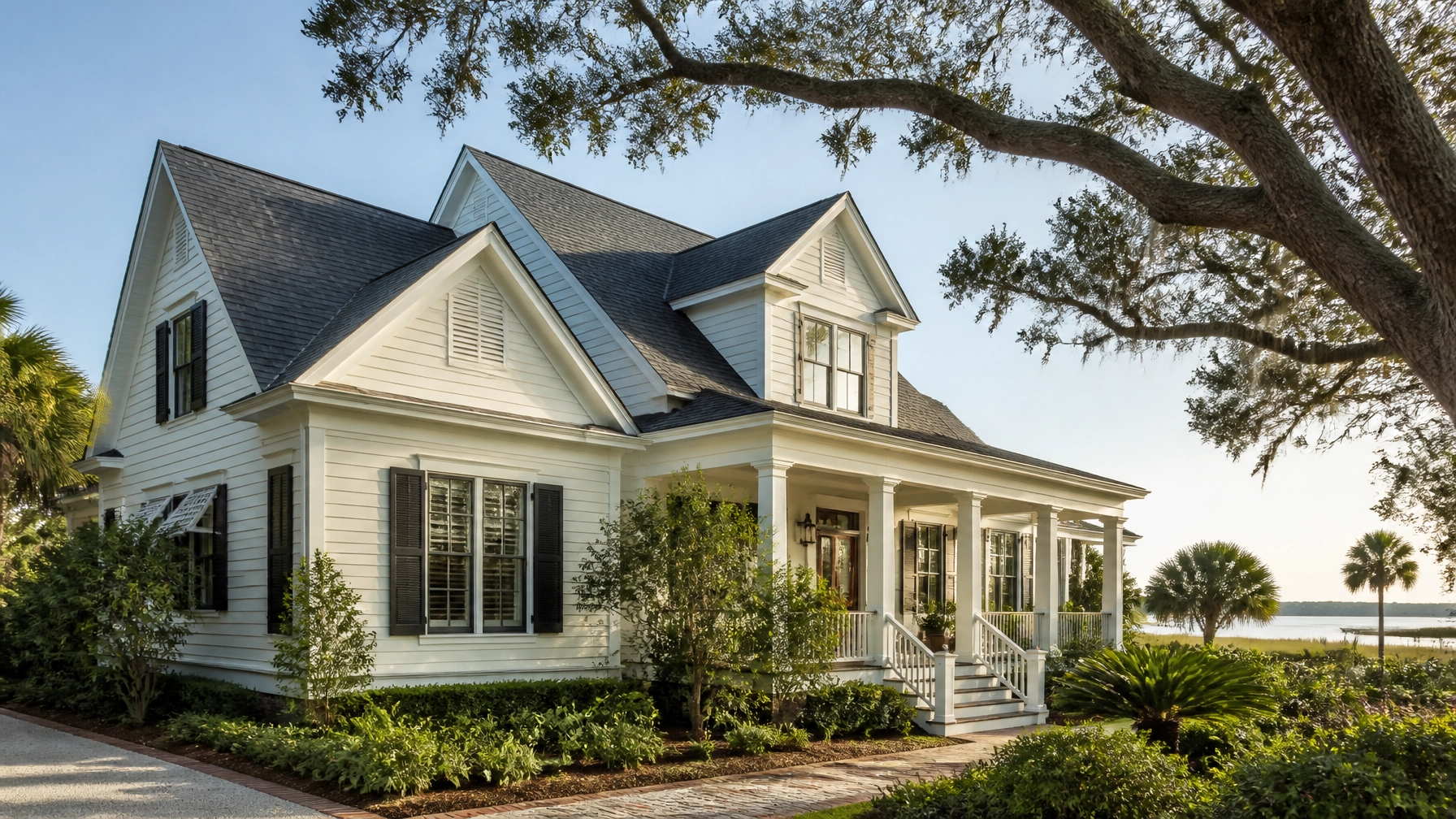
Charleston homeowners need roof information that is fast, local, and practical. Coastal wind exposure, salt air, hurricane season, historic-home requirements, and changing material prices can all affect the cost of a roof replacement.
This Charleston, SC FAQ provides quick answers using 2026 pricing benchmarks, local permit guidance, storm considerations, and insurance-related savings opportunities. For a property-specific starting point, Get My Roof Estimate Now can measure your roof from satellite imagery and return a free estimate in under 60 seconds.
1. How much does a roof replacement cost in Charleston, SC, in 2026?
For a typical Charleston roof, architectural asphalt shingles cost approximately $3.50–$9.70 per square foot installed.
A typical 2,000-square-foot roof may cost roughly:
- $7,000–$20,500 for architectural shingles (Popular)
- $15,100–$34,000+ for standing-seam metal (Premium)
These ranges may include common installation costs, but the final price depends on roof pitch, complexity, tear-off, underlayment, flashing, ventilation, permits, and repairs to the roof deck.
Remember: roofing is usually measured in squares. One roofing square equals 100 square feet. A 2,000-square-foot roof equals approximately 20 squares.
However, a home advertised as 2,000 square feet does not always have a 2,000-square-foot roof. Roof slope, overhangs, garages, porches, and multiple roof sections can increase the measured area.
2. What is the Charleston price difference between shingles and standing-seam metal?
Architectural shingles are the more affordable and common choice for Charleston homes. They offer a wide selection of colors and styles and typically last about 20–30 years when properly installed and maintained.
Standing-seam metal costs more upfront, but it can offer a 40–70-year service life depending on the material, coating, installation quality, and coastal exposure.
| Material | 2026 Charleston range | Typical position |
|---|---|---|
| Architectural shingles | $3.50–$9.70 per sq. ft. | Popular |
| Standing-seam metal | $7.55–$18.00 per sq. ft. | Premium |
Metal roofing may be a strong fit for homeowners planning to stay in their Charleston home long term or those prioritizing durability against wind, intense sun, and heavy rain. Aluminum and properly coated systems may deserve special consideration near salt air.

3. Does Charleston require a permit for a full roof replacement?
Yes. A full roof replacement generally requires a building permit inside the City of Charleston.
The City identifies residential roofing under alteration or repair work. A simple re-roofing project may qualify for an over-the-counter review, and same-day approval may be possible when the application is complete. Approval is not guaranteed.
Permit requirements can vary depending on whether the property is located in:
- The City of Charleston
- Charleston County
- North Charleston
- A historic district or preservation area
For a contractor-pulled permit, use a roofing company with a valid South Carolina contractor’s license and an active City of Charleston business license, when required. A homeowner may be able to pull the permit for their own primary residence, but it is still wise to confirm the requirements directly with the City of Charleston Permit Center.
Historic homes, preservation easements, and properties subject to review may require additional steps. Before scheduling work, ask who will obtain the permit and whether product, color, or design approvals apply.
4. Can a Charleston homeowner pull their own roofing permit?
A homeowner may be allowed to pull a permit for a primary residence.
City guidance indicates that a homeowner applying for work on their own primary residence may not need a City business license. If a contractor applies instead, the contractor should provide the appropriate South Carolina license information and City business license documentation.
Before applying, confirm:
- Whether the property is your primary residence
- Whether the project is inside the City of Charleston
- Whether the home is in a historic or preservation area
- Whether a tear-off, structural repair, or roof design change is planned
- What application, valuation, and inspection documents are required
A licensed contractor is usually the simpler option because the contractor can coordinate the permit, installation, inspections, and documentation.
5. Can wind mitigation lower my South Carolina insurance cost?
Possibly. South Carolina insurers offer wind-mitigation credits, but the exact savings depend on the carrier, policy, location, and documented improvements.
Charleston homeowners may see discounts commonly discussed in the range of:
- 10%–30% on eligible wind-related portions of a policy
- In some situations, up to 50% off the wind portion, depending on the carrier and the complete mitigation package
These discounts are not automatically applied just because a new roof is installed. You may need documentation, a wind-mitigation inspection, or certification under a recognized standard.
A FORTIFIED Roof can improve resistance to high winds by addressing details such as roof-deck attachment, sealed roof decking, edge protection, and stronger installation practices. Ask your insurer how a FORTIFIED certification would affect your policy before selecting materials or installation methods.
Charleston homeowners should also review the South Carolina Department of Insurance coastal insurance resources for current guidance.
6. Is there a South Carolina grant for a stronger roof?
Eligible coastal homeowners may qualify for assistance through the SC Safe Home Mitigation Grant Program.
Current program information lists grants of up to $7,500 for qualifying FORTIFIED Roof retrofits. Eligibility can depend on:
- Owner-occupied, single-family home status
- Location in an eligible coastal county
- Available program funding
- Application timing
- Compliance with program requirements
- Whether the work is a retrofit rather than new construction
Grant rules and funding windows can change. Review the current SC Safe Home program information before signing a contract. Do not assume reimbursement is guaranteed, and confirm whether approval must occur before work begins.

7. What storm activity should Charleston homeowners review in 2026?
Charleston roofs face repeated exposure to thunderstorms, tropical systems, wind-driven rain, and coastal humidity.
The August 22, 2026 storm produced severe-weather warnings in the broader Charleston area, with warnings citing radar-indicated winds near 60 mph. A nearby Pinopolis measurement recorded a gust of approximately 64 mph. Reports from the broader Lowcountry also referenced heavy rain, flooding or ponding in some areas, and storm-related damage such as downed trees.
Weather and storm-report summaries also referenced wind and hail activity near Charleston on July 5 and July 29, 2026, including reports associated with the Shadowmoss and Charleston Airport areas. Conditions can vary significantly from one neighborhood to the next, so a report near Charleston does not automatically prove damage at a specific address.
After a storm, look for:
- Missing, lifted, or creased shingles
- Exposed underlayment
- Damaged flashing around chimneys and vents
- Dented metal components
- Granules collecting in gutters
- Ceiling stains or attic moisture
- Loose gutters, branches, or debris on the roof
Photograph what you can safely see from the ground. Do not climb onto a wet or damaged roof. For official weather documentation, start with the National Weather Service Charleston office and keep copies of inspection reports for your insurer.

8. How accurate is a free satellite roof estimate?
Get My Roof Estimate Now uses satellite-powered measurements that are typically 90%–95% accurate for estimating roof size, pitch, and complexity.
The process is simple:
- Enter your Charleston property address.
- Confirm the correct home.
- Receive a low, middle, and high replacement price range.
The estimate is:
- Free
- Available in under 60 seconds
- Provided without a credit card
- Based on your property rather than a generic average
Satellite measurements are excellent for budgeting and planning. They cannot identify every condition visible during an in-person inspection, such as hidden rot, damaged decking, poor ventilation, or concealed flashing problems. Use the result as a reliable starting point, then request a detailed written quote before construction.
9. Should Charleston homeowners get an estimate before hurricane season?
Yes. Planning before a leak or emergency can give you more choices and better budget control.
If your Charleston roof is 15–30 years old, has repeated repairs, or shows storm wear, get a replacement range before hurricane season intensifies. A fast estimate can help you compare:
- Architectural shingles (Popular)
- Standing-seam metal (Premium)
- Synthetic roofing options
- Roof coatings for compatible low-slope systems
- Tear-off and replacement scenarios
- Potential wind-mitigation upgrades
A property-specific estimate also gives you a benchmark for comparing contractor proposals. If a quote is far above or below the expected range, ask what explains the difference.
Get a Charleston roof estimate in 60 seconds
Roof replacement is a major investment, but the first planning step does not need to be complicated. Get a free satellite-powered estimate for your Charleston, SC home at getmyroofestimatenow.com. See your roof size, material pricing, and low-middle-high replacement range with no credit card and no obligation.
Have another Charleston roofing question? Contact us for more information or start your estimate today.
Leave a Reply