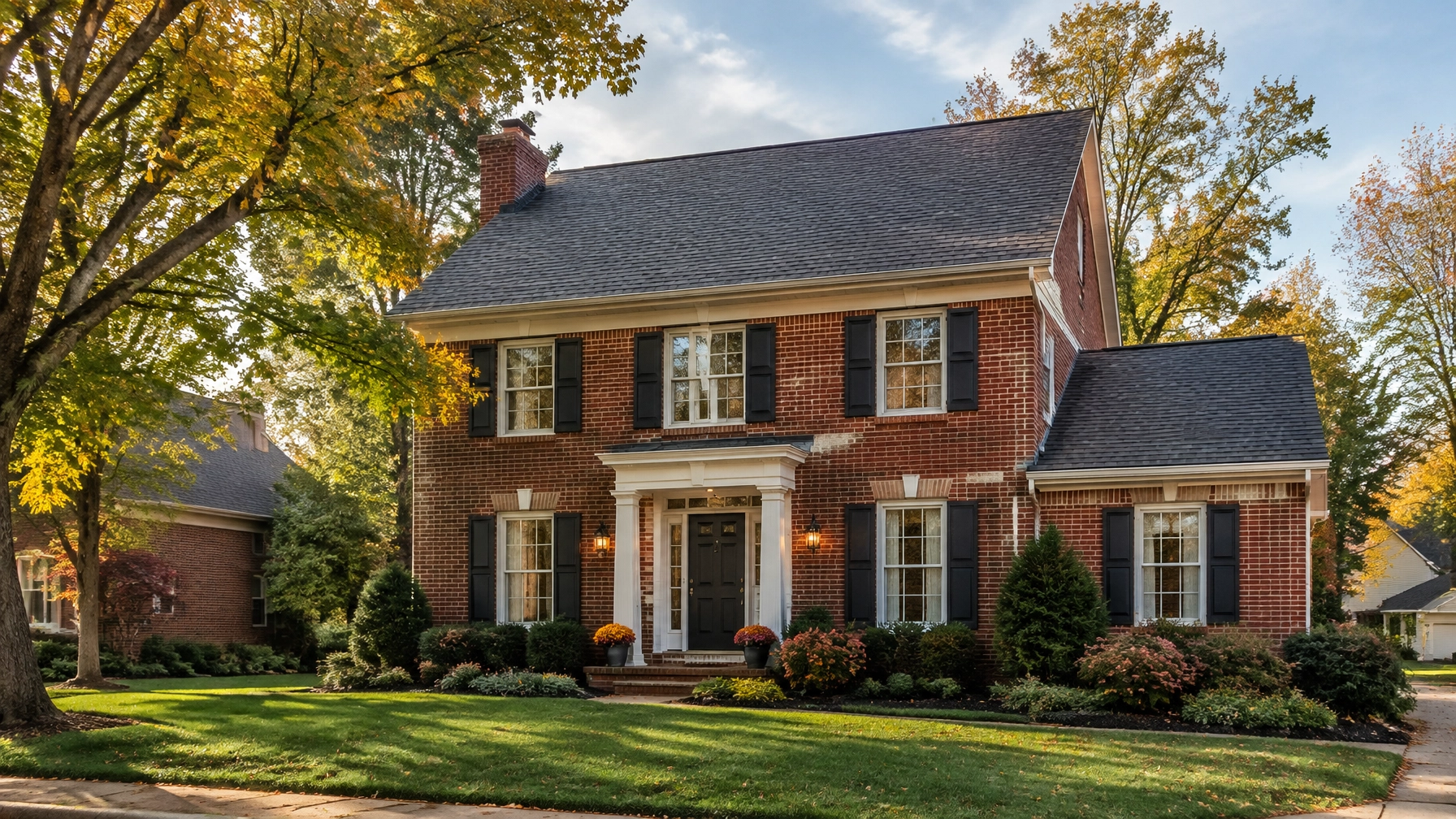
Louisville homeowners no longer need to wait days for a contractor visit just to learn whether a new roof fits the budget.
Satellite-powered roof measurement technology can analyze a property in about 60 seconds, estimate roof size and complexity, and produce a low-to-high replacement range before an in-person inspection. That speed matters in Derby City, where severe storms, hail, high winds, humidity, and tornado risk can turn an aging roof into an urgent financial decision.
In 2026, a typical Louisville roof surface measures approximately 1,800–2,600 square feet. Architectural shingle replacement commonly falls near $9,000–$18,000, while standing-seam metal can reach $20,000–$36,000 for a similar home.
The more precise question is not only, “What will my roof cost?” It is also:
- Which material fits Louisville’s climate?
- How much resale value can a new roof protect?
- Will the project improve curb appeal?
- Can technology provide a reliable starting estimate before contractor appointments?
Louisville’s Local Technology Edge
Louisville has become an important center for weather, mapping, aerial imagery, and geospatial innovation.
Climavision: Filling Kentucky’s Radar Blind Spots
Louisville-based weather technology company Climavision operates from 552 East Market Street in NuLu. As of January 2026, the company had 29 radar systems nationwide, with 10 integrated into National Weather Service forecasting workflows. Climavision expects that network to reach 42 systems by the end of 2026.
The company’s technology addresses a known limitation in traditional radar coverage. Kentucky has only three National Weather Service Doppler radar systems, and radar beams rise higher as they travel farther from the station. That can make low-altitude storm activity difficult to see.
During the 2025 EF4 tornado that affected Somerset and London, Kentucky, a Climavision radar positioned closer to the storm detected a clearer low-level signature. CEO Chris Goode described the image by saying, “In that detail, you actually see what is known as a hook echo.”
The event caused 19 deaths and demonstrated why better local weather intelligence matters. Climavision’s radar data is also being integrated into the National Weather Service’s Multi-Radar Multi-Sensor system through a five-year extension of its Cooperative Research and Development Agreement with NOAA’s National Severe Storms Laboratory.
For homeowners, the lesson is practical: better location data and better storm data help people make faster decisions about inspection, insurance documentation, repairs, and replacement.
KyFromAbove: Kentucky’s Open Aerial Data
Kentucky’s KyFromAbove program provides statewide aerial imagery and LiDAR elevation data. Supported by a reported $17 million contract with NV5, the program is transitioning toward cloud-optimized data and free, open access for Kentuckians.
The data includes:
- High-resolution aerial imagery
- Oblique imagery captured from angled perspectives
- LiDAR-derived elevation models
- Cloud-Optimized GeoTIFF imagery
- Cloud-Optimized Point Cloud data
That kind of detailed topographic and aerial information supports mapping, planning, emergency response, property assessment, and construction analysis. It also reflects the same broader technology trend behind modern roof estimating: using overhead imagery and computer vision to understand a property without immediately sending someone to the site.
EagleView Futureview East Comes to Louisville
From September 22–25, 2026, EagleView Futureview East will take place at the Louisville Marriott Downtown.
The event focuses on aerial imagery, property intelligence, GIS workflows, public safety, infrastructure, and geospatial innovation. EagleView reports a library of more than 3.5 billion images, coverage reaching approximately 94% of the U.S. population, and more than 300 patents.
That matters to homeowners because aerial measurement is no longer an experimental concept. It is becoming a standard tool for property analysis, insurance, emergency response, and roofing estimates.

PlanetiQ and the Larger Satellite Data Ecosystem
The technology story also extends into space. On September 11, 2026, PlanetiQ was selected for NOAA’s new Space-Based Environmental Monitoring IDIQ contract.
The 5-year base contract includes a 5-year option through August 2036. PlanetiQ will provide GNSS radio occultation atmospheric profiles, ionospheric monitoring, and thermospheric neutral density data used for weather forecasting, space-weather monitoring, and satellite orbit prediction.
PlanetiQ is not a Louisville roofing company. However, its work shows how rapidly environmental and geospatial data are expanding. The same broad movement toward precise, remote information is changing how homeowners evaluate properties and roofing costs.
How Satellite-Powered Roof Estimating Works
A modern roof estimate begins with the property address.
The system then uses aerial or satellite imagery, property data, and measurement software to evaluate:
- Roof surface area : calculated in square feet and roofing squares. One square equals 100 square feet.
- Roof pitch : steeper roofs usually require more labor, safety equipment, and installation time.
- Roof complexity : valleys, dormers, multiple ridgelines, skylights, chimneys, and penetrations affect material and labor requirements.
- Material options : estimates can compare architectural shingles, metal, synthetic products, and coatings.
- Regional pricing : Louisville labor rates, material costs, disposal, and permit requirements influence the final range.
The result is not a guaranteed contractor bid. It is a fast, property-specific planning estimate. A physical inspection is still important before installation, especially if the decking, flashing, ventilation, or structure may need repairs.
Louisville Roof Replacement Cost Guide for 2026
| Roofing material | Approx. installed cost | Approx. cost for a 2,000-square-foot roof | Best fit |
|---|---|---|---|
| Architectural shingles (Popular) | $4.50–$8.50 per sq. ft. | $9,000–$17,000 | Budget control, broad style selection |
| Standing-seam metal (Premium) | $7.50–$18.00 per sq. ft. | $20,000–$36,000 | Longevity, durability, modern curb appeal |
Actual pricing can change with roof pitch, tear-off requirements, decking repairs, access, material grade, and contractor availability. For a general comparison, use the roof cost calculator, then request a property-specific estimate.
Louisville’s Climate Should Influence Your Material Choice
Louisville has a humid subtropical climate with several roofing stressors:
- Severe thunderstorms
- Hail and high winds
- Tornado risk along the edge of Dixie Alley
- Summer heat and humidity
- Algae and moss growth
- Occasional winter ice storms
Architectural shingles remain the most common choice because they balance cost, appearance, and installation availability. Homeowners should look for products with appropriate wind ratings, algae resistance, and impact performance.
Standing-seam metal costs more initially but offers long service life, low maintenance, and strong wind performance. It can also provide a distinctive appearance on modern, farmhouse, or contemporary homes.

Permits, Contractors, and Insurance
Louisville Metro requires a residential building permit for roof replacements. Permit fees are based on the project and commonly range from approximately $75 to $300 or more, with $75 serving as the minimum in many cases.
Your contractor should also maintain current Louisville Metro Home Improvement Contractor registration. If the property is in Jeffersontown, St. Matthews, or another independent municipality, that local government may issue its own permits and apply different procedures.
Before signing a contract:
- Confirm who will pull the permit.
- Verify contractor registration and insurance.
- Request proof of general liability and workers’ compensation coverage.
- Ask whether tear-off and disposal are included.
- Confirm the warranty for both materials and workmanship.
- Check whether the contractor will document storm damage for your insurer.
The Louisville Metro Construction Review page is the best place to verify current requirements.
New Roof ROI and Louisville Home Value
A roof replacement is both a maintenance expense and a home-value decision.
A typical replacement recoups approximately 60%–85% of its cost at resale, depending on the material, installation quality, local market conditions, and the condition of the old roof. The return is rarely a dollar-for-dollar increase in the sale price. Instead, value may appear through several channels:
- Fewer inspection objections
- Less buyer negotiation
- Better listing photography
- Improved curb appeal
- Greater buyer confidence
- Lower immediate maintenance concerns
- Better protection from weather-related damage
For a Louisville home valued near the $250,000–$270,000 median range, a clean, modern roof can materially affect first impressions. A roof with curling shingles, visible algae, missing tabs, or sagging lines can make the entire property appear neglected.
What Is the Best Roof for Home Value?
For many Louisville properties, architectural shingles offer the best balance of purchase price, appearance, availability, and resale value. They are often the practical choice when the homeowner expects to sell within several years.
Standing-seam metal may be the better long-term option for homeowners who plan to stay in the home, want stronger durability, or own a modern property where metal improves the design. Its higher cost does not guarantee a higher dollar return, but it can strengthen the home’s market position and reduce future replacement concerns.
The best roof for home value is usually the one that:
- Fits the neighborhood
- Matches the home’s architecture
- Is correctly installed
- Addresses local weather risks
- Does not over-improve the property for its market
Louisville Roof Replacement FAQ
How accurate is a satellite roof estimate?
Modern aerial measurement can be accurate to within inches in many cases, commonly reaching approximately 90%–95% accuracy. It is designed to provide a strong starting range, not replace a final inspection.
Can I get a Louisville roof estimate without a contractor visit?
Yes. Enter your address into Get My Roof Estimate Now to receive a free, satellite-powered estimate in about 60 seconds. No credit card is required.
Does a new roof increase resale value?
It can. A new roof may improve curb appeal, reduce inspection concerns, and support a stronger sale position. Homeowners commonly recoup about 60%–85% of the project cost, although the actual result varies.
Should I choose shingles or metal?
Architectural shingles are typically the value-focused choice. Standing-seam metal is a premium option with greater longevity and strong durability. Compare both using the roofing materials guide.
Get Your Louisville Roof Estimate in 60 Seconds
Louisville’s weather and property technology ecosystem is becoming more precise: from low-altitude storm radar to statewide LiDAR and advanced aerial imagery.
Homeowners can use that same technology to make a better roofing decision. Get a free estimate based on your actual roof size, pitch, complexity, material choice, and regional pricing at getmyroofestimatenow.com. No appointment is required to get started, and there are no hidden fees.
Leave a Reply