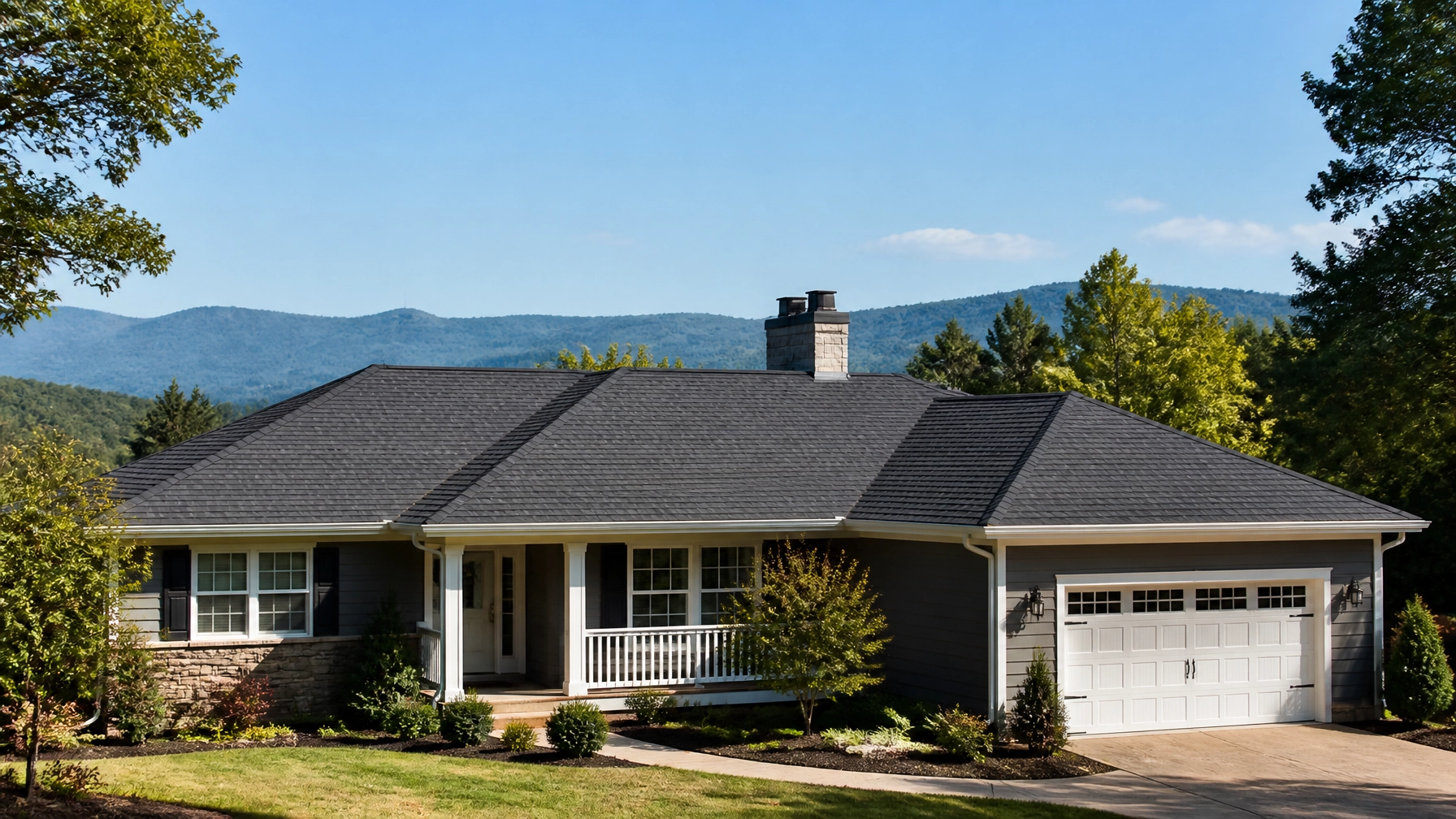
Chattanooga homeowners are starting September 2026 with a familiar Tennessee challenge: intense heat followed by the possibility of severe storms.
The first week of the month is expected to bring highs in the mid-to-upper 90s, with heat indexes near or above 100°F. September 1 also marks the beginning of meteorological fall, but Chattanooga’s roof systems still have to handle late-summer heat, humidity, thunderstorms, hail, wind, and flash-flood-producing rain.
That makes accurate roof planning more important than ever.
In Chattanooga, a full roof replacement typically costs about $3–$10 per square foot installed, with many standard projects clustering near $11,000–$13,000. The final number depends on roof size, pitch, complexity, material, tear-off requirements, ventilation, and local labor.
With satellite-powered measurement technology, homeowners can now receive a fast starting point before scheduling contractor visits.
Why Chattanooga Is a Natural Home for Satellite Roofing Technology
Chattanooga has become a regional center for geospatial data, remote sensing, and spatial computing.
Local environmental intelligence firm Skytec uses satellite imagery, GIS, and GeoAI to identify changes across large areas. The UTC Center for Applied Geospatial Data Science supports applied research using satellite, remote-sensing, and geospatial data. Chattanooga-based SpatialGen is developing infrastructure for real-time 3D reconstruction and spatial computing.
These technologies are designed for environmental monitoring, infrastructure, disaster response, and mapping. The same core concept applies to residential roofing:
- Capture a detailed view of the property.
- Measure the roof planes and total surface area.
- Analyze pitch, edges, valleys, and complexity.
- Convert measurements into material quantities.
- Apply local pricing to create a realistic replacement range.
A homeowner does not need to understand GIS or 3D reconstruction to benefit from the result. The practical advantage is simple: less waiting and better information before contacting contractors.

Chattanooga’s Tornado Response Demonstrated the Value of Change Detection
Chattanooga has already seen how satellite technology can support urgent local decisions.
After the Easter Sunday tornadoes on April 12, 2020, an EF3 tornado with estimated winds up to 145 mph traveled approximately 14.5 miles through southeast Chattanooga, East Ridge, East Brainerd, Collegedale, and surrounding areas.
Skytec worked with UTC’s Interdisciplinary Geospatial Technology Lab and the Lyndhurst Foundation to analyze Planet satellite imagery. Planet’s constellation of more than 150 satellites provided frequent global coverage, allowing the team to compare imagery taken before and after the tornado.
The project:
- Mapped more than 5,000 impacted acres
- Created a tornado impact index
- Helped identify damaged trees and vegetation
- Supported EPB, CDOT, Hamilton County GIS, and cleanup crews
- Helped guide restoration and power-recovery decisions
According to Skytec’s account of the project, EPB faced approximately 60,000 customers without power and deployed 1,400 workers. Crews also constructed hundreds of new utility poles and installed 56 miles of new power lines.
The lesson for homeowners is not that a satellite image replaces an inspection. It does not. The lesson is that high-resolution imagery and change detection can quickly identify where attention is needed.
For roofing, satellite measurements are useful for estimating the roof’s size and configuration. A contractor still needs to verify decking, flashing, ventilation, underlayment, and hidden moisture conditions before installation.
Weather Satellites and Roof Risk in the Tennessee Valley
NOAA’s geostationary weather satellites continuously monitor the Tennessee Valley for developing storms, hail, lightning, heavy rainfall, and flash-flood threats. NOAA and the National Weather Service provide local forecasts, radar, satellite imagery, and climate records for the Chattanooga area.
GOES-East, now represented by GOES-19, and GOES-18 provide broad regional weather monitoring. Commercial satellite imagery and AI-based analysis add a different layer: property-level screening and measurement.
That combination matters in Chattanooga because September weather can change quickly:
- The typical September rainfall benchmark is approximately 4.23 inches.
- September 2026 begins with unusual heat, including forecast highs near 100°F.
- Historical September rainfall has been influenced by tropical systems.
- September 1977 is remembered as an exceptionally wet month, with Hurricane Babe contributing approximately 6.62 inches of rain in the Chattanooga area.
Heat can accelerate shingle aging, especially on older roofs with poor ventilation. Storms can loosen tabs, damage ridge caps, dent metal panels, crack flashing, or create small openings that are not visible from the ground.
2026 Chattanooga Roof Replacement Cost Guide
The following ranges are planning benchmarks, not a final proposal. Your roof’s measured surface area: not the home’s interior square footage: determines the material quantity.
One roofing square equals 100 square feet of roof surface.
| Tier | Material | Typical installed range | Approximate 2,000-square-foot roof |
|---|---|---|---|
| Budget | Basic asphalt shingles or entry-level system | $3–$5 per sq. ft. | $7,000–$10,000 |
| Popular | Architectural asphalt shingles | $5–$9 per sq. ft. | $10,000–$18,000 |
| Premium | Metal or synthetic roofing | $8–$20+ per sq. ft. | $16,000–$40,000+ |
Budget: Basic Asphalt
Basic asphalt shingles are the lowest-cost replacement option. They may work well for homeowners focused on controlling the initial investment, but product life, wind ratings, appearance, and warranty coverage vary.
A simple roof with one or two planes may fall near the lower end. Multiple valleys, steep slopes, extensive tear-off, or decking repairs can push the price higher.
Popular: Architectural Shingles
Architectural shingles are the most common choice for Chattanooga homeowners.
They provide:
- More dimensional appearance than basic three-tab shingles
- Broad color and style selection
- Practical protection for most single-family homes
- A strong balance between cost and curb appeal
For a typical 1,500–2,600-square-foot home, many homeowners should plan around $11,000–$13,000 for a straightforward architectural shingle replacement. A complex roof or a project with significant repairs may exceed that range.
Premium: Metal and Synthetic Roofing
Metal roofing generally costs more upfront but can offer long service life, strong wind performance, and a modern appearance. Synthetic materials can reproduce the look of slate or wood while reducing some weight and maintenance concerns.
These systems require a larger budget. A quote that appears unusually low may exclude tear-off, ventilation upgrades, flashing replacement, disposal, or code-related work.

Chattanooga Storm and Heat Roof Checklist
After a hot spell or severe-weather event, check your roof from the ground. Do not climb onto a wet or damaged roof.
Look for:
- Missing, lifted, or curled shingles
- Granules collecting in gutters or downspouts
- Dark patches or exposed underlayment
- Dented metal vents, flashing, or panels
- Cracked pipe boots and sealant
- Loose ridge caps
- Water stains on ceilings or attic rafters
- Sagging roof sections
- Fallen branches or visible impact damage
- Gutter separation or unusual overflow
If you see active leaking, place a container under the leak and contact a qualified roofing professional. Avoid temporary repairs that could create additional damage or complicate an insurance claim.
Get a Chattanooga Roof Estimate in 60 Seconds
Traditional estimating often starts with multiple calls and several days of scheduling.
Get My Roof Estimate Now uses satellite imagery to estimate roof size, pitch, and complexity. Results are designed to arrive in under 60 seconds and provide low-to-middle-to-high pricing ranges based on material choices and regional costs.
The estimate is:
- Free
- Available without a credit card
- Based on satellite-powered measurements
- Useful for comparing architectural shingles, metal, synthetic materials, and coatings
- A starting point before connecting with verified, licensed, and insured local contractors
You can also use the roof cost calculator to review broader replacement scenarios.
Conclusion
Chattanooga’s satellite and geospatial technology community is helping make complex local decisions faster and more precise. For homeowners, that translates into a practical advantage: better roof measurements, faster budget planning, and less time waiting for preliminary contractor visits.
With extreme heat opening September 2026 and Chattanooga’s ongoing exposure to storms and heavy rain, now is a sensible time to understand your roof’s condition and likely replacement cost.
Frequently Asked Questions
How much does a roof replacement cost in Chattanooga in 2026?
Most Chattanooga roof replacements fall roughly between $7,000 and $20,000, depending on roof size, material, pitch, complexity, and repair requirements. Many standard architectural shingle projects are near $11,000–$13,000.
Is $3 per square foot realistic for a Chattanooga roof replacement?
It can represent the low end of a basic project, but it may not include every cost. A complete replacement involving tear-off, disposal, underlayment, flashing, ventilation, and labor often trends closer to $5–$9 per square foot for architectural shingles.
Can satellite imagery determine my entire roof replacement price?
Satellite imagery can estimate roof dimensions, pitch, and complexity and create a useful pricing range. It cannot confirm hidden decking damage, concealed leaks, ventilation problems, or every code requirement. A contractor should verify those conditions before work begins.
What roofing material is most popular in Chattanooga?
Architectural asphalt shingles are the most common balance of affordability, appearance, and performance. Metal is a premium alternative, while synthetic roofing is typically selected for specialized appearance or durability goals.
Should I replace my roof before selling my Chattanooga home?
Not always. Start by obtaining an estimate and documenting the roof’s age and condition. A realistic cost range can help you decide whether replacement, repair, a seller credit, or a pricing adjustment makes the most financial sense.
Leave a Reply