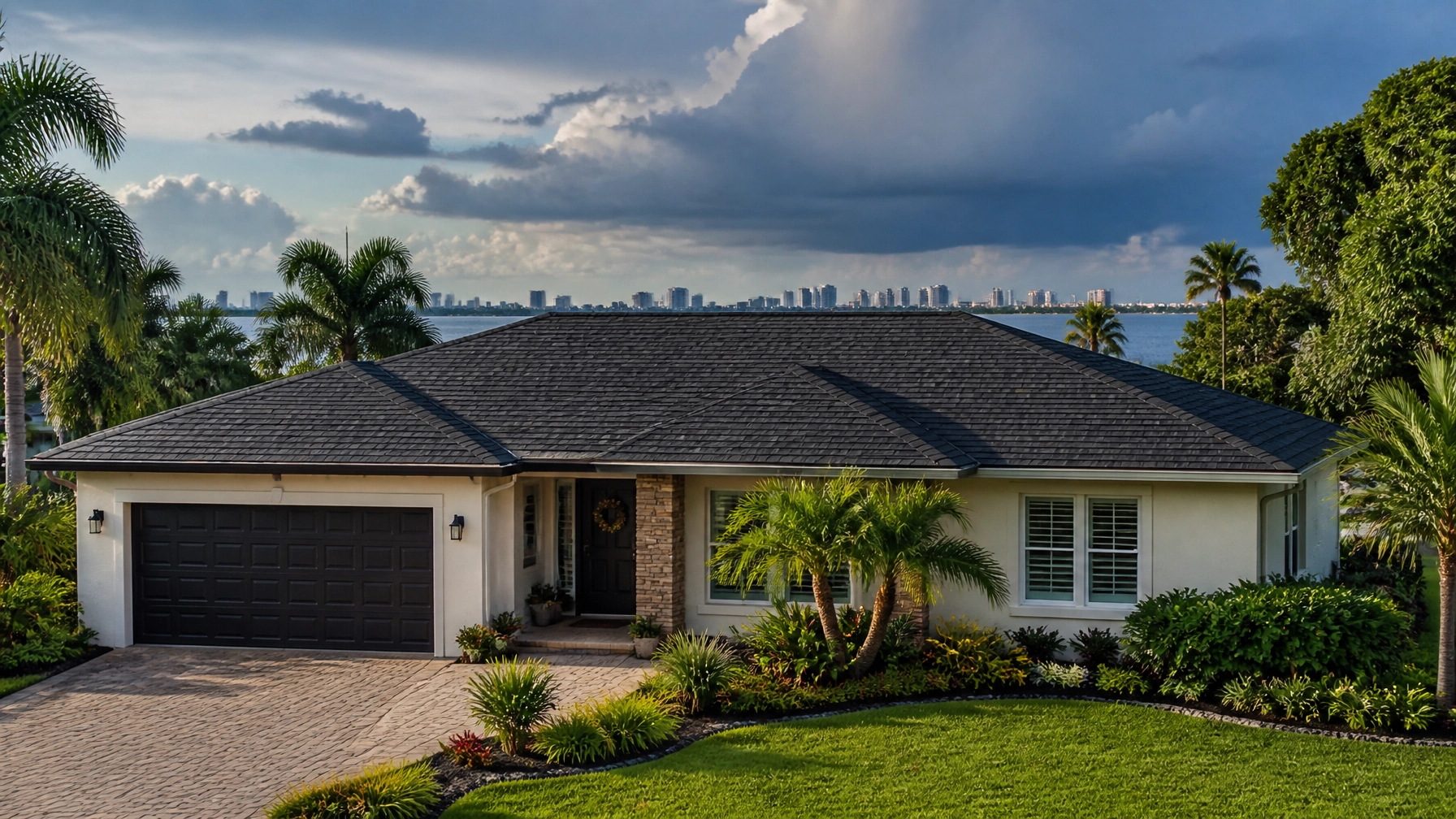
Florida is North America’s lightning capital. Tampa Bay sits directly in one of the country’s most active thunderstorm corridors.
On August 20, 2026, Florida had already exceeded 2.3 million reported lightning strikes for the year. A stormy 24-hour period produced more than 90,000 strikes statewide, including major activity around Tampa Bay. That level of weather activity is more than a forecasting statistic. It affects roof inspections, construction schedules, insurance decisions, and the lifespan of every roofing system in the region.
The technology watching those storms is advancing quickly. NOAA’s Geostationary Lightning Mapper (GLM) aboard GOES-19 continuously maps total lightning across Florida and the Gulf. At the same time, satellite imagery, coastal models, artificial intelligence, and property-level roof measurement are making roofing decisions faster and more precise.
For Tampa homeowners, the takeaway is simple: you can now understand your roof’s condition, replacement cost, and storm exposure before scheduling multiple contractor visits.
The satellite advantage starts with GOES-19
GOES-19 is NOAA’s eastern geostationary weather satellite. Its GLM instrument detects and maps in-cloud, cloud-to-cloud, and cloud-to-ground lightning across the Western Hemisphere.
The important advantage is continuity. Unlike a single radar scan or a ground observation, GLM watches storm activity over Tampa Bay, the Gulf of Mexico, and surrounding areas continuously.
Forecasters use lightning behavior to identify:
- Rapidly intensifying thunderstorms
- Strong updrafts and developing storm cores
- Dangerous lightning near outdoor work areas
- Convective bursts inside tropical systems
- Changes in hurricane structure and intensity
NOAA explains that GLM data can reveal the spatial and timing patterns of lightning, not simply whether one strike occurred. That gives forecasters a faster picture of storm development.
For roofing crews, this matters operationally. A roof replacement should not continue when lightning is approaching, even if rain has not yet started. Real-time satellite data helps crews make safer stop-and-start decisions.
A July 2026 outage showed the value of redundancy
On July 15, 2026, GOES-19 entered safehold after an onboard anomaly. NOAA temporarily shifted some coverage to GOES-18 while engineers restored the eastern satellite’s systems.
Normal operations, including GLM coverage, were restored by July 17. The event demonstrated an important point: modern weather forecasting depends heavily on geostationary satellites, but it also requires backup systems, radar, ground observations, and models.
That same layered approach is useful in roofing. Satellite imagery can measure and screen a roof quickly. A licensed contractor still verifies deck damage, flashing, ventilation, and code requirements in person before construction.
GeoXO will expand the satellite technology edge
NOAA’s next-generation GeoXO program is being rebaselined for a four-satellite series launching from 2032 through 2043.
The planned system includes:
- GeoXO Imager (GXI): Higher-resolution environmental and weather imagery
- GeoXO Sounder (GXS): Detailed profiles of atmospheric moisture, temperature, and winds
- Improved support for severe weather, flooding, fires, and coastal hazards
As of NOAA’s August 31, 2026, user-readiness update, a lightning mapper is not yet included in the core baseline, although the capability remains under consideration. That means Tampa’s current lightning monitoring still relies primarily on GOES-18 and GOES-19 GLM systems.
NOAA is also working with three companies to advance satellite technology for severe-weather tracking. The direction is clear: more data, faster processing, and better local decision-making.

Tampa’s storm-surge models add coastal precision
Lightning is only one part of Tampa’s weather risk. Storm surge can cause catastrophic damage even when a roof itself remains intact.
The University of South Florida’s College of Marine Science operates high-resolution coastal modeling systems, including:
- Tampa Bay Coastal Ocean Model (TBCOM)
- West Florida Coastal Ocean Model (WFCOM)
These models combine satellite observations, ocean sensors, tide data, and atmospheric forecasts to estimate water levels, currents, and surge conditions. TBCOM can model conditions inside Tampa Bay and nearby waterways at much finer scales than broad regional forecasts.
For homeowners, coastal modeling supports better preparation decisions:
- Moving vehicles and equipment before surge arrives
- Protecting electrical systems and stored materials
- Understanding whether a property may face flooding
- Coordinating emergency roof work before a storm
- Avoiding unsafe travel during a storm response
A roof estimate does not predict storm surge. It does, however, help homeowners understand the size and cost of a roofing project before an emergency creates a rushed decision.
Tampa’s space operations reinforce the technology ecosystem
MacDill Air Force Base is home to U.S. Space Forces–Central, the Space Force component supporting U.S. Central Command.
Its responsibilities include integrating:
- Satellite communications
- Missile warning
- GPS-based positioning, navigation, and timing
- Space operations for military missions
That mission is separate from residential roofing, but it reflects Tampa’s broader position in satellite technology and operations. The region is not only exposed to severe weather; it is also connected to organizations that operate and depend on space-based systems every day.
Commercial satellite imagery and AI are changing roof assessments
Commercial imagery and AI tools are increasingly useful for storm-damage triage.
Aerial and satellite comparisons can help identify:
- Missing or displaced shingles
- Blue tarps or emergency coverings
- Large areas of discoloration
- Debris patterns
- Changes between pre-storm and post-storm imagery
- Roof sections that may need closer inspection
AI should be treated as a screening tool, not a final diagnosis. It may miss concealed leaks, lifted flashing, soft decking, or damage under overlapping materials. A professional inspection remains necessary for insurance documentation and construction planning.
The technology is most valuable when it reduces wasted time. Homeowners can identify likely damage, estimate project scope, and decide which contractors to contact before arranging a full site visit.
What a Tampa roof replacement costs in 2026
Typical Tampa-area single-family homes have approximately 1,500 to 2,600 square feet of roof area. Replacement prices commonly range from $9,000 to $30,000, with many homeowners landing between $11,000 and $19,500.
| Tier | Typical material | Tampa planning range | Best fit |
|---|---|---|---|
| Budget | Basic asphalt shingles | $9,000–$12,000 | Lowest upfront cost on a straightforward roof |
| Popular | Architectural shingles | $11,000–$19,500 | Balanced appearance, durability, and price |
| Premium | Metal or tile roofing | $18,000–$30,000+ | Longer service life and upgraded storm performance |
Typical material benchmarks include:
- Architectural shingles (Popular): $5–$12 per square foot
- Metal roofing (Premium): $9–$25 per square foot
- Tile roofing (Premium): $10–$25 per square foot
- Tear-off: approximately $1,500–$3,000
- Permits: commonly $150–$500
Your final price will also depend on roof pitch, valleys, dormers, penetrations, access, ventilation, decking repairs, and the number of roofing squares. One roofing square equals 100 square feet.

Florida code and insurance factors to check
Tampa homeowners should confirm more than the shingle price.
Florida’s 25% replacement rule generally means that when more than 25% of a roof is replaced, the entire roof must meet current Florida Building Code requirements. Your licensed contractor should explain how the rule applies to your project and local jurisdiction.
Ask about:
- Permit responsibility
- Required inspections
- Wind-rated roof coverings
- Secondary water barriers
- Correct nailing patterns
- Decking and flashing upgrades
- Manufacturer and workmanship warranties
A wind-mitigation inspection may also document features such as a 130-mph-rated roof covering, 8d ring-shank nails in a 6/6/6 pattern, and a secondary water barrier. Depending on the home, policy, insurer, and documentation, these features may contribute to wind-premium savings in the range of 10%–35%.
Insurers are also scrutinizing roofs that are 15 years or older, especially after hurricanes and severe thunderstorms. Keep inspection reports, permit records, invoices, photographs, and warranty documents.
Tampa hurricane-season roof checklist
NOAA’s 2026 Atlantic outlook calls for a below-normal season: 7–13 named storms, 2–6 hurricanes, and 0–2 major hurricanes. A strong El Niño is one factor behind the outlook, but a below-normal forecast does not mean Tampa homeowners can ignore preparation. One storm is enough to create major damage.
Use this checklist:
- Check the roof before the next storm. Look from the ground for missing shingles, lifted edges, sagging areas, or loose metal.
- Clean gutters and downspouts. Heavy rain needs a clear drainage path.
- Trim branches near the roof. Remove dead limbs that could break during high winds.
- Photograph current conditions. Store date-stamped roof and exterior photos.
- Confirm your insurance requirements. Ask whether a roof inspection or wind-mitigation form is required.
- Do not climb onto the roof during or after a storm. Use a licensed professional.
- Get an instant replacement cost range. Knowing whether your likely project is $12,000 or $25,000 improves emergency planning.
Get a Tampa roof estimate in 60 seconds
Get My Roof Estimate Now uses satellite imagery to measure your actual roof and estimate replacement pricing based on size, pitch, and complexity.
The service provides:
- A free estimate with no credit card
- Results in approximately 60 seconds
- Satellite-powered measurements accurate to within inches
- Low, middle, and high price ranges
- Material options for shingles, metal, synthetic roofing, and coatings
- Connection to verified, licensed, and insured local contractors
You can also compare assumptions with the roof cost calculator, but a property-specific satellite estimate is the better starting point for a Tampa home.

Final takeaway
Tampa’s satellite technology edge is practical, not theoretical. GOES-19 GLM tracks lightning activity. USF models coastal water behavior. Commercial imagery and AI help identify potential roof damage. Property-level satellite measurement turns that broader technology into a fast replacement-cost estimate.
For Tampa homeowners, the smartest sequence is straightforward: check the roof, understand the code and insurance requirements, get a property-specific price range, and then compare qualified contractors before the next storm creates urgency.
Frequently Asked Questions
How much does a roof replacement cost in Tampa in 2026?
Most Tampa roof replacements cost approximately $9,000–$30,000. Many homeowners pay between $11,000 and $19,500, depending on roof size, material, pitch, complexity, tear-off, permits, and repairs.
What roofing material is best for Tampa?
Architectural shingles are the most popular balance of cost and performance. Metal and tile are premium options that can provide longer service life and strong storm performance when properly installed and code-compliant.
Does satellite imagery replace a roof inspection?
No. Satellite imagery can measure roof size and identify visible changes, but it cannot reliably confirm concealed leaks, decking damage, flashing problems, or every code issue. A licensed roofing professional should complete the final inspection.
How fast can I get a Tampa roof estimate?
Get My Roof Estimate Now provides a free, satellite-powered estimate in approximately 60 seconds. No contractor visit or credit card is required to get started.
Do I need a permit for a Tampa roof replacement?
Permits are typically required for roof replacement in Tampa and Hillsborough County. Confirm the exact requirements with your licensed contractor and local building department.
Can a new roof lower my Florida insurance premium?
It may. Wind-mitigation features and proper documentation can qualify some homeowners for insurance savings. The amount depends on the insurer, policy, roof system, inspection, and documented construction features.
Leave a Reply