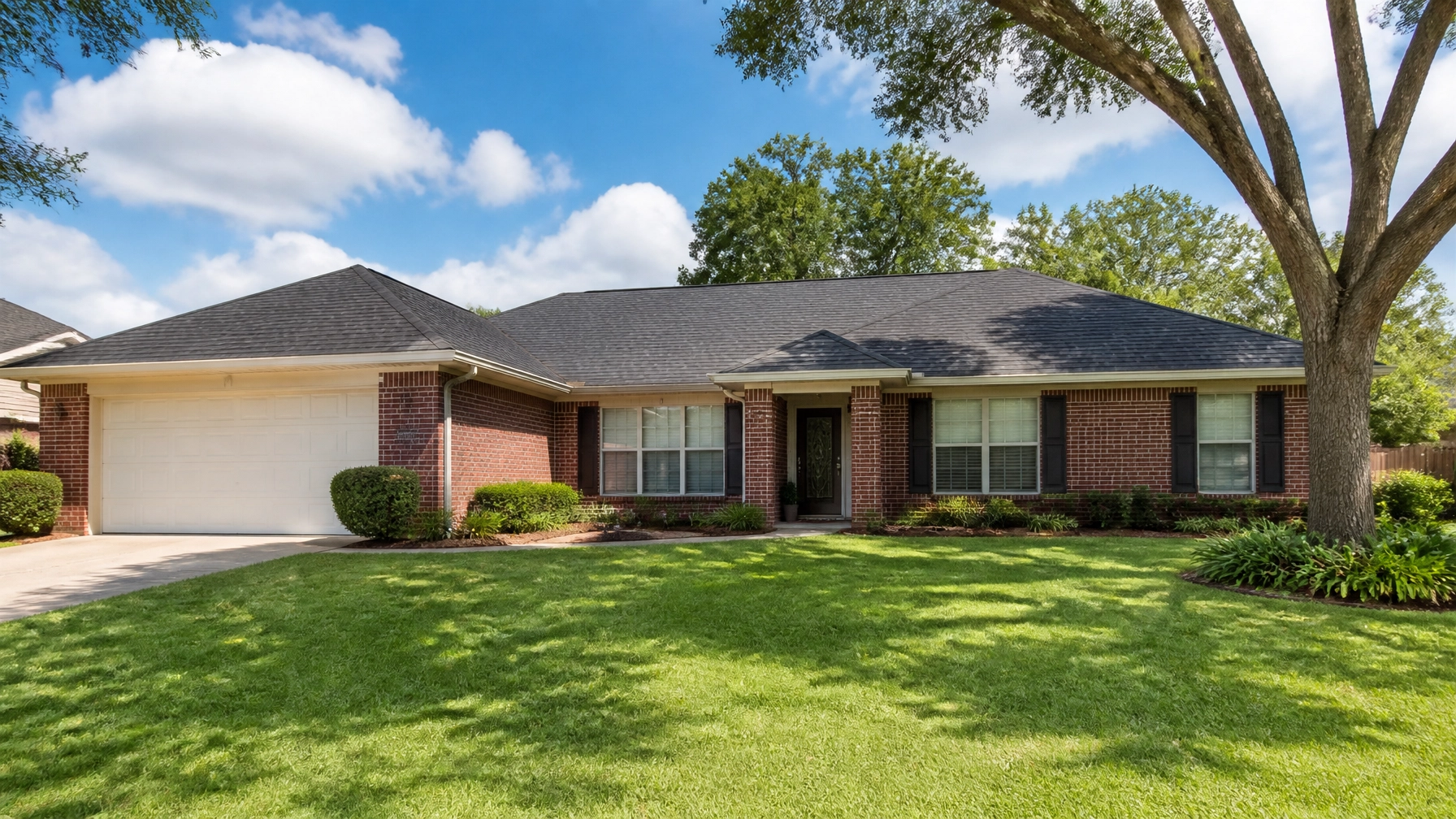
In Houston, your roof isn't just part of your home’s aesthetic, it’s a frontline soldier. Between the relentless June-to-November hurricane seasons, the 95-degree humidity that turns attics into ovens, and the sudden Gulf Coast downpours, our roofs take a beating that homeowners in other states simply don't understand.
If you’ve noticed a few shingles in your yard after a storm or a damp spot on your guest room ceiling, you’re likely asking the $15,000 question: Do I really need a full roof replacement, or can I get away with a repair?
The truth is often somewhere in the middle, but in Houston’s unique climate, waiting too long can turn a $500 patch job into a $20,000 structural nightmare. Here is the data-driven truth about roofing in the Bayou City for 2026.
The Quick Answer: Houston Roofing by the Numbers (2026)
If you’re looking for a ballpark figure before diving into the details, here is the current market reality for Houston, TX:
- Average Replacement Cost: $8,500 – $22,000 (Popular)
- Average Repair Cost: $400 – $2,500 (Budget)
- Typical Lifespan (Asphalt): 15–22 years (due to extreme heat/UV)
- Key Indicator: If repairs exceed 30% of the cost of a new roof, replace it.
To get a precise number for your specific home without the hassle of a salesperson visiting, you can use our Satellite Roof Cost Calculator to get an accurate quote in under 60 seconds.
5 Signs It’s Time for a Full Replacement
How do you know when a "quick fix" is just throwing good money after bad? Look for these five red flags that indicate your roof has reached the end of its tour of duty.
1. The "Granule Graveyard" in Your Gutters
Take a look at your downspouts. Do you see piles of black, sand-like grit? Those are granules. They protect your shingles from Houston’s intense UV rays. Once they wash away, the asphalt underneath becomes brittle and cracks. If your shingles look "bald" or shiny, a replacement is imminent.
2. Curling and "Cupping" Shingles
High humidity followed by intense heat causes shingles to expand and contract rapidly. If the edges of your shingles are curling upward (cupping) or the middle is starting to bulge, they are no longer shedding water effectively. This is a primary cause of the slow leaks that rot your roof decking.

3. The 20-Year Rule
While many shingles are rated for 30 years, Houston’s climate is a "high-stress" environment. If your roof was installed before 2006, it has likely survived multiple major wind events and thousands of hours of 90+ degree heat. At this age, the materials have lost their structural integrity.
4. Daylight in the Attic
This is the most direct evidence you can find. Go into your attic on a sunny day and turn off the lights. If you see pinpricks of light coming through the roof boards, water is getting in. If you see water stains or "trails" on the rafters, the damage has already started.
5. Multiple Leak Points
Repairing one leak is a maintenance task. Repairing three leaks in different areas of the house is a symptom of a systemic failure. Patching multiple spots is like putting Band-Aids on a sinking ship; eventually, the "hull" (your underlayment) is just too far gone.
The Houston Factor: Why Our Roofs Die Young
In states like Ohio or Pennsylvania, an asphalt roof might easily cruise to 25 years. In Texas, we have a different set of rules. When we calculate Texas Roof Estimates, we factor in these three local stressors:
The "Oven" Effect (Intense UV)
Houston averages 204 sunny days per year. That UV radiation breaks down the chemical bonds in asphalt shingles, making them "crunchy." When a shingle loses its flexibility, it can't withstand the wind. It simply snaps.
Hurricane Season and Wind Uplift
Even if a hurricane doesn't make a direct hit, the peripheral winds of tropical storms create "wind uplift." This breaks the sealant strip between shingles. Once that seal is broken, the shingles flap in the wind, allowing rain to be driven up and under the shingle, straight onto your wood decking.
Extreme Humidity and Algae
The "black streaks" you see on many Houston roofs aren't dirt; they are Gloeocapsa magma, a type of algae that thrives in our humidity. While it's mostly cosmetic, it can hold moisture against the shingle, accelerating the rot of the organic matting inside.

Repair vs. Replace: The 30% Rule
Homeowners often ask: "Is it cheaper to just keep repairing it?"
Economically, the "30% Rule" is the industry standard. If the cost of your repairs, considering the frequency and the scale, reaches 30% of the cost of a full replacement, you are losing money.
Example:
- Full Replacement Quote: $12,000
- 30% Threshold: $3,600
If you are looking at a $2,500 repair for a roof that is 18 years old, you are better off putting that $2,500 toward a new roof. Why? Because the new roof comes with a 20-50 year warranty and can lower your homeowner's insurance premiums in Texas, especially if you choose Class 4 Impact-Resistant Shingles.
How to Get an Accurate Estimate in 60 Seconds
The traditional way to get a roof estimate is a headache:
- Call three contractors.
- Wait for them to show up (if they show up).
- Sit through a 45-minute sales pitch in your living room.
- Compare three vastly different handwritten quotes.
At Get My Roof Estimate Now, we’ve simplified the process using high-resolution satellite imagery. We measure your roof's square footage, pitch, and complexity from above with 95% accuracy.
By entering your address on our homepage, you receive a transparent price range based on current 2026 Houston labor and material costs. No credit card, no high-pressure sales, just the data you need to make a decision.

Houston Roofing FAQ (AEO Quick Answers)
How much does a new roof cost in Houston, TX for 2026?
A typical roof replacement in Houston costs between $8,500 and $22,000. Most homeowners with a 2,000 sq. ft. home opt for architectural shingles, which average around $14,000. Premium materials like metal or clay tile can range from $25,000 to $50,000+.
Does insurance cover roof replacement after a Houston storm?
Yes, most Texas homeowner insurance policies cover damage from "sudden and accidental" events like hail, hurricanes, or fallen trees. However, they typically do not cover "wear and tear" or damage on roofs older than 20 years. Always document damage immediately after a storm.
How long does a roof replacement take?
For most standard Houston homes (1,500–3,000 sq. ft.), a professional crew can complete a tear-off and replacement in 1 to 2 days, weather permitting.
What is the best roofing material for Houston's heat?
Metal roofing is the gold standard for heat reflection, but Architectural Asphalt Shingles (specifically "Cool Roof" variants) are the most popular balance of cost and performance. They reflect more solar energy than traditional 3-tab shingles, keeping your AC bills lower.
Do I need a permit for a new roof in Houston?
Yes. Within the Houston city limits and throughout Harris County, a building permit is generally required for a roof replacement. A reputable contractor will handle the permitting process for you to ensure the work meets local windstorm codes (Texas Department of Insurance requirements).
Conclusion: Don't Guess, Measure.
Deciding whether to repair or replace your roof is a major financial decision. Don't base it on a "gut feeling" or a contractor who only wants to sell you the most expensive option.
Get the facts first. Use our satellite technology to see exactly what a fair price looks like for your Houston home. Whether you need a quick patch or a total overhaul, knowing your numbers is the first step to protecting your biggest investment.
Ready to see your number? Get your instant Houston roof estimate here.
Leave a Reply