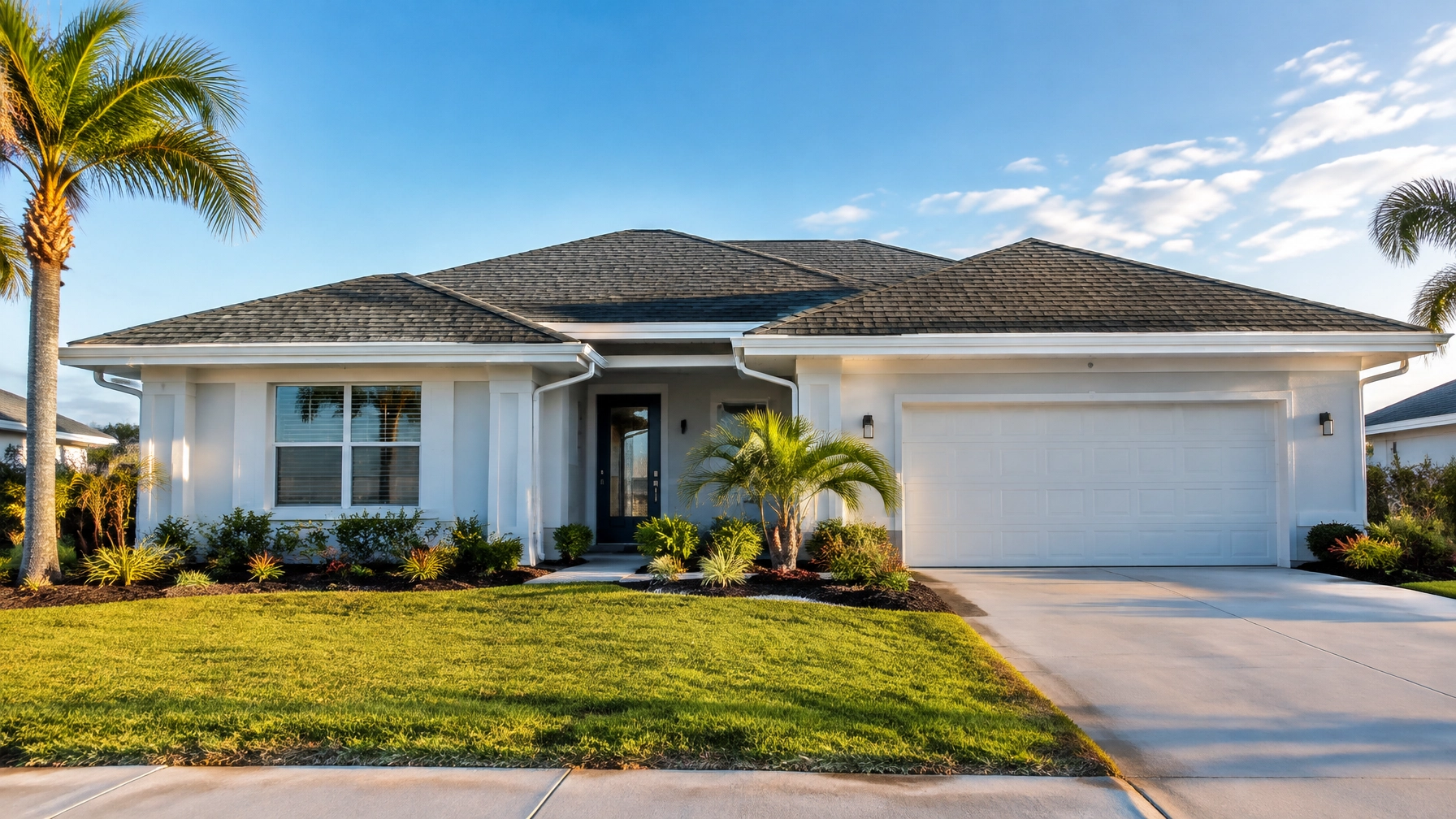
A full roof replacement in Daytona Beach typically costs $11,000–$19,000 for architectural shingles, $20,000–$38,000 for standing-seam metal, and approximately $16,000–$32,000 for synthetic or composite systems in 2026.
DIY labor can appear to save thousands. In practice, Daytona Beach homeowners must account for permits, high-wind code requirements, safety equipment, disposal, inspections, insurance documentation, and warranty conditions. For most full replacements, hiring a licensed professional is the lower-risk decision.
This guide compares the true cost of DIY versus professional installation for Volusia County homeowners.
Daytona Beach Roof Replacement Costs in 2026
The following ranges apply to a typical 1,500–3,000 square-foot roof, assuming ordinary access and no major structural reconstruction. One roofing square equals 100 square feet.
| Roofing system | Low | Middle | High | Best fit |
|---|---|---|---|---|
| Architectural shingles (Popular) | $11,000 | $14,500 | $19,000 | Most single-family homes |
| Standing-seam metal (Premium) | $20,000 | $28,000 | $38,000 | Long service life and coastal durability |
| Synthetic/composite (Premium) | $16,000 | $24,000 | $32,000 | Slate or shake appearance without natural stone weight |
| Roof coating or SPF (Restoration option) | $6,000 | $8,500 | $12,000 | Select low-slope roofs with sound decking |
Coatings and spray polyurethane foam are not automatically substitutes for a full replacement. They may be appropriate for certain low-slope systems, but they do not solve rotten decking, widespread storm damage, failed flashing, or an aging shingle roof.
For a broader starting point, use the roof cost calculator or request a property-specific estimate from Get My Roof Estimate Now.
What You Are Actually Paying For
A roof estimate includes more than shingles or metal panels.
For a typical Daytona Beach project, the total often breaks down approximately as follows:
- Materials (35%–50%): Roof covering, underlayment, ice-and-water protection where required, flashing, vents, fasteners, sealants, and accessories.
- Labor (30%–45%): Tear-off, installation, flashing, ventilation work, cleanup, supervision, and inspection coordination.
- Disposal and equipment (8%–15%): Dumpster, trailer, hauling, dump fees, protective ground coverings, and specialty tools.
- Permits and administration (2%–5%): Permit fees, documentation, recorded notices, and project management.
- Decking and repairs: Variable. Replacing damaged plywood or structural components can add hundreds or several thousand dollars.
The actual roof surface area, not the home’s interior square footage, is what determines material quantities. Pitch, valleys, dormers, roof penetrations, height, and accessibility also affect the price.
DIY Roof Replacement: Where the Savings Come From
DIY savings primarily come from eliminating professional labor. On a $14,500 architectural shingle project, that could represent several thousand dollars.
You may also save by:
- Buying materials directly.
- Performing your own tear-off.
- Scheduling your own dumpster.
- Completing basic cleanup.
- Managing subcontractors yourself.
However, a full roof replacement is not simply a weekend home-improvement project. In Daytona Beach, the roof must resist intense wind, rain, humidity, and salt-air exposure. A small installation error can become a leak or wind failure during the next storm.
The safety issue
Roofing involves fall hazards, heat exposure, sharp fasteners, unstable decking, ladders, and heavy materials. A fall from even a one-story roof can cause serious injury.
Professional crews bring:
- Fall-arrest systems and roof brackets.
- Trained workers.
- Material staging equipment.
- Proper nail guns and compressors.
- Established tear-off and cleanup procedures.
- Workers’ compensation and liability coverage.
If a friend, helper, or unlicensed worker is injured on your property, your homeowner’s insurance may not cover the claim.

Daytona Beach Permits and Owner-Builder Rules
A full roof replacement or significant repair requires a permit in Daytona Beach and throughout Volusia County. The applicable office depends on whether the property is inside Daytona Beach city limits or in unincorporated Volusia County.
The City of Daytona Beach Permits & Licensing department and the Volusia County residential permits office provide jurisdiction-specific requirements.
Expect to address:
- Roof deck nailing.
- Underlayment ratings and installation.
- Flashing details.
- Wind-rated roof coverings.
- Ventilation calculations.
- Manufacturer specifications.
- Required inspections and affidavits.
- A Notice of Commencement recorded with the Clerk of Courts.
Processing can take approximately two to four weeks, with permit and administrative fees often around $150–$400, depending on valuation and jurisdiction.
Unpermitted work can result in:
- Stop-work orders.
- Double permit fees.
- Daily fines.
- Required removal and reinspection.
- Problems with title searches and resale.
- Difficulty proving code compliance to an insurer or buyer.
Florida’s owner-builder exemption
Florida law allows some homeowners to act as their own contractor. The property generally must be owner-occupied, and the owner must personally supervise work that is not performed by licensed contractors.
The Florida owner-builder statute makes the responsibilities clear:
- You become the responsible party on the permit.
- You assume legal and financial responsibility for code compliance.
- You must personally appear or satisfy local signing requirements.
- You cannot hire unlicensed people to act as contractors or supervise the work.
- You generally cannot sell or rent the home within 12 months under the exemption.
Before choosing this route, confirm the current owner-builder disclosure with the permitting office. Pulling your own permit does not eliminate the technical requirements of the Florida Building Code.
Why Coastal Daytona Beach Is Different
Daytona Beach sits in a coastal, high-wind environment. Design wind speeds can exceed 130 mph, depending on the exact location and exposure.
A compliant replacement may require attention to:
- Wind-rated shingles, metal, or other coverings.
- Roof-to-wall connections.
- Roof deck attachment.
- Sealed roof deck or secondary water resistance.
- Corrosion-resistant fasteners and flashing.
- Proper perimeter and corner fastening.
- Attic ventilation and moisture control.
Florida’s humidity also contributes to mold, algae streaking, and wood deterioration. Salt air can accelerate corrosion around fasteners, metal flashing, vents, and exposed hardware.
Roofing standards matter even more after storms such as Hurricane Ian and Hurricane Nicole in 2022. Summer thunderstorms and hurricane season continue through November 30, so a roof that looks acceptable from the ground may still have vulnerable attachment or flashing details.
DIY vs. Professional: The True Cost Comparison
| Cost or risk | DIY approach | Licensed professional |
|---|---|---|
| Labor | Potential savings of several thousand dollars | Included in project price |
| Permit | Homeowner handles application, fees, affidavits, and inspections | Contractor normally coordinates the permit |
| Dumpster and disposal | Homeowner rents, loads, and pays disposal fees | Included or itemized in the contract |
| Decking damage | Unexpected cost paid directly by homeowner | Identified and documented during installation |
| Safety | Homeowner assumes fall and injury risk | Crew uses safety procedures and insurance |
| Code compliance | Owner is responsible for errors | Licensed contractor is responsible for contracted work |
| Material warranty | Incorrect installation may void coverage | Manufacturer requirements are followed |
| Insurance | Missing wind-mitigation documentation may affect coverage or discounts | Completion and inspection records are easier to document |
| Resale | Unpermitted work can create title and buyer concerns | Permit closeout supports resale documentation |
| Schedule | Weather, skill, and inspection delays can extend the project | Experienced crew usually completes work faster |
The biggest DIY mistake is comparing only labor savings with the contractor’s total price. The fair comparison is labor savings minus safety equipment, equipment rental, disposal, mistakes, delayed inspections, damaged materials, and future repair risk.
My Safe Florida Home Makes Documentation More Valuable
The My Safe Florida Home program is active in 2026 following more than $405 million in reappropriated funding. Eligible homeowners may receive matching grants of up to $10,000 for hurricane mitigation improvements, including roof-to-wall connections and secondary water resistance.
Current eligibility is limited, generally requiring:
- A homesteaded, owner-occupied single-family home or townhouse.
- A home value of $700,000 or less.
- Construction before January 1, 2008.
- Compliance with program income and inspection requirements.
The program is also prioritizing a backlog of approximately 45,000 homeowners who already completed inspections.
Professionally documented, permitted work can make it easier to prove that qualifying improvements were completed correctly. It can also help when requesting wind-mitigation insurance discounts. Always confirm current requirements directly through the My Safe Florida Home program.
Get a Real Budget Before Choosing DIY or Pro
Before buying materials or requesting contractor bids, get the roof measured. Get My Roof Estimate Now uses satellite-powered measurements to estimate roof size, pitch, and complexity.
The service is:
- Free.
- Available without a credit card.
- Delivered in under 60 seconds.
- Approximately 90%–95% accurate, with measurements accurate to within inches for many properties.
- Designed to show low, middle, and high price ranges for multiple materials.
This is a budgeting tool, not a substitute for an in-person inspection. A contractor still needs to verify decking, flashing, ventilation, storm damage, and other conditions that satellite imagery cannot see.

When DIY May Make Sense
DIY may be reasonable for limited work such as:
- Cleaning gutters.
- Photographing visible storm damage.
- Replacing a small number of accessible components under proper guidance.
- Handling landscaping and cleanup before a professional installation.
- Comparing material options and estimates.
A complete roof replacement is a different category. If the project involves multiple roof planes, steep slopes, rotten decking, storm damage, metal roofing, or complicated flashing, professional installation is usually the safer choice.
FAQ
Can I replace my Daytona Beach roof without a permit?
Generally, no. Full roof replacements and significant repairs require a permit. Contact the City of Daytona Beach or the applicable Volusia County office before starting.
Can I pull my own roof permit in Florida?
Some owner-occupied homeowners can use Florida’s owner-builder exemption. You assume responsibility for the work, must supervise directly, and cannot use unlicensed contractors or labor in prohibited roles.
How long does a Daytona Beach roof permit take?
Allow approximately two to four weeks for processing, although timing varies by jurisdiction, application quality, workload, and project complexity.
What is the cheapest full roof replacement material?
Architectural asphalt shingles are usually the most practical budget choice. For a typical Daytona Beach roof, plan on approximately $11,000–$19,000 in 2026.
Can a roof coating replace shingles?
Usually not. Coatings can extend the life of certain low-slope roofing systems, but they do not correct rotten decking, failed flashing, widespread shingle deterioration, or structural damage.
Can DIY roofing affect my insurance?
It can. Missing permits, incomplete inspections, or undocumented wind-mitigation features may affect claims, coverage decisions, or available insurance discounts. Ask your carrier what documentation it requires.
Bottom Line
DIY roof replacement can reduce the labor line item, but Daytona Beach’s wind, humidity, salt air, permitting rules, and storm exposure raise the consequences of mistakes.
For most Volusia County homeowners, the practical approach is:
- Get a free satellite-based estimate in under 60 seconds.
- Confirm the roof size and material options.
- Obtain at least two or three written bids.
- Verify licensing, insurance, permits, inspections, and warranty terms.
- Use a licensed professional for the installation unless you fully understand the owner-builder obligations and risks.
A fast, accurate budget gives you the information needed to decide: before you climb onto the roof or sign a contract.
Leave a Reply