Author: James Turner

  • 2026 Roof Replacement Cost in Lafayette, LA: Hub City Pricing, Louisiana Fortified Roof Grants & Permit Rules

    2026 Roof Replacement Cost in Lafayette, LA: Hub City Pricing, Louisiana Fortified Roof Grants & Permit Rules

    Replacing a roof in Lafayette typically costs $11,500–$24,200 for a 2,000-square-foot architectural shingle project in 2026. Metal roofing generally costs more: plan on $15,000–$40,000+, with premium standing-seam systems reaching up to $21 per square foot.

    Lafayette’s humid subtropical climate, frequent thunderstorms, hail, and hurricane-season wind make installation quality especially important. Homeowners should also account for Lafayette permit fees, Louisiana contractor licensing, and the possibility of a FORTIFIED Roof upgrade.

    This guide covers current pricing, local rules, incentives, and practical planning benchmarks for homeowners in the Hub City and surrounding Acadiana communities.

    2026 Lafayette Roof Replacement Cost at a Glance

    Roofing is priced by the square, equal to 100 square feet of roof surface. A home with 2,000 square feet of living space may have more than 2,000 square feet of actual roof area after accounting for pitch, overhangs, and complexity.

    Roofing option 2026 Lafayette material and installation range Typical project context
    Architectural shingles (Popular) $456–$960 per square $11,500–$24,200 for a typical 2,000 sq. ft. project
    Metal roofing (Premium) $600–$1,200 per square Approximately $15,000–$40,000+
    Standing-seam metal (Premium) Up to $21 per sq. ft. Higher-end systems with custom details and complex layouts
    FORTIFIED Roof upgrade Often adds $2,000–$10,000 Enhanced fastening, sealed roof deck, and storm-resistance details

    For a straightforward architectural shingle replacement, many Lafayette homeowners should use $11,500–$16,000 as an initial planning range. A steep, complex, storm-damaged, or structurally compromised roof can move toward $18,000–$24,200 or more.

    For a faster property-specific number, use the free roof cost calculator, or request a free satellite-based estimate. The satellite tool measures your roof remotely and returns pricing in about 60 seconds.

    Architectural Shingles vs. Metal Roofing

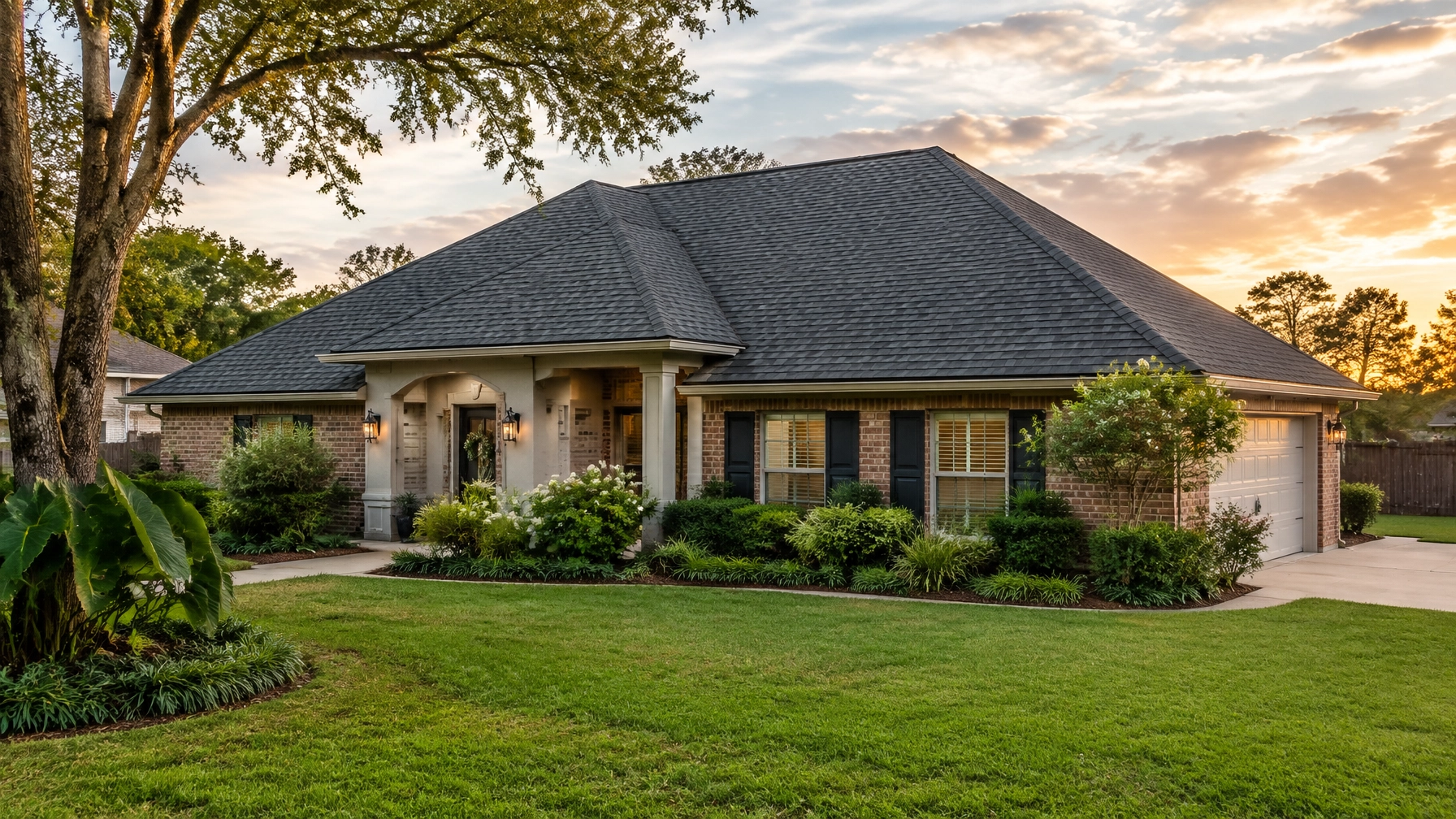
    Fresh architectural shingle roof on a Louisiana colonial-style home

    Architectural shingles (Popular)

    Architectural shingles remain the most common choice for Lafayette homes because they offer a practical balance of price, appearance, and service life.

    They are a strong fit for:

    • Ranch homes and traditional Louisiana residences
    • Homeowners replacing an aging 15- to 30-year-old roof
    • Buyers preparing a home for sale
    • Property owners who want a conventional appearance without metal’s higher upfront cost

    The $456–$960 per square range reflects differences in shingle quality, roof design, labor, tear-off requirements, ventilation, flashing, and local contractor availability.

    Metal roofing (Premium)

    Metal roofing can provide long service life and a clean appearance, but the initial investment is higher. Standing-seam panels require precise measurements, specialized installation, and careful detailing around chimneys, walls, vents, and valleys.

    Metal may make sense when you value:

    • Long-term durability
    • A modern or updated architectural style
    • Lower maintenance
    • A roof system that can remain in place for decades
    • Strong wind-performance specifications

    New standing-seam metal roof on a modern Louisiana home

    Always compare complete systems rather than panel prices alone. Underlayment, trim, fasteners, ventilation, flashing, tear-off, and deck repairs can materially affect the final estimate.

    What Drives the Final Lafayette Roof Price?

    Two homes with the same floor plan can receive very different roofing estimates. The main cost variables are:

    1. Roof size

    Roofers measure the actual roof surface, not simply the home’s interior square footage. A 2,000-square-foot home may require more than 20 roofing squares if it has wide eaves or multiple roof sections.

    2. Pitch and accessibility

    Steeper roofs require additional safety equipment, labor, and installation time. Limited driveway access, landscaping, fences, and nearby structures can also increase labor costs.

    3. Roof complexity

    Dormers, valleys, skylights, chimneys, multiple ridgelines, and roof-to-wall transitions create more cuts and flashing work. Complex roofs typically fall toward the upper end of the local range.

    4. Tear-off and disposal

    Removing an old roof adds labor, disposal, and sometimes deck exposure. A second layer of shingles, saturated underlayment, or hidden damage can increase the project total.

    5. Deck and ventilation repairs

    Rotten or weakened decking should be replaced before new roofing is installed. Ridge vents, soffit ventilation, flashing, and drip-edge details also affect performance in Lafayette’s hot, humid climate.

    6. Storm-related damage

    Lafayette homeowners have experienced the effects of Gulf storms, including the broader regional impacts of Hurricanes Rita, Laura, and Delta. Hail and wind damage may also be covered by insurance, depending on the policy and the cause of loss. Document damage, contact your insurer promptly, and avoid signing an assignment of benefits without understanding the contract.

    For related help, review the company’s storm and hail damage services.

    Louisiana Fortify Homes Program and the $10,000 Tax Credit

    Louisiana offers two separate paths that may help homeowners pursue a stronger FORTIFIED Roof.

    Louisiana Fortify Homes Program

    The Louisiana Fortify Homes Program offered a lottery grant of up to $10,000 for eligible homeowners upgrading to a FORTIFIED Roof.

    The 2026 lottery round:

    • Opened June 1, 2026
    • Closed June 19, 2026
    • Offered up to $10,000 per selected homeowner
    • Is now closed as of September 2026

    Future rounds may be announced. Monitor the Louisiana Department of Insurance Fortify Homes page for official updates, eligibility rules, deadlines, and application instructions.

    $10,000 FORTIFIED Roof tax credit

    Louisiana also provides a separate FORTIFIED Roof tax credit of up to $10,000, subject to state requirements, application procedures, funding limits, and eligible installation dates.

    The grant and tax credit cannot be combined for the same roof project. Homeowners must evaluate which benefit applies before signing a contract or beginning work. Confirm current details with the Louisiana Department of Insurance and Louisiana Department of Revenue.

    A FORTIFIED upgrade can include:

    • Enhanced roof-deck attachment
    • A sealed roof deck
    • High-wind shingle fastening
    • Improved edge and flashing details
    • Documentation and verification by a qualified evaluator

    Storm-resilient roofing details on a Louisiana home

    Lafayette Roof Permit Rules

    Full re-roofing generally requires a building permit through the Lafayette Consolidated Government Permitting and Codes Division.

    Homeowners or contractors can apply:

    • Online through the MGO Connect portal
    • In person at 220 West Willow Street, Building B, Lafayette, LA 70501

    Typical Lafayette residential permit charges include:

    • Approximately $3.50 per $1,000 of fair market value
    • $35 minimum permit fee
    • $50 residential plan review fee
    • A double-fee penalty if work begins without the required permit

    Permit requirements can change based on project scope, property location, and code updates. Confirm the current requirements with Lafayette Consolidated Government before work begins.

    Your roofing contract should clearly identify who is responsible for:

    • Pulling the permit
    • Paying permit and review fees
    • Scheduling inspections
    • Providing wind and attachment details
    • Closing the permit after final inspection

    Louisiana Roofing Contractor Licensing

    For residential roofing projects valued at $7,500 or more, Louisiana requires the contractor to hold the appropriate LSLBC Residential Roofing or Residential Construction classification.

    Because most full roof replacements in Lafayette exceed $7,500, homeowners should verify the contractor before signing.

    Use the Louisiana State Licensing Board for Contractors to check:

    • Current license status
    • Residential Roofing classification
    • Residential Construction classification
    • Complaints or disciplinary information
    • Whether the license matches the contracting business

    Also request proof of general liability insurance and workers’ compensation coverage where applicable. The LSLBC license information page explains the state’s basic license categories.

    Lafayette Wind Requirements and FORTIFIED Roof Details

    Lafayette is inland from the Gulf but remains exposed to hurricane-season wind, heavy rain, and thunderstorms moving through Acadiana. A quality roof installation must follow Louisiana’s adopted building code and the manufacturer’s high-wind instructions.

    Ask your contractor to explain:

    • The shingle wind rating
    • The required nail pattern
    • Roof-deck attachment
    • Underlayment type
    • Flashing and drip-edge installation
    • Wind-uplift documentation

    A FORTIFIED Roof commonly includes:

    • Six nails per shingle where required by the high-wind installation method
    • High-wind-rated shingles
    • Peel-and-stick or another approved sealed roof-deck system
    • Enhanced roof-deck fastening
    • Improved protection at eaves, rakes, valleys, and roof-to-wall transitions
    • Corrosion-resistant fasteners where required

    The FORTIFIED technical documents provide current standards, checklists, and installation resources. Projects permitted on or after November 1, 2025 may need to follow the 2025 FORTIFIED Home Standard, so confirm which standard applies to your project.

    The Bottom Line for Lafayette Homeowners

    For 2026 budgeting:

    • Architectural shingles: Plan on $11,500–$24,200 for a typical 2,000-square-foot project.
    • Metal roofing: Plan on $15,000–$40,000+.
    • Standing-seam metal: Can reach $21 per square foot.
    • FORTIFIED upgrade: May add $2,000–$10,000 before incentives.
    • Permit: Budget for the local formula, $35 minimum, and $50 plan review fee.
    • Contractor: Verify the required LSLBC classification for projects of $7,500 or more.

    Before requesting contractor appointments, get a property-specific baseline. Get a free instant satellite-based roof estimate with no credit card required. You’ll receive an estimate based on your roof’s measured size, pitch, complexity, material choice, and Lafayette-area pricing: so you can plan with clearer numbers before scheduling onsite visits.
  • Daily Weather Blitz – Slot 4: Charlotte, NC Weather & Roof Durability Report (Sept 14, 2026)

    Daily Weather Blitz – Slot 4: Charlotte, NC Weather & Roof Durability Report (Sept 14, 2026)

    Charlotte’s Monday forecast is a reminder that roof damage does not require a major storm. Prolonged Piedmont heat, strong ultraviolet exposure, humidity, and repeated temperature swings can shorten the useful life of roofing materials over time.

    Today, Charlotte is mainly clear with a current temperature of 83°F, but it feels closer to 90°F. Humidity is 65%, the high is expected to reach 92°F, and the low should fall to approximately 69°F. Light northwest winds are near 3 mph, and a Heat Advisory is in effect.

    A dry backdoor cold front arrives Monday night. The front should bring lower humidity and milder temperatures in the mid-80s Tuesday and Wednesday before temperatures return to the low 90s Thursday and Friday. Isolated afternoon thunderstorms remain possible.

    For homeowners, the message is straightforward: use this weather shift to check your roof, attic, vehicles, and cooling system before the next round of heat and storms.

    Charlotte Weather Snapshot: Monday, September 14

    Condition Charlotte forecast
    Current temperature 83°F
    Feels like 90°F
    Humidity 65%
    High temperature Near 92°F
    Low temperature Near 69°F
    Wind Northwest at approximately 3 mph
    Sky Mainly clear
    Alert Heat Advisory
    Near-term pattern Drier and milder Tuesday and Wednesday; low 90s return Thursday and Friday

    You can compare local roofing conditions with the National Weather Service Charlotte point forecast.

    Why Today’s Heat Matters for Charlotte Roofs

    Charlotte’s Piedmont climate creates several overlapping roofing stresses:

    • High summer UV exposure breaks down shingle oils and accelerates fading.
    • Heat buildup raises roof and attic temperatures far above the outdoor air temperature.
    • Humidity supports algae, mold, and moisture-related wood deterioration.
    • Severe thunderstorms can bring wind, hail, heavy rain, and falling branches.
    • Daily expansion and contraction gradually stresses sealants, flashing, fasteners, and shingles.

    A dark roof surface can become dramatically hotter than the surrounding air. That heat transfers into the attic when ventilation and insulation are inadequate. The result can be higher air-conditioning demand, uncomfortable upper floors, and faster aging of the roof system.

    Today’s primary threat is not necessarily immediate roof failure. It is cumulative wear. A roof that has already lost granules, developed brittle edges, or suffered hidden hail damage has less reserve when the next thunderstorm arrives.

    The Backdoor Cold Front: A Short Maintenance Window

    The dry backdoor cold front arriving Monday night should lower humidity and bring milder mid-80s temperatures Tuesday and Wednesday. That creates a better window for several maintenance tasks:

    • Inspect the attic during cooler morning hours.
    • Check gutters and downspouts for blockages.
    • Look for loose flashing around chimneys, vents, and skylights.
    • Trim branches that touch or overhang the roof.
    • Schedule a professional inspection if the roof is more than 15 years old.
    • Photograph current roof conditions before the next severe storm.

    Temperatures are expected to rise back into the low 90s Thursday and Friday. Isolated afternoon thunderstorms are also possible, so do not assume a quiet weather period means storm risk has ended.

    Roof Materials That Fit Charlotte’s Climate

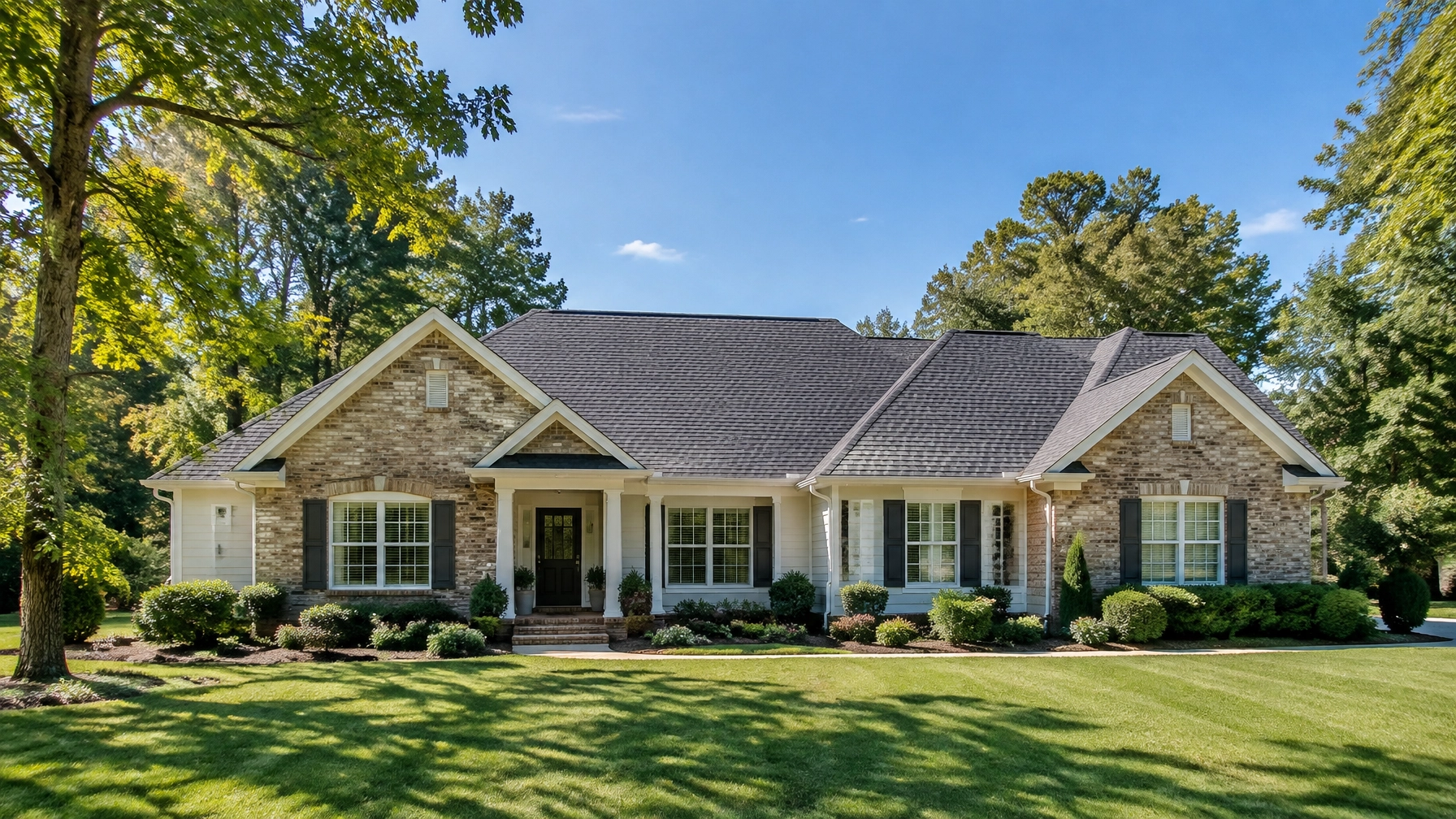
    New architectural impact-resistant shingle roof on a Colonial-style Charlotte home

    Material selection should account for heat, humidity, hail, appearance, budget, and how long you plan to own the home.

    Architectural shingles (Popular)

    Architectural shingles are the most practical choice for many Charlotte homeowners. They provide a stronger appearance than basic three-tab shingles and are available in many colors and profiles.

    For better storm resilience, consider Class 4 impact-resistant shingles. They are designed to better withstand hail impacts than standard products. They may cost more upfront, but the added protection can be useful in a region that experiences frequent spring and summer thunderstorms.

    Architectural shingles typically last approximately 25–30 years when properly installed and maintained. Charlotte pricing for a typical replacement commonly falls between $6,000 and $22,000, with many standard architectural shingle projects near $9,000, depending on roof size, pitch, complexity, tear-off, and decking condition. See the local Charlotte roof replacement cost guide for regional benchmarks.

    Standing seam metal (Premium, long-term)

    Standing seam metal roofing is a strong fit for homeowners who plan to remain in the property for decades. It can last approximately 40–70 years, reflects more solar heat than many dark asphalt roofs, and requires relatively little maintenance.

    Metal roofing costs more initially. However, its long service life, energy performance, and clean appearance can make it attractive for long-term ownership. It is especially well suited to modern homes, updated ranches, and properties where the homeowner prioritizes durability over the lowest initial price.

    Review current material ranges in the roofing materials comparison guide.

    Synthetic underlayment (Recommended)

    Synthetic underlayment offers a more durable moisture barrier than traditional felt in many roof systems. It helps protect the roof deck during installation and provides a secondary defense beneath the shingles or metal panels.

    Underlayment cannot compensate for poor flashing or improper installation, but it is an important part of a complete Charlotte roof system.

    Attic Ventilation Is a Durability Issue

    Clean residential attic with ridge and soffit ventilation protecting the roof deck

    Proper ventilation should be part of any roof replacement discussion, not an afterthought.

    A balanced system typically uses:

    • Soffit vents for intake air.
    • A ridge vent or properly designed exhaust vents for warm, moist air to exit.
    • Adequate insulation to reduce heat transfer.
    • Air sealing to limit household moisture entering the attic.

    Blocked soffits, crushed insulation, or improperly installed exhaust vents can trap heat and moisture. Over time, that may contribute to:

    • Roof deck rot.
    • Mold growth.
    • Rusted fasteners.
    • Premature shingle aging.
    • Higher summer energy costs.
    • Excessive strain on the air conditioner.

    Ask a roofing contractor to inspect the underside of the roof deck for dark staining, soft wood, condensation, or mold-like growth. If problems are found, correct the ventilation and moisture source before installing new roofing materials.

    Protect Your Home, Vehicle, and Daily Routine

    Reduce heat and AC strain

    During the Heat Advisory:

    • Close blinds or curtains on sun-facing windows.
    • Set ceiling fans to rotate counterclockwise.
    • Replace or clean HVAC filters.
    • Avoid major attic work during afternoon heat.
    • Use a programmable thermostat rather than repeatedly lowering the temperature.
    • Check that attic insulation has not shifted away from the eaves.

    A reflective metal roof or lighter-colored shingle can reduce solar heat absorption, but ventilation and insulation remain essential.

    Protect vehicles from UV and heat

    Roof maintenance is not the only priority during a Charlotte heat wave. UV and heat can damage vehicles as well.

    • Park in a garage or shaded area when possible.
    • Use a windshield sunshade.
    • Check tire pressure when tires are cool.
    • Inspect wiper blades and exterior trim for cracking.
    • Keep water in the vehicle, but never leave children or pets inside a parked car.
    • Watch for falling branches during thunderstorms.

    Prepare for afternoon storms

    Before isolated thunderstorms develop:

    • Secure patio furniture, umbrellas, and lightweight decorations.
    • Clear leaves from roof valleys and gutters.
    • Keep ladders off the roof unless you are trained and equipped.
    • Photograph existing roof conditions from the ground.
    • Know where your home’s water shutoff and electrical panels are located.

    After a storm, look for missing shingles, damaged gutters, dents in vents or flashing, fallen branches, and ceiling stains. Do not climb onto a wet or damaged roof. Contact a licensed and insured roofing professional instead.

    Roof Replacement ROI and Charlotte Home Value

    A roof replacement is a major investment, but it also affects how buyers evaluate a home.

    New roof ROI and resale planning

    A new roof can improve:

    • Buyer confidence during inspections.
    • Insurance conversations.
    • Curb appeal.
    • Energy performance.
    • The perceived condition of the entire property.

    The best roof for home value is not always the most expensive material. It is usually the option that fits the neighborhood, climate, home design, and expected ownership period.

    For many Charlotte properties, high-quality architectural shingles offer a strong balance of appearance, cost, and service life. Standing seam metal can make more financial sense for long-term homeowners who value durability and lower maintenance.

    Roof replacement resale value also depends on installation quality. A well-installed roof with clean flashing, adequate ventilation, documented materials, and transferable warranties is more persuasive to buyers than a low-cost replacement with limited documentation.

    In practical terms, roof curb appeal home value comes from a roof that looks clean, consistent, and properly maintained. The Get My Roof Estimate Now roofing materials guide notes that high-quality architectural shingles may add approximately 1%–3% to home value, while metal roofing may add roughly 1%–6%, depending on the property and local market. These are general benchmarks, not guarantees.

    Charlotte Roof Resilience Checklist

    Use the next few days to complete this short checklist:

    • Check for missing, curled, cracked, or blistered shingles.
    • Look for granules accumulating in gutters.
    • Inspect flashing around roof penetrations.
    • Confirm soffit vents are open and not blocked by insulation.
    • Check attic wood for moisture, staining, or rot.
    • Trim branches near the roof.
    • Clean gutters and verify downspouts discharge away from the foundation.
    • Schedule spring and fall roof inspections.
    • Arrange an after-storm inspection after significant wind or hail.
    • Compare replacement costs before an emergency forces a rushed decision.

    If your roof is aging or you are planning ahead, use the Charlotte satellite roof estimate tool. Enter your address to receive a free, satellite-based estimate in about 60 seconds, with no credit card and no contractor visit required upfront.

    In Charlotte’s heat-and-storm cycle, preparation is more affordable than avoidable emergency damage. Assess the roof while conditions are calm, improve attic airflow, and choose materials designed for the Piedmont climate.

  • How Satellite Tech Is Changing Roof Replacements in Houston, TX

    How Satellite Tech Is Changing Roof Replacements in Houston, TX

    Houston has always looked toward the sky. Now, satellite technology is helping homeowners make faster, more informed decisions much closer to home: starting with the roof over their heads.

    In Houston, a typical roof replacement costs approximately $8,500–$22,000, with many homeowners paying around $14,000 for architectural shingles on an average 2,000-square-foot roof. Architectural shingles commonly run about $5–$9 per square foot, while metal roofing may cost approximately $7–$17 per square foot, depending on the product and installation requirements.

    Instead of waiting days for multiple contractor visits just to get a starting number, homeowners can now enter an address and receive a satellite-powered estimate in under 60 seconds.

    That changes the replacement process from guesswork to planning.

    Houston’s Space Economy Is Powering Everyday Services

    Houston’s connection to space is well established through NASA’s Johnson Space Center and Space Center Houston. But in September 2026, the region’s satellite and space technology ecosystem is expanding beyond traditional government programs.

    Recent developments include:

    • Venus Aerospace opening a new rocket engine test stand at Houston Spaceport
    • Rice University launching the Center for Space Technologies, or CSTx
    • Cognitive Space developing AI for satellite scheduling
    • Little Place Labs processing satellite data with in-orbit analytics
    • Intuitive Machines expanding lunar and satellite network capabilities
    • Amazon filing for a Project Kuiper gateway ground station in Gaines County
    • The Space Force selecting Lake Kickapoo, Texas, for a future DARC space radar node
    • AST SpaceMobile adding three BlueBird satellites to support direct-to-phone 4G and 5G service

    This ecosystem matters because satellite technology is no longer limited to astronauts, launch vehicles, or telecommunications. It is now being used for practical services such as property measurement, storm assessment, insurance claims, and home improvement planning.

    What Satellite Imagery Can Tell You About a Roof

    A satellite-based roof estimate uses high-resolution imagery and property data to measure the roof from above. The system can evaluate key factors that influence replacement cost, including:

    • Roof length and width
    • Total roof area
    • Roof sections and planes
    • Pitch and slope
    • Valleys, hips, ridges, and other roof features
    • Approximate material requirements
    • Regional labor and material pricing

    Roofing companies typically measure roofs in squares. One roofing square equals 100 square feet of roof surface. A satellite measurement helps convert a property’s actual roof shape into a practical project estimate instead of relying on the home’s interior square footage.

    For homeowners, the benefit is speed. You do not need to schedule an appointment, wait for a contractor to drive across Houston, or take time off work before knowing whether a replacement is likely to fit your budget.

    Houston-area colonial home with a new dimensional architectural shingle roof

    From Address to Estimate in 60 Seconds

    Get My Roof Estimate Now uses satellite imagery to provide a property-specific roof replacement estimate.

    The process is simple:

    1. Enter your Houston property address.
    2. Let the system measure your roof using satellite imagery.
    3. Choose or compare roofing material options.
    4. Review a low, middle, and high price range.
    5. Connect with verified, licensed, and insured local contractors when you are ready.

    The measurements are designed to be accurate to within inches, with an estimated 90%–95% accuracy for roof sizing and characteristics. The result is a useful planning estimate: not a substitute for a final inspection.

    That distinction is important. Satellite imagery can measure the exterior roof profile, but it cannot confirm every condition below the surface. A contractor still needs to inspect decking, flashing, ventilation, skylights, chimney areas, and hidden moisture damage before installation.

    Houston Roof Replacement Cost Benchmarks

    The following ranges provide a practical starting point for Houston homeowners:

    Roofing option Typical price range Position
    Basic asphalt shingles Approximately $8,500–$12,000 Budget
    Architectural shingles Approximately $10,000–$16,000 Popular
    Premium or designer shingles Approximately $14,000–$22,000+ Premium
    Metal roofing Approximately $14,000–$28,000+ Long-term premium

    Actual pricing depends on roof size, pitch, complexity, tear-off requirements, access, permits, labor availability, and hidden structural repairs.

    You can also compare general material and roof-size scenarios with the roof cost calculator. For a property-specific Houston range, use the Houston roof estimate page.

    The Satellite Advantage After Houston Storms

    Houston roofs face a demanding combination of heat, humidity, heavy rain, hail, tropical storms, and hurricane-related wind. After a major event, homeowners and insurers need to know which properties may have serious damage.

    Satellite damage assessment helps speed up that process.

    Insurance and disaster-response teams can combine:

    • High-resolution optical imagery
    • Synthetic aperture radar, or SAR
    • Pre-storm and post-storm images
    • AI-based change detection
    • Roof-level damage classification

    Optical imagery can reveal missing shingles, exposed roof decking, debris, or blue tarps when cloud cover clears. SAR can collect data during cloudy conditions and at night, helping identify changes when standard photography is unavailable.

    Research on satellite-based building damage assessment shows that high-resolution optical and SAR imagery can support rapid regional damage screening. However, small punctures and minor leaks may still require an in-person inspection. Satellite data is best viewed as a fast triage and planning tool, not a complete substitute for field verification.

    Modern Houston home with a matte dark bronze standing-seam metal roof

    Does a New Roof Increase Home Value?

    A new roof can improve both buyer confidence and visual appeal. The financial return depends on the roof’s condition, the neighborhood, the material selected, and the timing of the sale.

    Industry estimates commonly place average roof replacement recovery around 60%–70% of the project cost. Local results can be higher when the existing roof is visibly worn, leaking, or near the end of its useful life.

    The strongest new roof ROI for home value usually comes from solving a clear buyer concern. A buyer may accept an older kitchen, but an aging roof can raise immediate questions about leaks, insurance, inspections, and unexpected repair costs.

    A new roof may help by providing:

    • Better first impressions in listing photos
    • Stronger curb appeal
    • Fewer inspection objections
    • Lower near-term maintenance concerns
    • Better protection against Houston weather
    • A clearer justification for the asking price

    The roof replacement resale value is not simply the installation price added to the home. Buyers also value reduced risk. A recently replaced roof can make a home feel more move-in ready and easier to budget for.

    The Best Roof for Home Value in Houston

    There is no single best roof for every Houston property. The right choice should match the home’s architecture, neighborhood expectations, climate exposure, and resale market.

    Architectural shingles (Popular)

    Architectural shingles are usually the strongest all-around option for Houston homeowners seeking a balance of cost, appearance, and resale appeal.

    They offer:

    • Broad buyer acceptance
    • Many color and texture choices
    • Lower upfront cost than metal
    • Improved appearance over basic three-tab shingles
    • Compatibility with most ranch, colonial, and suburban homes

    For many homeowners, architectural shingles provide the best combination of roof curb appeal and home value without over-improving the property.

    Standing-seam metal (Premium)

    Standing-seam metal roofing has a higher upfront cost but can deliver a distinct appearance and long service life. It may be especially appropriate for modern homes, custom properties, and homes where buyers value durability and energy performance.

    Potential benefits include:

    • Long expected service life
    • Strong wind and weather performance
    • Reflective surfaces that may reduce heat gain
    • Low-maintenance roof lines
    • Premium architectural appearance

    However, a premium material does not automatically create a better roof replacement ROI. If a metal roof is out of character for the neighborhood, the added cost may not be fully recovered at resale.

    Use Technology Before You Call Contractors

    Getting a fast estimate does not mean skipping professional advice. It means starting with better information.

    Before requesting contractor proposals, use a satellite estimate to understand:

    • Your approximate roof size
    • The effect of pitch and complexity
    • The price difference between shingles and metal
    • Whether a replacement fits your budget
    • How much project cost may be affected by tear-off
    • Which questions to ask during an inspection

    Then request written proposals from qualified contractors. Verify licensing, insurance, warranties, material specifications, permits, and the process for handling hidden damage.

    The roofing services team can also help homeowners compare replacement, inspection, repair, and storm-damage options.

    Houston residential roofing project with a new light-gray architectural shingle roof after a storm

    A Faster Way to Plan Your Houston Roof Replacement

    Satellite technology is changing roof replacements by moving the first step online. Homeowners no longer have to begin with a week of appointments just to understand the likely cost.

    In Houston, that means faster planning before hurricane season, quicker storm-damage screening, and better comparisons between architectural shingles and metal roofing. It also gives sellers a clearer way to evaluate whether a new roof may improve curb appeal, buyer confidence, and resale readiness.

    For a free, no-credit-card estimate, enter your address with Get My Roof Estimate Now. In about 60 seconds, you can see a property-specific price range and decide what to do next.

  • Daily Weather Blitz – Slot 2: Mobile, AL : September 13, 2026: A Hot Humid Sunday With Scattered Afternoon Storms, a Rainy Start to Next Week & What the Port City’s 67-Inch Rain Year, Hail History, and 160 mph Wind Code Do to Your Roof’s Durability

    Daily Weather Blitz – Slot 2: Mobile, AL : September 13, 2026: A Hot Humid Sunday With Scattered Afternoon Storms, a Rainy Start to Next Week & What the Port City’s 67-Inch Rain Year, Hail History, and 160 mph Wind Code Do to Your Roof’s Durability

    Storm-Ready Roofing & Weather Trends | Mobile, Alabama | Sunday, September 13, 2026

    Mobile homeowners should expect another classic late-summer Gulf Coast pattern today: heat, high humidity, sunshine early, and scattered thunderstorms developing through the afternoon and evening.

    The bigger roofing issue is not one storm. It is repeated exposure. Mobile receives roughly 67–69 inches of rain each year, has no true dry season, experiences periodic hail, and remains vulnerable to tropical weather throughout September. A roof that looks acceptable from the driveway can still have weakened flashing, lifted shingles, damaged underlayment, or blocked drainage.

    Here is what today’s weather and Mobile’s local building standards mean for roof durability.

    Mobile Weather Today: Hot, Humid, and Storm-Ready

    The National Weather Service Mobile/Pensacola forecast calls for:

    • High temperature: Approximately 90–93°F
    • Overnight low: Near 74–77°F
    • Morning: A mix of clouds and sunshine
    • Afternoon and evening: Scattered showers and thunderstorms
    • Storm coverage: Hit-or-miss, not an all-day washout
    • Primary threats: Torrential rainfall, frequent lightning, and gusty winds

    Storms may repeatedly move over the same neighborhoods. When that happens, localized street and yard flooding can develop quickly, especially where gutters, downspouts, drainage swales, or storm drains are already blocked.

    Coastal and beach communities should also watch for storms moving inland from the Gulf. Waterspouts are possible near the coast. Do not inspect a roof while lightning is nearby, and never climb onto a wet roof.

    The unsettled pattern continues into early next week, with daily storm chances before heat gradually builds again around midweek. Summer is not letting go yet.

    Tropical Update: Quiet Does Not Mean Risk-Free

    The National Hurricane Center reports that tropical cyclone formation is not expected across the Atlantic, Caribbean, or Gulf during the next several days. That is favorable news for Mobile homeowners.

    The current area of interest is a trough in the central Subtropical Atlantic with a low, approximately 20% chance of development over seven days. It is not a Gulf threat at this time.

    Still, September remains the heart of Gulf Coast hurricane season. The climatological peak occurs around September 10, so homeowners should treat every calm stretch as preparation time: not as proof that the season is over. Regional weather coverage from WALA Fox10 and News4JAX weather can supplement official NWS and NHC alerts.

    Why Mobile’s Rainfall Matters to Your Roof

    Mobile averages approximately 67–69 inches of rain per year, placing it among the wettest cities in the United States. The City of Mobile’s climate information reflects the area’s consistently wet, humid conditions.

    For a roof, that means:

    • Flashings are tested by frequent heavy downpours.
    • Small sealant failures can become recurring leaks.
    • Moss, algae, and organic debris can retain moisture.
    • Gutters and valleys have fewer opportunities to dry out.
    • Wind-driven rain can enter beneath damaged shingles.
    • Attic humidity can worsen wood deterioration and insulation problems.

    The most vulnerable locations are usually not the middle of an open shingle field. They are the transitions and penetrations:

    • Valleys
    • Chimneys
    • Plumbing vents
    • Skylights
    • Wall intersections
    • Dormers
    • Ridge vents
    • Areas around improperly sealed flashing

    After a storm, look for interior stains on ceilings and upper walls. A stain may not appear directly below the roof defect because water can travel along decking, rafters, insulation, and drywall before becoming visible.

    Storm clouds building over a Mobile-area suburban neighborhood

    Mobile’s Hail History Deserves Attention

    Mobile County has recorded 168 hail events since 1996, while Alabama has experienced hailstones as large as 5.38 inches. Golf-ball-size hail is particularly damaging because it can bruise shingles even when the roof still appears intact.

    After today’s storms, complete a ground-level inspection for:

    • Missing, displaced, or cracked shingles
    • Circular bruises or soft spots on asphalt shingles
    • Exposed underlayment
    • Granules collecting in gutters or at downspout outlets
    • Damaged ridge caps
    • Dented vents, gutters, flashing, or metal components
    • New leaks or ceiling stains

    Do not assume that no missing shingles means no damage. Hail bruising can reduce the protective life of a shingle without creating an immediate opening.

    For future replacement projects, consider Class 4 impact-rated shingles (Premium) or metal roofing. These materials are not hail-proof, but they can provide better resistance than standard products. Always confirm product ratings, warranty terms, and installation requirements with a qualified roofing professional.

    Hurricane Frederic Shows Why Wind Installation Matters

    On September 12, 1979, Hurricane Frederic struck Alabama. The storm remains the strongest hurricane on record to make landfall in the state, with approximately 130 mph sustained winds and a 145 mph gust recorded near the Dauphin Island Bridge, according to the National Weather Service Mobile Frederic summary.

    Hurricane Ivan delivered another major test in 2004 when it made landfall nearby as a Category 3 hurricane.

    These events illustrate an important point: roof performance depends on the entire roof system. High-wind materials cannot compensate for poor fastening, weak edge detailing, or unsealed ridge caps.

    A storm-ready installation should include:

    • A six-nail shingle pattern where required by the manufacturer and wind design
    • Properly sealed and mechanically secured ridge caps
    • Ring-shank nails when specified for the assembly
    • Correct fastening around roof edges and corners
    • Hurricane straps or clips connecting the roof structure to the walls
    • Properly anchored vents and flashing
    • No shortcuts around valleys, eaves, or rake edges

    High-wind roof installation with synthetic underlayment and shingle detailing

    What Mobile County’s 160 mph Wind Code Means

    Mobile County’s 2024 code adoption, effective July 1, 2026, uses ASCE 7-22 and sets a minimum 160 mph ultimate design wind speed for typical residential Risk Category II structures in the county’s jurisdiction. Review the Mobile County building code document for the complete requirements.

    The local roofing provisions include:

    • ASTM D7158 Class H asphalt shingles
    • Reinforced synthetic roof underlayment
    • Minimum underlayment tear-strength requirements
    • High-wind-tested ridge and off-ridge vents
    • TAS 100(A) testing for applicable roof ventilation
    • Proper anchoring according to manufacturer instructions

    Synthetic underlayment is especially important in Mobile. Compared with older felt paper, reinforced synthetic products generally provide better tear resistance and more reliable temporary protection if shingles are removed or damaged during installation.

    The code applies based on the governing jurisdiction. City of Mobile properties and other municipalities may have separate local requirements, so verify the applicable permitting office before replacement.

    A Practical Storm-Season Roof Checklist

    Before the next heavy-rain event:

    1. Clear gutters and downspouts. Confirm water flows away from the foundation.
    2. Check for standing water. Persistent pooling near the roof edge or foundation indicates drainage problems.
    3. Trim overhanging limbs. Large branches can puncture roofing during gusts.
    4. Look for loose roof components. Pay attention to ridge caps, flashing, vents, and satellite mounts.
    5. Inspect the attic safely. Look for damp insulation, daylight, water marks, or musty odors.
    6. Document damage after storms. Take photos from the ground and keep a dated record.
    7. Avoid temporary shortcuts. Do not apply roofing cement broadly or walk on damaged areas.
    8. Arrange a professional inspection if you see bruising, missing materials, active leaks, or repeated ceiling stains.

    If a storm causes active water intrusion, use a qualified emergency contractor for temporary protection and contact your insurance carrier promptly. Do not make permanent repairs before documenting the damage and understanding your policy requirements.

    What Does a Mobile Roof Replacement Cost?

    A typical Mobile-area roof replacement may run approximately $8,000–$25,000, depending on roof size, pitch, complexity, labor, tear-off requirements, and material.

    Common choices include:

    • Architectural shingles (Popular): Balanced cost, appearance, and performance
    • Metal roofing (Premium): Long service life and strong resistance to wind and rain
    • Synthetic roofing (Premium): Lightweight, durable, and available in multiple styles
    • Roof coatings (Specialized): Useful for certain low-slope systems, not every roof

    Roofing is measured in squares, with one square equal to 100 square feet. Valleys, dormers, steep slopes, multiple penetrations, and structural repairs can increase the final price.

    Homeowners can use the roof cost calculator for a general planning range. For a property-specific starting point, Get My Roof Estimate Now uses satellite imagery to measure roof size, pitch, and complexity, then produces a free estimate in under 60 seconds: with no credit card and no contractor visit required upfront.

    That instant estimate can help you plan storm-season repairs, compare materials, and decide whether a repair or full replacement makes financial sense before scheduling contractors.

    Bottom line: Mobile’s heat, rainfall, hail history, and hurricane exposure make roof maintenance a year-round responsibility. Check your roof after today’s storms, keep drainage clear, and use high-wind installation practices when replacement becomes necessary.

  • Daily Tech Blitz – Slot 6: Athens’ Satellite Tech Edge Is Bringing Classic City Precision to Northeast Georgia Roofs

    Daily Tech Blitz – Slot 6: Athens’ Satellite Tech Edge Is Bringing Classic City Precision to Northeast Georgia Roofs

    Athens is becoming a stronger center for applied satellite technology — and that matters well beyond space research.

    On September 5, 2026, severe storms moved across Northeast Georgia and metro Atlanta. The event brought downed trees, power outages exceeding 50,000 customers, damaging wind gusts, and hail reports reaching roughly 2.3 inches in the broader region. Athens avoided the worst of that system, but the message was clear: Northeast Georgia storms can intensify quickly.

    The National Weather Service office in Peachtree City monitors these systems with satellite data, including GOES imagery. In Athens, that same broader geospatial technology story is taking shape through the University of Georgia’s satellite, flood-modeling, remote-sensing, and artificial intelligence research.

    For homeowners, the practical application is simple: satellite analysis can now help you understand your roof’s size, slope, complexity, and likely replacement cost before scheduling contractor visits.

    Athens’ satellite technology edge

    The University of Georgia’s Small Satellite Research Lab (SSRL) has already established a strong foundation.

    UGA launched its first research satellite, SPOC, in October 2020. The student-led program has since expanded its work into new CubeSat missions, including:

    • MOCI: The Multiview Onboard Computational Imager is designed to use an onboard camera and GPU for 3D scene reconstruction.
    • LearnSat-1: An education-focused mission involving university partners in the United States, United Kingdom, Japan, and Australia, with a planned 2026 launch window.
    • AI-enabled Earth observation: Small satellites that process more information onboard can deliver faster, more useful data from orbit.

    UGA’s Small Satellite Research Lab and mission coverage reflect an important shift: satellite systems are no longer limited to collecting images. They increasingly analyze scenes, identify patterns, and support decisions.

    That same principle applies to roofing.

    UGA’s Institute for Resilient Infrastructure Systems has also been advancing high-resolution flood modeling for the Athens campus using field sensors and hydrologic modeling. Other UGA researchers are applying GeoAI to remote sensing, while Grady College work has used satellite data to improve hyperlocal winter storm forecasting in Athens.

    The result is a local technology environment built around better measurement, faster analysis, and more informed planning.

    What Athens weather means for your roof

    Athens has a humid subtropical climate with several roofing stressors:

    • Spring and summer thunderstorms
    • Wind-driven rain and hail
    • Heavy oak, pine, and hickory canopy
    • Falling limbs and roof debris
    • Heat and ultraviolet exposure
    • Granule loss on aging asphalt shingles
    • Algae streaking from Gloeocapsa magma, especially on north-facing slopes
    • Winter freeze-thaw cycles

    A roof can look acceptable from the ground while still approaching the end of its service life. Storm debris may damage flashing, vents, valleys, and individual roof planes without creating an immediate interior leak.

    Roofers measure roof area in squares, with one square equal to 100 square feet. A typical Athens home with 2,000–2,500 square feet of roof area may contain 20–25 squares, although pitch and roof design can increase the actual surface area.

    Athens ranch home with a new charcoal architectural shingle roof after a storm

    2026 Athens roof replacement cost benchmarks

    For planning purposes, most typical Athens roof replacements fall within an overall range of approximately $9,000–$25,000. Your actual price depends on roof size, pitch, complexity, tear-off requirements, decking condition, material choice, labor, and permit costs.

    Roofing material 2026 Athens planning benchmark Best fit
    Architectural shingles (Popular) $4.50–$7.00 per sq. ft.; approximately $9,000–$17,200 installed Most single-family homes and budget-conscious replacements
    Corrugated metal Approximately $8,000–$21,900 Durable upgrade with a lower entry cost than standing seam
    Standing-seam metal (Premium) Approximately $15,200–$38,200+ Long-term ownership, high durability, and modern curb appeal

    These figures are planning benchmarks: not a final contractor quote. A steep roof, multiple dormers, complicated valleys, skylights, chimney flashing, or damaged decking can move a project above the typical range.

    You can also compare national and regional assumptions with the roof cost calculator.

    How satellite roof analysis helps

    A traditional estimate often starts with several contractor appointments. That process can take days or weeks, especially after a regional storm.

    Get My Roof Estimate Now provides a faster starting point:

    1. Enter your Athens address.
    2. The system locates your property using satellite imagery.
    3. Automated analysis estimates roof size, pitch, and complexity.
    4. You receive low, middle, and high replacement ranges in under 60 seconds.

    The service is free, requires no credit card, and typically measures roofs with 90–95% accuracy for planning purposes. It can compare material options such as:

    • Architectural shingles (Popular)
    • Metal roofing (Durable)
    • Synthetic roofing
    • Roof coatings

    The system also accounts for regional pricing differences and measures the roof in squares. That gives you a more useful budget range than a generic national average.

    Start with a free satellite roof estimate. It is a planning tool, not a substitute for a physical inspection. A contractor still needs to confirm decking, flashing, ventilation, storm damage, and other conditions that satellite imagery cannot see.

    The platform can also connect homeowners with verified local contractors. Before hiring, confirm insurance, business credentials, written scope, and local permitting responsibility.

    Athens-Clarke County permit guidance

    Athens-Clarke County requires a building permit for most roof replacements and structural roof changes.

    There is an exemption for replacing asphalt shingles or mineral-surfaced roll roofing with the same material, provided the work qualifies under the county’s requirements. Minor repairs, such as patching a limited leak, generally do not require a permit.

    Because project scope matters, confirm your situation before work begins. Contact the Athens-Clarke County Building Permits and Inspections Department at 706-613-3520.

    Applications can be submitted through the county’s online portal or in person at:

    120 W Dougherty St
    Athens, GA 30601

    Permit fees are valuation-based and set by the Building Permits and Inspections Department. Ask whether the contractor will obtain the permit and include the fee in the written estimate.

    Modern Athens-area home with a new standing-seam metal roof and clean rooflines

    Avoid storm-chaser roofing problems

    Georgia does not have a statewide roofing contractor license. Athens-Clarke County relies on local business licensing, permit controls, insurance requirements, and contractor documentation.

    After a storm, be cautious with companies that:

    • Arrive uninvited and pressure you to sign immediately
    • Request a large upfront payment
    • Offer to “cover your deductible”
    • Provide vague, one-page estimates
    • Cannot show proof of insurance
    • Have no verifiable local address
    • Insist that storm damage automatically guarantees an insurance claim
    • Discourage you from getting a second opinion

    A reliable estimate should clearly identify the material, tear-off work, underlayment, flashing, ventilation, disposal, decking allowance, warranty, payment schedule, and permit responsibility.

    Athens homeowner decision checklist

    Before replacing or repairing your roof:

    • Check the roof’s approximate age.
    • Look for missing, cracked, curling, or heavily streaked shingles.
    • Inspect gutters for excessive granules.
    • Check the attic and ceilings for stains or damp odors.
    • Look for fallen limbs, dented vents, or damaged flashing after storms.
    • Get a satellite-based planning estimate.
    • Compare at least two or three written contractor proposals.
    • Confirm insurance and local business information.
    • Ask who handles permits and inspections.
    • Do not sign under pressure.

    Two-story Southern home in Athens with a new dimensional shingle roof and mature trees nearby

    Frequently asked questions

    How accurate is a satellite roof estimate?

    Get My Roof Estimate Now is typically 90–95% accurate for roof measurements. It provides a useful planning range, but a physical inspection is still needed to verify hidden damage, decking, flashing, and ventilation.

    How quickly can I receive an Athens roof estimate?

    The automated estimate is designed to arrive in under 60 seconds after you enter and confirm your address.

    Is the estimate free?

    Yes. The estimate is free, requires no credit card, and has no obligation to hire a contractor.

    What is the most popular roofing material in Athens?

    Architectural shingles are generally the most practical and widely selected option. They offer a strong balance of cost, appearance, and performance for Northeast Georgia homes.

    Is metal roofing worth considering?

    Metal roofing is a Durable option for homeowners planning to stay in the property for many years. Corrugated metal has a lower entry cost, while standing-seam metal is a Premium system with a higher upfront investment.

    Do I need a permit to replace my roof?

    Athens-Clarke County requires permits for most roof replacements and structural changes, although certain same-material asphalt shingle replacements and minor repairs may be exempt. Confirm the requirements with the county at 706-613-3520.

    Conclusion

    Athens’ satellite technology story is moving from orbit into everyday planning. UGA’s CubeSat research, local weather monitoring, flood modeling, and GeoAI work all point toward the same advantage: better information delivered faster.

    For homeowners, that means you do not have to wait for multiple contractor visits just to establish a realistic budget. Use satellite analysis to understand your roof’s dimensions, compare materials, and plan around Athens’ storm and climate conditions.

    Get a free, no-credit-card estimate from Get My Roof Estimate Now in under 60 seconds.

  • Daily Tech Blitz – Slot 7: Atlanta’s Satellite Tech Edge Is Bringing City-in-the-Forest Precision to Georgia Roofs

    Daily Tech Blitz – Slot 7: Atlanta’s Satellite Tech Edge Is Bringing City-in-the-Forest Precision to Georgia Roofs

    Atlanta’s technology story is increasingly tied to satellites, geospatial data, and fast decision-making. Georgia Tech researchers are developing spacecraft that can maneuver, map, observe, and communicate in new ways. The same city is also using high-resolution satellite imagery and machine learning to understand its changing tree canopy.

    That matters to homeowners. Atlanta’s roofs sit beneath dense tree cover and face heat, humidity, heavy rain, hail, wind, algae, and storm debris. Accurate roof measurements are especially useful when the roof is difficult to see from the street.

    For Atlanta homeowners planning a replacement in September 2026, a realistic budget is approximately $8,000–$25,000 or more, depending on size, pitch, material, roof complexity, tear-off requirements, and hidden damage.

    Atlanta’s Satellite and Geospatial Advantage

    Georgia Tech’s Space Systems Design Laboratory is contributing to several missions that demonstrate Atlanta’s technical depth.

    GPDM: Small spacecraft, dual-mode precision

    The Green Propulsion Dual Mode (GPDM) mission is a NASA and Georgia Tech technology demonstration built with NASA Marshall. Its 6U CubeSat uses a single tank of ASCENT “green” propellant to supply:

    • One chemical thruster for higher-thrust maneuvers
    • Four electrospray thrusters for fine, efficient control
    • A shared propulsion architecture designed for a small spacecraft

    GPDM is scheduled to launch on a SpaceX Falcon 9 rideshare mission no earlier than October 1, 2026, followed by a planned nine-month in-orbit demonstration.

    As NASA Marshall project manager Nehemiah Williams said in Aerospace America, “It's one of the most exciting things, I think, you can ever experience in life : to go from PowerPoint charts and sketches to a flight system that you get to show off to the world.”

    Other Georgia Tech-related missions include:

    • VISORS: Two 6U CubeSats flying in formation as a distributed space telescope to image the solar corona.
    • SWARM-EX: Three 3U CubeSats studying the equatorial thermosphere and ionization anomalies.
    • WEBS: A CubeSat exploring wireless energy transmission using beamed signals between spacecraft.

    Georgia Tech Space Week, scheduled for September 22–25, 2026, highlights this work through technical sessions, research presentations, and industry events in Atlanta.

    The practical lesson is not that a roof estimate uses the same spacecraft systems. It is that Atlanta has an unusually strong ecosystem for turning remote sensing and spatial data into useful, real-world decisions.

    The “City in the Forest” Is a Roofing Data Challenge

    Atlanta’s tree canopy makes the city attractive, but it can also make roof planning more difficult.

    The 2023 Atlanta Urban Tree Canopy Assessment, released in 2026 by Georgia Tech’s Center for Urban Resilience and Analytics, reported:

    Canopy benchmark Reported result
    2023 canopy cover 45.7%
    2018 canopy cover 46.5%
    2014 canopy cover 47.1%
    City goal 50%
    Average canopy loss, 2008–2023 Nearly 150 acres per year
    Canopy on single-family residential land 72%

    The study used high-resolution satellite imagery, including WorldView-2 imagery, together with random forest classification and field verification. Researchers found that Atlanta lost more than six times the area of Centennial Olympic Park in urban forest each year on average.

    That canopy affects roofing in several ways:

    • Branches can scrape or puncture shingles.
    • Falling limbs can damage decking, flashing, and gutters.
    • Shade can encourage algae and moss growth.
    • Leaves can block valleys and drainage paths.
    • Dense trees can make visual roof measurements incomplete.

    As tree protection expert Kathryn Kolb told the Atlanta Journal-Constitution, “It's up to the city to change that. And if they don't, Atlanta will look and feel quite differently as an urban area not too long from now.”

    For homeowners, the takeaway is simple: a roof should be evaluated as part of the entire property environment: not as an isolated rectangle.

    Satellite-Powered Roof Estimates for Atlanta Homes

    A satellite estimate provides a fast starting point before scheduling contractor visits.

    At Get My Roof Estimate Now, homeowners enter an Atlanta property address. The platform uses satellite imagery to measure roof areas and estimate dimensions such as:

    • Roof size in squares
    • Roof pitch
    • Roof sections and complexity
    • Material quantities
    • Regional labor and material pricing
    • Low, middle, and high replacement ranges

    The result is available in about 60 seconds, at no cost, and without requiring a credit card.

    Satellite-based measurements are typically designed to be accurate within inches and approximately 90–95% accurate for planning purposes. A contractor should still confirm the roof in person before finalizing a contract, especially when there may be structural damage, multiple roof layers, or unusual penetrations.

    Atlanta ranch home with a newly installed architectural shingle roof and mature greenery

    Atlanta Roof Replacement Costs in 2026

    The following figures are installed planning ranges for typical single-family homes. They are not final quotes.

    Roofing system 2026 Atlanta planning range Typical 2,000-square-foot roof
    Architectural shingles (Popular) $4.50–$10.70 per sq. ft. About $9,600–$17,000
    Standard architectural shingles Often $4.50–$7.00 per sq. ft. Common mid-range choice
    Standing-seam metal (Premium) $8.70–$18.00 per sq. ft. About $16,000–$36,000
    Overall replacement planning range Varies by size and complexity About $8,000–$25,000+

    Most Atlanta homes fall between 1,500 and 3,000 square feet of roof area. Roofing contractors usually measure in squares, with one square equal to 100 square feet.

    The biggest cost drivers are:

    • Roof size
    • Steepness and safety requirements
    • Valleys, dormers, skylights, and chimneys
    • Old roof removal
    • Rotted decking or framing
    • Material grade
    • Permit and disposal costs
    • Contractor availability after storms

    Use the Atlanta roofing estimate page for local benchmarks, or compare material and pitch assumptions with the roof cost calculator.

    Recent Storms Increase the Need for Fast Planning

    Atlanta’s humid subtropical climate already exposes roofs to heat, UV radiation, heavy rainfall, and moisture. Storm activity adds another layer of risk.

    In July 2026, hail and wind events affected Fulton, DeKalb, Gwinnett, and Cobb counties. Some storms produced hail near one inch and wind gusts around 60 mph, including a July 3 event near Acworth.

    On September 5–6, severe thunderstorms moved across metro Atlanta. Reports included:

    • Wind gusts near 60 mph
    • Hail up to approximately one inch
    • Downed trees and power lines
    • More than 50,000 metro-area power outages at peak
    • More than 34,000 outages reported in Fulton County

    After a storm, do not climb onto the roof. Instead:

    1. Photograph visible damage from the ground.
    2. Check ceilings and attic areas for moisture.
    3. Remove loose debris only if it is safe.
    4. Contact your insurer if storm damage is suspected.
    5. Get a professional inspection and written estimate.

    Does a New Roof Improve Home Value?

    A roof replacement can support resale value, but it is not automatically a dollar-for-dollar investment.

    Potential benefits include:

    • Better curb appeal
    • Fewer inspection objections
    • Improved buyer confidence
    • Lower risk of near-term repair costs
    • Improved protection from Atlanta weather
    • Possible energy benefits from reflective or metal roofing

    A clean architectural shingle roof is often the practical resale choice because it balances appearance, cost, and availability. Standing-seam metal may offer a longer service life and strong heat performance, but its higher upfront cost may not be fully recovered at resale.

    For the best return, match the material and color to the home’s architecture and neighborhood. Also keep documentation, permits, invoices, warranties, and before-and-after photos.

    Modern Atlanta home with a standing-seam metal roof and lush tree canopy

    A Practical Atlanta Roof Planning Process

    1. Start with a satellite estimate

    Get a property-specific range before scheduling multiple appointments. This gives you a baseline for budgeting.

    2. Confirm the roof’s condition

    Look for missing shingles, granule loss, sagging areas, exposed flashing, ceiling stains, and moss or algae. Do not treat a satellite estimate as a structural inspection.

    3. Compare materials

    Ask for separate pricing for architectural shingles, impact-resistant shingles, metal, or other suitable systems.

    4. Review the written scope

    Confirm that the quote includes tear-off, underlayment, flashing, ventilation, cleanup, permits, disposal, and possible decking repairs.

    5. Verify the contractor

    Choose a licensed, insured, established local roofer. Request proof of insurance and a written workmanship warranty.

    6. Schedule around weather and trees

    Trim dangerous branches through qualified professionals, protect landscaping, and plan for rain delays. Fall can be a practical replacement season, but storm demand may affect contractor availability.

    Frequently Asked Questions

    How much does a new roof cost in Atlanta in 2026?

    Most typical replacements fall between $8,000 and $25,000 or more. Architectural shingles on a 2,000-square-foot roof commonly run about $9,600–$17,000, while standing-seam metal can cost approximately $16,000–$36,000.

    Can I get an Atlanta roof estimate without a contractor visit?

    Yes. A satellite-powered estimate can measure your roof and provide a planning range in about 60 seconds. A contractor inspection is still recommended before signing a final agreement.

    Are satellite roof measurements accurate?

    Satellite measurements are generally intended to be approximately 90–95% accurate and accurate within inches for planning. Complex roofs, tree cover, and hidden structural problems may require in-person confirmation.

    What roofing material works well in Atlanta?

    Architectural shingles are the most common practical choice. Metal roofing is a premium option that can offer long service life and strong heat performance. Impact-resistant products may also be worth considering in hail-prone areas.

    What should I do after Atlanta hail or wind damage?

    Stay off the roof, take ground-level photos, check for interior leaks, contact your insurance company if appropriate, and arrange a professional inspection. Fast documentation can help prevent minor damage from becoming a larger moisture problem.

    Get an Atlanta Roof Estimate in 60 Seconds

    Atlanta’s satellite and geospatial technology is helping researchers understand spacecraft, weather, tree canopy, and urban change. Homeowners can use a similar data-first approach when planning a major roofing project.

    Start with a free, no-credit-card satellite estimate from Get My Roof Estimate Now. You can review your estimated roof size, compare materials, and build a more realistic 2026 replacement budget before inviting contractors to your property.

    Atlanta residential roofing project with clean shingles and storm-ready roof details

    Sources

  • Daily Weather Blitz – Slot 5: Knoxville, TN : September 13, 2026: A Warm 90°F Sunday With Morning Clouds, a Hot Low-90s Monday & What the Scruffy City’s 52-Inch Rain Year, Hail Season, and Freeze-Thaw Winters Do to Your Roof’s Durability

    Daily Weather Blitz – Slot 5: Knoxville, TN : September 13, 2026: A Warm 90°F Sunday With Morning Clouds, a Hot Low-90s Monday & What the Scruffy City’s 52-Inch Rain Year, Hail Season, and Freeze-Thaw Winters Do to Your Roof’s Durability

    Knoxville is heading into a hot, mostly dry stretch. Sunday, September 13, brings morning clouds followed by a mostly sunny afternoon near 90°F, with a 0% chance of rain. Monday stays hot in the low 90s, with a heat index in the mid-90s. Tuesday remains mostly clear, hot, and steamy.

    That short-term forecast is comfortable for outdoor plans. It also highlights the long-term conditions your roof must handle: intense summer sun, high humidity, frequent rainfall, occasional hail and wind, and repeated winter freezes.

    For Knoxville homeowners, roof durability is not determined by one storm. It is shaped by years of thermal stress, moisture exposure, storm impacts, and freeze-thaw movement.

    Quick Knoxville Forecast: September 13–19, 2026

    The National Weather Service Knoxville-area point forecast provides the following outlook:

    Day Expected conditions Roof durability takeaway
    Sunday, Sept. 13 Morning clouds, mostly sunny afternoon, high near 90°F, dry, 0% rain chance Strong sun increases surface temperatures and UV exposure
    Monday, Sept. 14 Mostly clear to partly sunny, low 90s, heat index in the mid-90s Heat can accelerate aging in older shingles
    Tuesday, Sept. 15 Mostly clear, hot, and steamy; low 90s, feels mid-90s Humidity slows drying and encourages algae growth
    Wednesday–Thursday Continued heat, highs in the low to mid-90s Extended thermal cycling continues
    Later in the week Increasing moisture chances, with showers and thunderstorms possible Wind, heavy rain, and hail become the main concerns

    A dry day does not reverse existing roof damage. It simply gives homeowners a useful inspection window. If your roof is safe to view from the ground, check it before the next round of moisture arrives.

    Knoxville’s Climate Creates a Multi-Season Roofing Test

    Knoxville has a humid subtropical climate. The city receives approximately 51.93 inches of precipitation annually, commonly rounded to 52 inches. Rain is spread through the year, while spring and summer thunderstorms can deliver short periods of heavy rainfall, strong wind, and hail.

    The region also experiences:

    • Roughly 50–90 days below freezing in a typical year, with about 66 freeze days in many climate summaries
    • A median first freeze near November 2
    • A median last freeze near April 1
    • Approximately 4.6 inches of annual snowfall
    • Frequent humidity in the Tennessee Valley
    • Occasional hail measuring approximately 0.75–1.75 inches
    • Thunderstorm wind damage that is generally more frequent than major hail damage

    Knoxville is not exposed to the same hail frequency as the Great Plains. However, occasional severe storms can still damage shingles, gutters, flashing, siding, and roof-mounted equipment. The EF2 tornado that affected western Knox County in August 2023 is a reminder that significant wind events can occur in the region.

    How Knoxville Weather Affects Roof Durability

    1. Summer heat and UV exposure cause thermal stress

    A roof can become significantly hotter than the surrounding air. On a 90°F day, dark asphalt shingles may reach much higher surface temperatures under direct sunlight.

    Repeated heating and cooling can cause:

    • Shingle brittleness
    • Loss of flexibility around roof edges and penetrations
    • Premature cracking
    • Faster loss of protective oils in asphalt materials
    • Increased granule shedding
    • Expansion and contraction around flashing and sealants

    UV radiation also gradually breaks down exposed roofing materials. A roof with little attic ventilation can experience even greater heat buildup because trapped attic air raises the temperature below the roof deck.

    Proper ventilation does not make a roof immune to heat. It helps control attic temperatures and moisture, supporting more stable roof performance over time.

    2. Freeze-thaw cycles fatigue shingles and flashing

    Knoxville winters are moderate, but moderate does not mean harmless. Moisture can enter small cracks, exposed fastener areas, aging sealants, or deteriorated flashing. When temperatures fall below freezing, that moisture expands.

    Repeated freeze-thaw movement can contribute to:

    • Shingle surface fatigue
    • Granule loss
    • Cracking around pipe boots and vents
    • Deterioration of caulking
    • Movement at flashing joints
    • Water entry beneath damaged shingles
    • Decking damage if leaks go unnoticed

    A roof does not need heavy snow to experience winter wear. Knoxville’s repeated transitions between wet, freezing, and thawing conditions can be enough to expose weak areas.

    3. Hail can create damage that is not visible from the ground

    Hail in the 0.75–1.75-inch range can bruise asphalt shingles, loosen granules, damage ridge caps, and dent metal components. Some impacts are obvious. Others are subtle and only become visible during a professional inspection.

    After a hailstorm, look for:

    • Circular impact marks
    • Areas with missing or displaced granules
    • Exposed fiberglass mat
    • Cracked ridge caps
    • Dented gutters and downspouts
    • Damaged skylights, vents, or soft metals
    • Shingles that appear lifted or uneven

    Do not walk on a steep or wet roof to inspect it. Use binoculars from the ground or arrange a qualified inspection.

    Traditional Knoxville colonial home with a clean new asphalt shingle roof and visible chimney flashing

    4. Thunderstorm winds test roof fastening and uplift resistance

    Thunderstorm winds are among Knoxville’s most common severe-weather threats. Wind does not need to remove an entire roof to cause problems. It can lift a shingle edge, break the seal strip, or loosen flashing.

    Damage often begins at vulnerable locations:

    • Rake and eave edges
    • Ridge caps
    • Valleys
    • Roof-to-wall transitions
    • Chimney flashing
    • Plumbing vents
    • Dormers and other roof penetrations

    Once a shingle loses its seal, future wind and rain can worsen the condition. A small lifted edge can eventually become a missing shingle or a leak path.

    5. Rain and humidity encourage algae and moss

    With approximately 52 inches of annual precipitation and frequent humidity, Knoxville roofs often remain damp longer than roofs in drier climates. Shaded slopes are especially vulnerable.

    Algae commonly appears as dark streaks. Moss may develop where leaves, branches, and moisture remain on the roof surface.

    Growth can:

    • Reduce curb appeal
    • Hold moisture against shingles
    • Interfere with drainage
    • Lift shingle edges
    • Accelerate surface deterioration
    • Signal inadequate sunlight or ventilation

    Avoid pressure washing asphalt shingles. High-pressure water can remove granules and shorten the roof’s service life. Use a roofing professional or an approved low-pressure cleaning method.

    Practical Roof-Durability Checklist for Knoxville Homeowners

    Use the current dry stretch to complete a basic ground-level inspection.

    Check for storm and age-related damage

    Look for:

    • Missing, curled, cracked, or lifted shingles
    • Granules collecting heavily in gutters
    • Dark impact marks or bruising
    • Sagging rooflines
    • Loose ridge caps
    • Damaged vents or pipe boots

    Inspect flashing and drainage

    Pay particular attention to:

    • Chimney flashing
    • Valleys
    • Skylights
    • Roof-to-wall transitions
    • Gutters and downspouts
    • Areas where branches overhang the roof

    Clean gutters help move Knoxville’s heavy rainfall away from the roof edge and foundation. They do not correct defective flashing or damaged shingles, so both systems need attention.

    Consider impact-resistant materials

    For homeowners replacing a roof, Class 4 impact-resistant shingles may be worth comparing with standard architectural shingles. They are designed to better withstand impact testing and may help reduce storm-related damage. Insurance savings vary by carrier, policy, and documentation requirements, so confirm available discounts before choosing a product.

    Standing-seam metal roofing is another option. It can offer long service life, strong wind performance, and good heat reflectivity when properly designed and installed. The best roof depends on your budget, roof pitch, home style, drainage, and expected ownership period.

    Modern Tennessee Valley home with a standing seam metal roof after a summer storm

    Roof Replacement, Curb Appeal, and Home Value

    Roof condition affects more than weather protection. It also influences buyer confidence and inspection results.

    Recent national estimates commonly place asphalt roof replacement ROI in the 60%–70% range, although actual results vary by market, material, installation quality, and the condition of the old roof. A replacement roof may also add roughly 2%–5% to a home’s value, but there is no guaranteed dollar-for-dollar return.

    The strongest value benefits usually come when the existing roof is visibly worn or near the end of its service life.

    A new roof can support:

    • Better roof replacement resale value
    • Stronger roof curb appeal home value
    • Fewer inspection objections
    • Less pressure for buyer repair credits
    • Better buyer confidence
    • More predictable ownership costs

    For many homeowners, architectural asphalt shingles provide the best balance between cost, appearance, and service life. Metal may provide stronger long-term durability, but its higher upfront cost does not always produce a proportionally higher resale price.

    The best roof for home value is usually one that fits the neighborhood, is correctly installed, has documented warranties, and solves the home’s actual weather risks. In Knoxville, that means prioritizing drainage, ventilation, wind resistance, algae resistance, and protection from occasional hail.

    Roof inspection detail showing clean gutters, intact flashing, and architectural shingles on a Knoxville home

    Get a Knoxville Roof Estimate in 60 Seconds

    Roof size, pitch, complexity, material, tear-off requirements, and regional labor rates all affect replacement pricing. For a general planning range, the roof cost calculator lists typical 2026 replacement costs of approximately $9,000–$22,000, depending on the project.

    For a property-specific estimate, Get My Roof Estimate Now uses satellite imagery to measure your roof and estimate pricing based on its actual size, pitch, and complexity.

    There is no credit card requirement, no contractor visit needed upfront, and no obligation. Enter your Knoxville address to receive a free estimate in about 60 seconds, then use the information to plan repairs, compare materials, or evaluate your roof replacement ROI.


    Weather references: National Weather Service Knoxville-area forecast and NWS Knoxville climate data. Roofing costs and estimates vary by property and local conditions.

  • Daily FAQ Blitz – Slot 2: AEO FAQ Quick Answers for Wilmington, NC Homeowners (2026)

    Daily FAQ Blitz – Slot 2: AEO FAQ Quick Answers for Wilmington, NC Homeowners (2026)

    Wilmington homeowners face a demanding roofing environment. Salt air, intense UV exposure, high humidity, hurricanes, hail, and coastal wind all affect roof cost, lifespan, insurance, and resale value.

    For a typical 2,000–2,500 square-foot home, a Wilmington roof replacement in 2026 commonly falls between $10,500 and $17,000. Your final price depends on roof size, pitch, complexity, tear-off requirements, material, ventilation, and wind-resistance upgrades.

    Here are seven fast answers to the questions New Hanover County homeowners ask most.

    1. How much does a roof replacement cost in Wilmington in 2026?

    Quick answer: Budget approximately $10,500–$17,000 for a typical 2,000–2,500 square-foot Wilmington home.

    Typical material pricing includes:

    • Architectural shingles (Popular): $375–$725 per roofing square
    • Standing-seam metal (Premium): $900–$1,500 per square
    • Total standing-seam metal projects: commonly $18,000–$55,000 or more

    A roofing square equals 100 square feet of roof surface. The roof’s measured area is usually larger than the home’s conditioned floor area because of pitch, overhangs, porches, and attached structures.

    Your estimate may also include:

    • Old-roof tear-off and disposal
    • Replacement plywood or roof-deck repairs
    • Ice-and-water shield
    • Drip edge and flashing
    • Ridge or soffit ventilation
    • Permit or inspection costs, if required
    • Higher-wind fastening and installation details

    Use the Get My Roof Estimate Now roof cost calculator for a general benchmark. For a property-specific number, the company’s free satellite estimate tool measures your roof and returns a low-middle-high range in about 60 seconds.

    New architectural shingle roof on a Wilmington-area ranch home

    2. Does a Wilmington or New Hanover County roof replacement require a permit?

    Quick answer: A like-for-like re-roof with no structural changes typically does not require a permit, but structural or design changes generally do. Confirm your exact scope with New Hanover County Building Safety before work begins.

    A building permit is typically required when the project includes:

    • Roof-deck or structural repairs
    • A roof-pitch change
    • New or relocated skylights
    • Structural framing changes
    • Alterations that change the building envelope

    New Hanover County Building Safety is located at:

    230 Government Center Drive, Wilmington, NC 28403

    You can also review the county’s “Do I Need a Permit?” guidance. A reputable contractor should explain the permit status in writing and handle required applications and inspections.

    Wilmington roofs must also meet North Carolina’s coastal wind requirements. Depending on the property and scope, that can include:

    • Design wind standards in the approximate 130–150 mph range
    • Six-nail shingle fastening patterns
    • Ice-and-water shield in required areas
    • Proper attic ventilation
    • Correct flashing and edge protection
    • Flood-zone or elevation review where applicable

    Confirm flood-zone status before finalizing the roof scope, particularly for properties near the Cape Fear River, Intracoastal Waterway, or low-lying coastal areas.

    3. Does my Wilmington roofing contractor need a North Carolina license?

    Quick answer: A North Carolina general contractor license is generally required when the project value is $40,000 or more.

    Roofing work may fall under the S(Roofing) specialty classification or under a broader Building Contractor classification. The requirement comes from North Carolina General Statutes Chapter 87 and guidance from the North Carolina Licensing Board for General Contractors.

    For most residential re-roofs below $40,000, a state general contractor license may not be required. However, homeowners should still verify:

    • General liability insurance
    • Workers’ compensation coverage
    • Local business-license requirements
    • Roofing experience in coastal North Carolina
    • References from recent Wilmington-area projects
    • Written workmanship and manufacturer warranties

    Search a contractor’s credentials through the Board’s public license lookup. Do not rely only on a truck sign, online review, or verbal promise.

    4. How do Wilmington storms affect roof damage and insurance coverage?

    Quick answer: Wilmington’s coastal storm exposure makes wind, hail, named-storm deductibles, and roof settlement terms especially important.

    The area has a very high hurricane risk, along with recurring wind, hail, and heavy-rain events. Local 2026 storm markers include:

    • May 28: reported wind gusts around 59 mph
    • August 21: hail up to approximately 1.00 inch, with damaging-potential winds
    • September 6: reported storm damage across the Cape Fear region

    The National Weather Service warning and local reporting show why homeowners should inspect roofs after severe weather, even when leaks are not immediately visible.

    Review these insurance details before filing a claim:

    • ACV: Actual Cash Value deducts depreciation based on roof age and condition.
    • RCV: Replacement Cost Value can reimburse current replacement costs, subject to policy terms.
    • Wind and hail deductible: Often 2%–5% of dwelling coverage in coastal areas.
    • Named-storm deductible: May apply when damage occurs during an officially named storm.
    • Roof payment schedules: Older roofs may shift from RCV to ACV under certain policies.

    The North Carolina Department of Insurance windstorm and hail guidance explains how separate deductibles and coastal coverage can work. Photograph damage, prevent additional water entry, and speak with your insurance carrier before authorizing permanent repairs.

    5. How long will a roof last in Wilmington’s coastal climate?

    Quick answer: Coastal salt air, humidity, UV exposure, and wind can shorten roof life compared with inland areas.

    Typical Wilmington lifespan benchmarks include:

    • 3-tab shingles (Budget): 12–20 years
    • Architectural shingles (Popular): 18–30 years
    • Impact-resistant shingles: 25–35 years
    • Standing-seam metal (Premium): 40–70 years or more

    For coastal homes, aluminum or Galvalume metal may be preferable to materials more vulnerable to salt corrosion. Architectural shingles remain the most common balance of cost, appearance, availability, and service life.

    Poor attic ventilation can shorten any roof’s life. Excess heat and moisture contribute to shingle aging, trapped humidity, mold, and premature deterioration of roof decking. Ask for ventilation details: not just the shingle brand: when comparing estimates.

    Standing-seam metal roof on a modern coastal North Carolina home

    6. Is a FORTIFIED roof worth considering in Wilmington?

    Quick answer: A FORTIFIED roof can improve wind and rain performance and may qualify for insurance credits, but it costs more upfront.

    A FORTIFIED roof uses enhanced construction details for:

    • Roof-deck attachment
    • Sealed roof decking
    • Stronger edge protection
    • Improved underlayment
    • Better resistance to wind-driven rain
    • More secure shingle or metal attachment

    The upgrade may add approximately 10%–20% to a standard roof replacement, depending on the existing structure and selected designation. Coastal North Carolina homeowners may also qualify for insurance savings. Roof-only FORTIFIED credits are often in the mid-single-digit range on the wind/hail portion of a policy, while higher FORTIFIED designations may provide larger credits.

    Review current options through FORTIFIED Home incentives and the North Carolina Department of Insurance mitigation-credit information.

    Ask your contractor whether the estimate includes official designation, evaluator costs, documentation, and the specific fastening and underlayment requirements. A roof described as “built stronger” is not automatically a certified FORTIFIED roof.

    Coastal Wilmington home with a storm-resilient roof system

    7. How much resale value does a new roof add in Wilmington?

    Quick answer: A new roof may recoup approximately 60%–70% of its cost at resale, while also reducing buyer objections and appraisal deductions.

    In Wilmington’s coastal market, a newer roof can help prevent:

    • Buyer requests for repairs
    • Delayed closings
    • Insurance eligibility concerns
    • Negotiated concessions
    • Appraisal deductions of approximately $8,000–$20,000 for an aging or damaged roof

    A well-documented roof replacement should include:

    • Final invoice
    • Material specifications
    • Permit and inspection records, if applicable
    • Warranty documents
    • Before-and-after photos
    • FORTIFIED documentation, if applicable
    • Maintenance and repair history

    Architectural shingles are usually the practical resale choice for most Wilmington homes. Standing-seam metal can deliver a longer service life and stronger premium appeal, but the higher upfront cost may not be fully reflected in every buyer’s valuation.

    Get a Free Wilmington Roof Estimate in 60 Seconds

    You do not need to wait for several contractor appointments just to establish a budget.

    Enter your Wilmington address into the Get My Roof Estimate Now satellite-powered tool. The system measures your roof’s size, pitch, and complexity, then factors in material options and regional pricing to provide a free estimate in about 60 seconds.

    There is:

    • No credit card requirement
    • No upfront cost
    • No obligation to hire
    • No hidden fees
    • No contractor visit required for the initial estimate

    Use the estimate to plan a replacement, compare architectural shingles with metal, evaluate storm-damage options, or prepare your Wilmington home for sale.

  • Daily ROI Blitz – Slot 2: Tuscaloosa, AL New Roof ROI ,  How a Dixie Alley–Ready Replacement Adds Home Value in the Druid City in 2026

    Daily ROI Blitz – Slot 2: Tuscaloosa, AL New Roof ROI , How a Dixie Alley–Ready Replacement Adds Home Value in the Druid City in 2026

    A new roof on a typical Tuscaloosa home costs approximately $7,000–$32,000+ in 2026, depending on material, roof complexity, and storm-resistance features. For many homeowners, a properly selected architectural shingle roof can recover roughly 60%–75% of its cost at resale.

    That makes a roof replacement more than a maintenance expense. It can protect negotiating power, improve inspection results, strengthen curb appeal, and support a faster sale in a market where buyers have more choices.

    This guide explains new roof ROI and home value in Tuscaloosa, including current local pricing, neighborhood considerations, Dixie Alley weather risks, and which roof materials offer the best return.

    Tuscaloosa’s 2026 Housing Market Makes Roof Condition More Important

    Tuscaloosa County’s June 2026 median sales price was approximately $309,900, up about 8.9%–9.4% year over year, according to local market reporting and the Alabama Center for Real Estate.

    However, the market is not moving as quickly as it did a year earlier:

    • Median or typical time to contract: approximately 28–34 days
    • Comparable prior-year timing: approximately 14 days
    • Inventory: rising
    • Buyer position: more favorable, with additional room for negotiation

    The city proper shows a lower price range, with median sales around $279,000–$284,000 and Zillow’s estimated typical home value near $231,000. Values vary significantly by location:

    • 35406, including Lake Tuscaloosa: approximately $443,000–$449,000
    • 35404: approximately $162,000
    • 35401: approximately $175,000

    A roof upgrade will not produce the same dollar return on every property. A premium metal roof may make sense for a higher-value lake home but be difficult to recover on a lower-priced property near central Tuscaloosa.

    The practical takeaway: a sound, attractive roof helps your home compete when buyers can compare properties and negotiate repairs.

    What a Tuscaloosa Roof Replacement Costs in 2026

    For a typical 2,000-square-foot home, local project pricing commonly falls into these ranges:

    Roofing option 2026 installed cost Value position
    3-tab asphalt shingles $7,000–$11,000 Budget
    Architectural shingles $8,500–$18,500 Popular
    Most common architectural shingle project $10,000–$15,000 Popular
    Class 4 impact-resistant shingles Add 10%–20%, or about $1,000–$3,000 Premium
    Standing-seam metal $15,000–$32,000+ Premium

    Your final price depends on roof size, pitch, valleys, dormers, flashing, ventilation, accessibility, tear-off requirements, and structural repairs.

    Material prices also increased during 2026. Asphalt manufacturers implemented one round of increases in the approximate 4%–8% range, followed by another increase of about 6%–9% effective June 1. Metal roofing has also faced double-digit cost pressure related to steel and aluminum tariffs, with some market estimates placing the increase around 10%–22%, depending on the product and supplier.

    Use our roof cost calculator for a general starting point, or request a property-specific estimate based on your actual roof measurements.

    Why a New Roof Can Increase Resale Value

    1. It reduces the buyer’s immediate repair risk

    A failing roof creates uncertainty. Buyers may worry about:

    • Hidden decking damage
    • Interior leaks
    • Mold or insulation problems
    • Insurance availability
    • Near-term replacement costs
    • Delays after closing

    That uncertainty often becomes a price concession. A failing or aging roof can reduce a sale price by approximately $10,000–$20,000, depending on age, condition, inspection findings, and buyer demand.

    A replacement roof removes one of the largest objections in a standard home inspection.

    2. It protects your negotiating position

    In a rising but slower market, buyers are less likely to overlook a roof that is near the end of its service life. They may request a repair, a seller credit, or a price reduction.

    A new roof does not guarantee that you will recover every dollar spent. It can, however, prevent a buyer from using the roof as leverage after the offer is accepted.

    3. It improves roof curb appeal and home value

    The roof is one of the largest visible surfaces on a home. A stained, uneven, or visibly worn roof can make the entire property look older.

    A clean architectural shingle profile can improve:

    • First impressions from the street
    • Listing photography
    • Appraiser perception
    • Buyer confidence
    • Overall roof curb appeal and home value

    This matters in neighborhoods such as Alberta, Forest Lake, Lakewood, The Downs, Huntington Place, Rock Quarry, Taylorville, Cottondale, Holt, and Northport, where exterior condition can influence how quickly comparable homes attract attention.

    Tuscaloosa-style Southern colonial home with a new dark architectural shingle roof

    Worked Example: New Roof ROI on a $280,000 Tuscaloosa Home

    Assume a Tuscaloosa home is worth approximately $280,000 and needs a standard architectural shingle replacement.

    • Replacement cost: $13,500
    • Planning-level resale recovery: 68%
    • Direct resale value recapture: $9,180

    The calculation is:

    $13,500 × 0.68 = $9,180

    That is the direct roof replacement ROI estimate. The remaining investment may still produce meaningful financial protection by:

    • Reducing the chance of a $10,000–$20,000 buyer credit
    • Preventing appraisal deductions
    • Avoiding emergency leak repairs before listing
    • Improving buyer confidence
    • Helping the property compete against homes with newer roofs

    The exact return depends on the roof’s prior condition, the quality of installation, local comparable sales, and how long you remain in the home.

    Tuscaloosa Weather Makes Storm Resilience Part of the Value Equation

    Tuscaloosa sits in a region where roof durability is not merely cosmetic. The area is part of the broader Dixie Alley storm corridor.

    The historic April 27, 2011 EF4 tornado caused major damage in and around the Alberta neighborhood. More recently, 2026 weather concerns have included:

    • February 26 hail reports with hail up to approximately 2.75 inches
    • A May 22 EF1 tornado reported in eastern Tuscaloosa County
    • Additional hail activity on March 9 and July 31
    • Severe weather on September 6–7

    Tuscaloosa’s humid subtropical climate adds other long-term stress:

    • High heat and ultraviolet exposure
    • Algae and streaking
    • Pine needles and organic debris
    • Thermal expansion and contraction
    • Heavy rain and wind-driven moisture

    A Class 4 impact-resistant shingle may cost more upfront, but it can be a reasonable premium in storm-exposed areas. Always confirm potential insurance discounts directly with your carrier because qualification rules vary.

    The Best Roof for Home Value in Tuscaloosa

    Architectural shingles (Popular): Best cost-to-value choice

    For most Tuscaloosa homeowners planning to sell within several years, architectural shingles offer the strongest balance of:

    • Appearance
    • Cost
    • Availability
    • Buyer familiarity
    • Resale appeal
    • Warranty options

    They are usually the best roof for home value on a typical resale property in the $175,000–$350,000 range.

    Class 4 shingles (Premium): Best for storm-conscious homeowners

    Class 4 impact-resistant shingles are worth considering when:

    • Your home is in a hail-prone area
    • You plan to remain in the home longer
    • You want stronger storm credentials for buyers
    • Your insurer offers a qualifying discount
    • The roof is otherwise well-suited to the property

    They typically add about $1,000–$3,000 to a standard project.

    Standing-seam metal (Premium): Best for select lake and high-value homes

    Metal roofing can offer long service life, strong wind performance, and a distinct premium appearance. It may be a good fit for:

    • Lake Tuscaloosa properties in 35406
    • Modern or architecturally distinctive homes
    • Long-term owners
    • Homes where premium materials are common in the surrounding market

    Metal can recover up to approximately 80% in favorable, metal-friendly markets, but it does not automatically create that return everywhere. On a lower-priced home, the higher initial cost may exceed what local buyers are willing to pay.

    Upscale lake-area home with a new standing-seam metal roof near Lake Tuscaloosa

    Permits, Licensing, and Storm-Chaser Protection

    A full roof replacement generally requires a building permit within Tuscaloosa city limits. Commonly cited 2026 permit allowances range from approximately $150–$650, although the official fee may be calculated from project valuation. Check the City of Tuscaloosa Building Inspections permit information and confirm the current online application portal, inspection requirements, and fee before work begins.

    For properties outside city limits, verify requirements with Tuscaloosa County.

    Your contractor should also be properly licensed through the Alabama Home Builders Licensure Board. Residential roofing work above the applicable threshold requires the appropriate roofer or home builder license. Ask for:

    • License verification
    • General liability insurance
    • Workers’ compensation coverage
    • Written labor and material warranties
    • A detailed scope of work
    • Permit responsibility in writing

    After a hail event, be cautious of storm chasers who arrive uninvited, demand a large deposit, or pressure you to sign an insurance assignment immediately. Start with documentation, obtain multiple estimates, and avoid permanent work before your insurer has reviewed covered damage.

    Close-up of impact-resistant architectural shingles and flashing on a storm-ready Alabama home

    Get Your Tuscaloosa Roof Cost Before You List

    A roof replacement can improve home value, reduce sale friction, and protect your equity: but the right decision starts with accurate project pricing.

    Get a free satellite roof estimate from Get My Roof Estimate Now. Enter your address and receive a property-specific estimate in approximately 60 seconds.

    • No contractor visit required upfront
    • No credit card
    • No obligation
    • Satellite-powered measurements
    • Low, middle, and high price ranges
    • Material comparisons for shingles, metal, and other systems

    Whether you own a starter home near 35401, a family property in Northport, or a premium lake home in 35406, know your roof replacement cost before buyers, appraisers, or storm damage make the decision for you.

  • Daily FAQ Blitz – Slot 6: AEO FAQ Quick Answers for Kalamazoo, MI Homeowners (2026)

    Daily FAQ Blitz – Slot 6: AEO FAQ Quick Answers for Kalamazoo, MI Homeowners (2026)

    Kalamazoo homeowners planning a roof replacement in 2026 should budget approximately $7,000–$38,000+ for a typical 2,000-square-foot roof, depending on the material, roof complexity, and hidden repairs.

    Kalamazoo is located in southwest Michigan in Kalamazoo County. Local housing areas include Milwood, West Main Hill, Oakwood, Winchell, Edison, and nearby Portage. Roofs here must handle four distinct seasons, including snow, ice, hail, heavy rain, and wind storms.

    This FAQ provides quick, practical answers about Kalamazoo roof replacement costs, permits, Michigan contractor licensing, ice barriers, insurance, and lifespan.

    How much does a roof replacement cost in Kalamazoo, MI, in 2026?

    For a typical 2,000-square-foot roof, current planning ranges are:

    Roofing material Estimated cost Category
    3-tab asphalt shingles $7,000–$10,500 Budget
    Architectural shingles $10,600–$16,000 Popular
    Class 4 impact-resistant shingles $12,000–$19,000 Upgraded
    Standing-seam metal $22,000–$38,000+ Premium

    These are planning ranges, not firm bids. Roof pitch, valleys, dormers, chimneys, skylights, access, tear-off requirements, and local labor rates can change the final price.

    Add a 10%–15% contingency for damaged decking, concealed moisture, flashing repairs, or structural issues discovered after the old roof is removed.

    For a broader starting point, use the roof cost calculator. For a property-specific estimate, use the free satellite-powered roof estimate.

    New architectural shingle roof on a Kalamazoo Michigan ranch home

    What is the fastest way to estimate my Kalamazoo roof replacement cost?

    The fastest option is a free satellite-powered estimate from Get My Roof Estimate Now.

    Enter your address and receive results in about 60 seconds. The system measures roof size, pitch, and complexity from satellite imagery with approximately 90%–95% accuracy. You receive:

    • Low, middle, and high price ranges
    • Material comparisons
    • Regional pricing adjustments
    • No contractor visit required upfront
    • No credit card required
    • No hidden fees

    Use the result to create a realistic budget before scheduling contractor inspections.

    Does Kalamazoo require a permit for a roof replacement?

    Yes. The City of Kalamazoo requires a permit for a full roof replacement.

    Standard re-roofing work generally uses the city’s Non-Structural Maintenance Roofing and/or Siding Permit Application. Minor repairs under roughly one roofing square: about 100 square feet: may be exempt, but confirm the threshold with the city before work begins.

    The City of Kalamazoo Building & Construction Permits division can confirm current requirements. The permit office phone number is (269) 337-8000.

    Important considerations:

    • Apply before the replacement starts.
    • Confirm whether inspections are required.
    • Keep the final inspection and permit records.
    • Properties in historic districts may need additional approval.
    • Portage and other nearby communities may have separate permit rules.

    Do historic homes in Kalamazoo need extra approval?

    Possibly. If your property is in a designated historic district, contact the city before choosing materials or scheduling work.

    Historic district properties may require a Certificate of Appropriateness or similar historic approval for visible exterior changes. The city’s roofing/siding application includes a historic approval section.

    Do not assume that replacing one material with another: such as asphalt shingles with metal: will receive automatic approval.

    Can a Kalamazoo homeowner pull their own roofing permit?

    An owner-occupied single-family homeowner may be able to pull their own permit, depending on the project and local requirements. However, the homeowner assumes responsibility for:

    • Code-compliant installation
    • Proper inspections
    • Contractor oversight
    • Safety and liability
    • Future problems caused by improper work

    For most roof replacements, hiring a properly licensed and insured contractor is the lower-risk choice.

    What Michigan license should a roofing contractor have?

    A Michigan roofer generally needs either:

    • An Individual Residential Builder license, or
    • A Maintenance and Alteration Contractor license with the Roofing (M) specialty

    The Michigan licensing path typically includes:

    • A 60-hour approved prelicensure course
    • The PSI Business and Law exam
    • The PSI Maintenance and Alteration Roofing Specialty trade exam
    • A $195 state application fee

    Verify the contractor through the official Michigan LARA license search and licensing resources. Also confirm general liability insurance and workers’ compensation coverage where applicable.

    What ice barrier does a Kalamazoo roof need?

    Michigan’s residential code requires an ice barrier at roof edges in cold-weather and ice-dam-prone areas. The barrier should extend from the lowest roof edge to at least 24 inches inside the exterior wall line.

    This matters because Kalamazoo roofs regularly face:

    • Freeze-thaw cycles
    • Snow accumulation
    • Ice dams
    • Meltwater backing up beneath shingles
    • Wind-driven winter precipitation

    On steep roofs, additional coverage may be required based on the roof slope and code interpretation. Ask the contractor to explain the planned ice-and-water shield coverage in writing.

    How important is attic ventilation in southwest Michigan?

    Proper ventilation helps manage heat and moisture. A well-designed system normally includes:

    • Intake vents at the soffits or lower roof edge
    • Exhaust vents near the ridge or upper roof
    • Unblocked air channels through the attic
    • Proper baffles around insulation

    Ventilation does not replace an ice barrier. Kalamazoo homeowners need both systems installed correctly to reduce moisture buildup, premature shingle aging, and ice-dam risk.

    Does snow load affect a Kalamazoo roof replacement?

    Yes. Roof framing and structural components must be able to carry local snow loads under Michigan’s residential code and applicable structural design standards.

    During replacement, ask the contractor to inspect for:

    • Sagging roof planes
    • Cracked or undersized framing
    • Damaged trusses or rafters
    • Soft roof decking
    • Long-term moisture damage
    • Heavy snow accumulation areas

    A roof replacement estimate should identify whether decking repairs are included, excluded, or priced as an allowance.

    Standing-seam metal roof on a modern Michigan home

    How long do common roofing materials last in Kalamazoo?

    Typical service lives are:

    • 3-tab shingles (Budget): 15–20 years
    • Architectural shingles (Popular): 20–30 years
    • Class 4 shingles (Upgraded): 25–35 years
    • Standing-seam metal (Premium): 40–70+ years

    Harsh winters can shorten asphalt shingle life. Humid summers may also encourage algae or moss growth, especially on shaded roof slopes.

    A 15- to 30-year-old roof should be inspected even if it has not developed an obvious leak.

    Will Michigan homeowners insurance cover a roof replacement?

    Insurance may cover sudden damage from a covered event, such as wind, hail, or a fallen tree. It generally does not cover normal aging, poor maintenance, or expected material deterioration.

    Michigan homeowners should understand the difference between:

    • Replacement Cost Value (RCV): The cost to replace covered damage with similar materials, subject to policy conditions.
    • Actual Cash Value (ACV): The replacement cost minus permitted depreciation.

    For policies issued or renewed on or after January 1, 2025, Michigan generally prohibits depreciating labor in ACV calculations unless the homeowner selected a qualifying optional endorsement. Physical roofing materials may still be depreciated. Review your policy and endorsements with your insurer.

    Wind and hail deductibles of 1%–2% are common. Check the deductible before filing a claim.

    What should I do after the September 2026 severe storm season?

    Before filing a claim, inspect the roof safely from the ground. Look for:

    • Missing or lifted shingles
    • Dark impact marks
    • Exposed underlayment
    • Damaged vents, gutters, or flashing
    • Granules collecting near downspouts
    • Fallen branches or visible punctures

    Take dated photos from multiple angles. Do not climb onto the roof or make permanent repairs before documenting the damage and asking your insurer about the claim process.

    A professional inspection can help separate new storm damage from older wear.

    Ground-level inspection view of a Michigan roof after a storm

    Does a new roof increase Kalamazoo home value?

    A roof replacement can improve buyer confidence, reduce inspection objections, and protect the home from water damage. A common planning benchmark is a replacement return on investment of approximately 60%–70%, although the result depends on the home, neighborhood, material, workmanship, and market conditions.

    Kalamazoo’s 2026 median home value is often estimated around $250,000–$300,000. Choose a material that fits the property rather than automatically selecting the most expensive option.

    Kalamazoo roof replacement checklist

    Before approving a project:

    • Get an instant satellite estimate for a starting budget.
    • Request at least two or three written contractor estimates.
    • Verify the contractor through Michigan LARA.
    • Confirm general liability and workers’ compensation coverage.
    • Ask who obtains the Kalamazoo permit.
    • Confirm ice barrier and ventilation details.
    • Request a decking repair allowance or unit price.
    • Check the wind/hail deductible before filing a claim.
    • Document September 2026 storm damage from the ground.
    • Get material and workmanship warranties in writing.
    • Keep permit, inspection, invoice, and warranty records.

    WordPress category: Roofing Costs

    WordPress tags: Kalamazoo MI roofing, Michigan roof replacement cost 2026, Kalamazoo roof permit, LARA contractor license, Michigan ice barrier, snow load roofing, Kalamazoo roof replacement, Michigan storm damage roofing