Author: James Turner

  • Daily FAQ Blitz – Slot 2: AEO FAQ Quick Answers for New Orleans, LA Homeowners (2026)

    Daily FAQ Blitz – Slot 2: AEO FAQ Quick Answers for New Orleans, LA Homeowners (2026)

    New Orleans homeowners face demanding roofing conditions. The Big Easy has a humid subtropical climate with intense heat, heavy rain, hurricane season from June 1 through November 30, and frequent algae growth on shaded roofing.

    In 2026, replacing the roof on a typical 2,000-square-foot home generally costs $9,000–$25,000. Architectural shingles typically run $450–$750 per roofing square, while standing-seam metal commonly costs $700–$1,500 per square. Roof pitch, design complexity, storm upgrades, decking repairs, and local labor rates can move the final price higher.

    Below are seven quick answers to common New Orleans roofing questions.

    1. Do I need a permit to replace my roof in New Orleans?

    Quick answer: Yes, a residential re-roofing permit is required when the work affects 50% or more of the roof on a one- or two-family dwelling. Work affecting less than 50% may be exempt unless another permit requirement applies.

    Applications go through the city’s One Stop App. The city requires:

    • A geotagged photo of the home’s exterior
    • A signed estimate or contract with homeowner and contractor signatures

    After installation, the required inspection documentation includes 16 geotagged photos:

    • Four photos showing removal of the existing roof
    • Four showing water-intrusion-resistant underlayment
    • Four showing drip edge and flashing
    • Four showing the completed shingles or metal panels

    Photos should cover the front, left, right, and rear views. The base permit fee starts around $60. Properties in HDLC or Vieux Carré Commission areas may have a 50% historic-district surcharge, with additional review and a possible Certificate of Appropriateness.

    Louisiana also requires mandatory permits and inspections for roofing projects under statewide rules effective August 1, 2025. Confirm the exact requirement for your project with the city or your licensed contractor before work begins.

    For the official city process, review the New Orleans Residential Re-Roofing Permit page.

    2. How much does a new roof cost in New Orleans in 2026?

    Quick answer: A typical 2,000-square-foot roof costs approximately $9,000–$25,000, although premium systems and major repairs can exceed that range.

    Typical 2026 benchmarks include:

    • Architectural shingles (Popular): $9,000–$15,000
    • Premium shingles (Premium): $13,000–$18,000
    • Standing-seam metal (Long-term): $20,000–$40,000+

    Per-square pricing is approximately:

    • Architectural shingles: $450–$750 per square
    • Standing-seam metal: $700–$1,500 per square

    A roofing square equals 100 square feet. A 2,000-square-foot roof contains roughly 20 squares before waste and measurement adjustments.

    Your price may increase because of:

    • Steep pitch or difficult access
    • Multiple roof sections, valleys, dormers, or penetrations
    • Tear-off and disposal of old roofing
    • Rotten decking or structural repairs
    • Chimney, skylight, and wall flashing
    • Poor attic ventilation
    • Impact-resistant materials
    • FORTIFIED wind-resistance upgrades
    • Local permit and inspection requirements

    Use the roof cost calculator for a general benchmark, then compare it with a property-specific estimate.

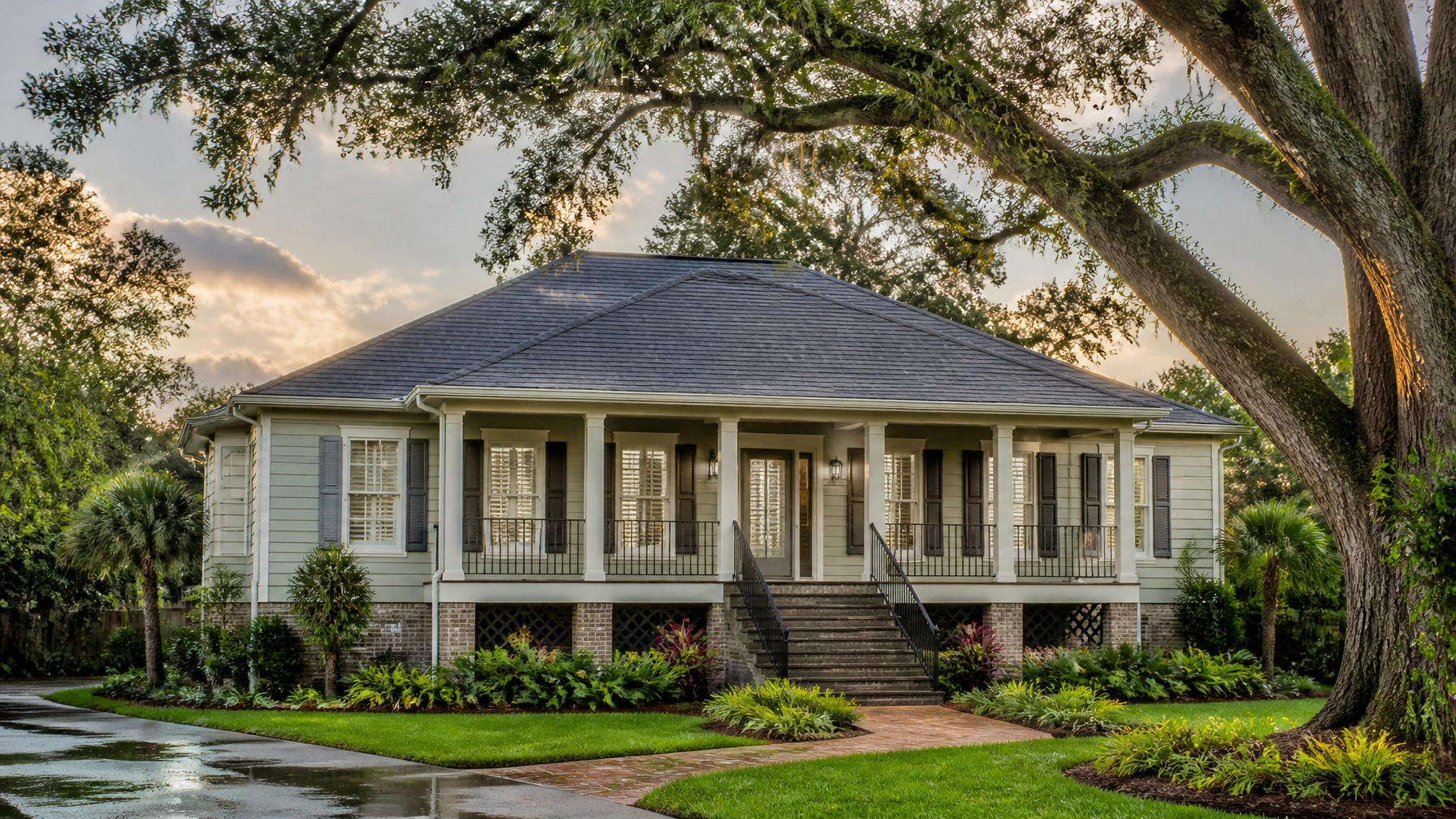
    New Orleans shotgun-adjacent home with a new architectural shingle roof

    3. What roofing license should a New Orleans contractor have?

    Quick answer: Beginning January 1, 2026, a contractor performing residential roofing work valued at $7,500 or more must hold a Residential Roofing or Residential Construction classification from the Louisiana State Licensing Board for Contractors.

    A Home Improvement Registration alone is not sufficient for a residential roofing project at or above that threshold.

    Before signing, verify the contractor through the Louisiana State Licensing Board for Contractors. Also request:

    • Active LSLBC license information
    • General liability insurance
    • Workers’ compensation coverage
    • A detailed written scope of work
    • Material and workmanship warranties
    • Confirmation of who will obtain the permit
    • References for completed local projects

    Be especially careful after hurricane season. Storm chasers may arrive quickly, pressure homeowners to sign immediately, or use out-of-state crews with limited local accountability. A legitimate contractor should allow time for license and insurance verification.

    4. How does roof age affect Louisiana insurance coverage?

    Quick answer: Louisiana insurers increasingly move roofs around 15 years old from Replacement Cost Value (RCV) coverage to Actual Cash Value (ACV) coverage. Many insurers also become reluctant to renew asphalt-roof policies when the roof approaches 20 years old.

    The difference matters:

    • RCV: Coverage is based on the cost to replace the roof with similar materials, subject to your deductible and policy terms.
    • ACV: The insurer subtracts depreciation for age and condition before determining the payment.

    A separate named-storm or hurricane deductible is also common. It is often 1%–5% of the dwelling coverage limit, rather than a flat dollar amount.

    For example, a 2% hurricane deductible on a home insured for $300,000 would equal $6,000. Your policy may use a different percentage, so review the declarations page and roof endorsements.

    A new roof may help with:

    • Policy renewability
    • Reduced underwriting concerns
    • Potential insurance discounts
    • Better protection during severe weather

    Ask your insurance agent whether the proposed roof system must meet specific wind, impact, or certification requirements.

    5. Can a FORTIFIED roof reduce insurance costs or qualify for a grant?

    Quick answer: Yes. Louisiana Regulation 136 requires insurers to offer hurricane-premium discounts for homes with an official IBHS FORTIFIED designation. The discounts apply to policy renewals beginning January 1, 2027, and benchmark reductions range from approximately 16% to 49% of the hurricane portion of the premium.

    The exact discount depends on:

    • Your Louisiana region
    • Whether the home is designated FORTIFIED Roof, Silver, or Gold
    • Your insurer’s approved rating plan
    • Whether the work receives official certification

    The Louisiana Fortify Homes Program may also provide grants of up to $10,000 for eligible homeowners completing a FORTIFIED Roof upgrade. Eligibility generally includes an owner-occupied primary residence with a homestead exemption. Lottery windows open periodically through the Louisiana Department of Insurance Fortify Homes Program.

    Do not assume that a wind-resistant roof automatically qualifies. Ask about the certification process, evaluator requirements, eligible contractors, and current application window before beginning construction.

    Historic-style New Orleans home with a standing-seam metal roof

    6. What should I know about storm claims and roofing deductibles?

    Quick answer: Never agree to a contractor waiving, absorbing, or offsetting your insurance deductible. Louisiana law prohibits this practice, and it is a major warning sign.

    After a storm:

    1. Photograph visible damage before making temporary repairs.
    2. Cover openings to prevent additional water intrusion.
    3. Save damaged materials when practical.
    4. Notify your insurer promptly.
    5. Get a written inspection and estimate.
    6. Keep copies of all messages, invoices, and claim documents.

    Policyholders generally have 180 days from a catastrophic event to submit proof of loss, depending on the policy and claim circumstances. The general prescriptive period for filing suit is commonly 24 months from the date of loss.

    Deadlines can vary by policy and event. Read the “Duties After Loss,” “Loss Settlement,” and “Suit Against Us” sections of your policy. If the insurer disputes coverage, depreciation, or the amount of damage, consider consulting a licensed Louisiana insurance professional or attorney.

    7. Can satellite imagery provide an accurate roof replacement estimate?

    Quick answer: Yes. Get My Roof Estimate Now uses satellite imagery to estimate roof size, pitch, and complexity in about 60 seconds. The system provides measurements with approximately 90%–95% accuracy, is free, and does not require a credit card.

    The estimate can help you:

    • Establish a realistic budget before contractor visits
    • Compare architectural shingles, metal, synthetic materials, and coatings
    • Understand low, middle, and high price ranges
    • Account for regional labor and material costs
    • Decide whether to repair, replace, or plan ahead
    • Compare multiple contractor proposals against the same baseline

    A satellite estimate is a practical starting point, not a replacement for a physical inspection. A contractor still needs to evaluate decking, flashing, ventilation, hidden moisture, code requirements, and storm-related damage.

    You can also compare metal roofing and asphalt shingles, or review the company’s metal roofing guide and asphalt shingles guide.

    Get Your New Orleans Roof Estimate in 60 Seconds

    Before scheduling multiple contractor visits, get a fast budget baseline for your New Orleans home. Enter your address to receive a free satellite-powered estimate based on your roof’s size, pitch, and complexity.

    Get your free New Orleans roof estimate

    There is no credit card requirement, no upfront cost, and no obligation. Use the estimate to plan your project, compare materials, and speak with verified local contractors from a more informed position.

    This article provides general educational information for New Orleans homeowners. Permit rules, insurance coverage, grant eligibility, and legal deadlines can change or depend on project-specific facts. Confirm requirements with the City of New Orleans, your insurer, the LSLBC, or a qualified professional.
  • Daily Tech Blitz – Slot 7: Nashville’s Satellite Tech Edge Is Bringing Music City Precision to Rooftop Estimates

    Daily Tech Blitz – Slot 7: Nashville’s Satellite Tech Edge Is Bringing Music City Precision to Rooftop Estimates

    Nashville is becoming more than Music City. It is developing a serious technology ecosystem built around satellites, broadband, geospatial data, and connected infrastructure.

    That shift matters to homeowners.

    In 2026, a Nashville roof replacement typically falls between $9,500 and $22,300 for architectural shingles, according to current local pricing guides. A typical 2,000-square-foot Nashville home may have approximately 20 roofing squares, but the actual roof area depends on pitch, overhangs, valleys, dormers, and other design details.

    Satellite imagery can measure those details before a contractor visits. With Get My Roof Estimate Now, homeowners can receive a free, property-specific estimate in approximately 60 seconds: with no credit card and no upfront contractor appointment.

    Nashville’s Satellite Technology Story

    Nashville’s satellite advantage is not based on one project. It is the result of several connected trends:

    • Commercial satellite manufacturing in Middle Tennessee
    • Satellite-supported broadband expansion across rural Tennessee
    • City planning built around sensors, data, mapping, and connectivity
    • Consumer tools that use aerial and satellite imagery for faster property estimates

    Together, these developments reflect a broader shift toward remote measurement and data-driven decisions.

    Blackwing Space and the “Space 3.0” Model

    One of the most notable examples is Blackwing Space, a Nashville-area nanosatellite manufacturer with operations centered at The Nest at The Factory in Franklin, Tennessee.

    Founded by Paul Anderson and Oliver Muoto, Blackwing Space is building commercial nanosatellite platforms known as:

    • Sparrow (1U and 1.5U XL)
    • Kestrel (3U XL)
    • Osprey (6U XL)

    The company describes its approach as “Space 3.0”: a commercial, modular, and more accessible model for satellite development. Instead of treating every spacecraft as a one-off government-scale project, Blackwing positions its satellites as commercial off-the-shelf, or COTS, systems with standardized components, transparent pricing, and faster integration.

    That product mindset has applications well beyond aerospace. It supports the same principle behind instant roof estimates:

    Use standardized technology, real-world data, and automation to reduce unnecessary waiting.

    A Nashville-area ranch home with a newly installed architectural shingle roof

    Tennessee’s $200 Million Broadband Expansion

    The satellite trend also extends beyond Nashville’s urban core.

    In March 2026, Tennessee announced approximately $202 million in federal BEAD broadband funding to expand high-speed internet access. The program is designed to reach unserved and underserved locations across the state, including rural properties where traditional wired infrastructure may be difficult or expensive to deploy.

    The state’s technology-neutral broadband plan includes fiber, cable, and low-Earth-orbit satellite solutions. Approximately 43,000-plus locations are expected to benefit from the broader deployment effort, with projects anticipated to continue through 2028.

    This matters for homeowners because improved connectivity makes remote services more practical. A property owner in a rural Tennessee county can increasingly use:

    • Online roof measurement
    • Digital insurance documentation
    • Remote contractor comparisons
    • Online permitting resources
    • Cloud-based project planning
    • Video consultations with roofing professionals

    Satellite broadband and satellite imagery are different technologies, but they support the same outcome: less dependence on in-person access during the early planning stage.

    Connected Nashville: Data Before Dispatch

    Metro Nashville’s Connected Nashville strategy focuses on using data, sensors, connectivity, and smart infrastructure to improve city services.

    Examples of smart-city applications include:

    • Data-driven traffic management
    • Sensor-based infrastructure monitoring
    • Geographic information systems
    • Connected public assets
    • GPS and location-based services
    • Better coordination between departments

    Public procurement records show that Metro has pursued multi-year technology, GIS, GPS, and infrastructure-related services. However, available public documents do not clearly identify a 2025 five-year agreement formally titled a citywide “satellite services contract.” The closest documented examples include enterprise GIS work and a later five-year GPS device and monitoring services contract.

    The distinction is important. Satellite-enabled GPS and geospatial mapping may support connected-city operations, but they should not automatically be described as a dedicated satellite services agreement.

    For homeowners, the practical lesson is straightforward: Nashville is increasingly comfortable using remote data instead of manual measurement as the first step. Roofing technology follows that same local pattern.

    How Satellite Roof Measurement Works

    A satellite-based roof estimate uses overhead imagery, property data, and measurement software to create a digital outline of the roof.

    The system evaluates factors such as:

    • Roof length and width
    • Roof planes and sections
    • Approximate pitch
    • Valleys and intersections
    • Dormers and extensions
    • Roof complexity
    • Estimated material quantities

    The result is translated into roofing squares.

    What Is a Roofing Square?

    One roofing square equals 100 square feet of roof surface.

    A home advertised as 2,000 square feet of living space does not necessarily have a 2,000-square-foot roof. Roof pitch and design add surface area. A typical Nashville property may require around 20 roofing squares, but satellite measurement helps replace a rough guess with a property-specific starting point.

    Get My Roof Estimate Now reports roof measurement accuracy of approximately 90% to 95%, often within inches for key dimensions. It is designed to provide an initial planning estimate: not to replace a final contractor inspection when construction begins.

    A Nashville modern home with a new standing-seam metal roof

    Nashville Roof Replacement Pricing for 2026

    Local architectural shingle replacement costs commonly range from $9,500 to $22,300 in Nashville. A separate benchmark of approximately $421 to $885 per roofing square can help homeowners understand material and installation pricing, although real projects vary based on scope.

    Plan for an additional 10% to 15% contingency for potential deck repairs, permits, ventilation work, flashing, or other concealed conditions.

    Roofing material Planning range for Nashville Best fit
    3-tab asphalt shingles (Budget) About $7,500–$13,000 Basic replacement with a simple roof
    Architectural shingles (Popular) About $9,500–$22,300 Most Nashville single-family homes
    Synthetic roofing (Premium alternative) About $14,000–$28,000 Homeowners seeking added durability or a specialty appearance
    Standing-seam metal (Long-term) About $16,000–$35,000+ Long service life, modern design, and energy performance
    Roof coatings (Specialized) Project-dependent Select low-slope or compatible roof systems

    These ranges are planning figures, not binding bids. Your final price depends on roof size, pitch, accessibility, tear-off requirements, material selection, labor availability, and hidden damage.

    Use the Nashville roof estimate page for local pricing, or compare variables with the roof cost calculator.

    Why Roof Geometry Changes the Price

    Two homes with the same living-area square footage can have very different roofing costs.

    A simple ranch roof may require fewer cuts, less flashing, and less labor. A Nashville colonial or custom home may include:

    • Multiple roof elevations
    • Steep sections
    • Dormers
    • Skylights
    • Chimneys
    • Numerous valleys
    • Difficult access
    • Older decking beneath the shingles

    These features increase waste, installation time, safety requirements, and material complexity. Satellite measurement helps identify much of that geometry before a contractor arrives.

    A Faster Nashville Roof Planning Checklist

    Use this checklist before requesting contractor bids:

    1. Check the roof’s age. Asphalt roofs often approach replacement planning around 20 to 25 years, depending on quality and weather exposure.
    2. Look for warning signs. Missing shingles, granule loss, sagging, ceiling stains, and visible daylight require attention.
    3. Measure the property remotely. Enter your address into a satellite-based estimator for a fast starting range.
    4. Review low-middle-high pricing. A single number can hide uncertainty. A range shows how material and complexity affect the budget.
    5. Add a 10%–15% contingency. Reserve funds for deck repairs, permits, ventilation, and flashing.
    6. Compare materials. Architectural shingles are the common value choice; metal and synthetic products may offer different longevity and appearance benefits.
    7. Confirm contractor credentials. Request licensing, insurance, warranties, references, and a written scope of work.
    8. Schedule an in-person inspection when ready. Remote measurement is ideal for budgeting. A final contractor inspection confirms current condition and construction details.

    Get a Nashville Roof Estimate in 60 Seconds

    Satellite technology is changing how Nashville businesses, public agencies, and homeowners use information. Blackwing Space is making commercial nanosatellites more accessible through its Space 3.0 COTS model. Tennessee is using satellite options as part of a broader effort to close its digital divide. Connected Nashville is advancing data-based infrastructure planning.

    Homeowners can apply the same technology to a major household decision.

    Enter your Nashville address into Get My Roof Estimate Now to receive:

    • A free satellite-measured estimate
    • Results in approximately 60 seconds
    • No contractor visit upfront
    • No credit card requirement
    • Transparent low-middle-high pricing
    • Material comparisons
    • A connection to verified, licensed, and insured local contractors

    Start with better information, then move to an on-site inspection when you are ready to build.

    Sources and Local References

  • Daily ROI Blitz – Slot 5: Montgomery, AL New Roof ROI ,  What a Replacement Adds to Your Home Value in 2026

    Daily ROI Blitz – Slot 5: Montgomery, AL New Roof ROI , What a Replacement Adds to Your Home Value in 2026

    A new roof on a typical 2,000-square-foot Montgomery home costs approximately $8,500–$17,000 for asphalt-based options and $19,500–$35,000 or more for standing-seam metal. The most popular middle-ground choice, architectural shingles, often runs $11,000–$15,000 locally.

    For resale, the 2025 Zonda/JLC Cost vs. Value benchmarks indicate that asphalt shingle replacement recoups approximately 68% of project cost, while metal roofing recoups about 50%. These are national benchmarks, not guarantees for a specific Montgomery property.

    The key takeaway: a new roof may not return every dollar directly through the sale price, but it can improve new roof ROI, roof replacement resale value, buyer confidence, insurance readiness, and curb appeal, all important advantages in Montgomery’s more negotiable 2026 housing market.

    Montgomery’s 2026 Housing Market Makes Roof Condition More Important

    Montgomery remains relatively balanced to buyer-friendly in 2026. Depending on the source and calculation method, reported median sale prices range from roughly $205,000 to $267,000. Realtor.com reported a median listing price near $209,900 in May 2026.

    Other local indicators point to a market where buyers have more time and leverage:

    • Homes are spending approximately 57–68 days on the market
    • About 19% of sellers are reducing asking prices
    • Year-over-year growth is modest, generally ranging from 2% to 7.8%
    • Inventory is rising compared with the exceptionally competitive conditions of earlier years

    In this environment, buyers are more likely to compare properties carefully and request credits for visible defects. A roof near the end of its service life can become a negotiation point, even when it is not actively leaking.

    A replacement roof helps remove that uncertainty. It gives buyers a documented, recent improvement instead of a projected expense they must budget after closing.

    See current market context from Redfin’s Montgomery housing market report and Realtor.com’s Montgomery market data.

    How a New Roof Supports Home Value

    1. It improves roof curb appeal and first impressions

    Roofing covers a large portion of the visible exterior. Discolored, curled, or mismatched shingles can make an otherwise well-maintained home look older.

    A new roof can improve:

    • Color consistency
    • Roofline definition
    • Exterior maintenance perception
    • Listing photography
    • Buyer confidence during the first showing

    This matters in neighborhoods such as Old Cloverdale, Midtown, Cottage Hill, East Montgomery, Wynlakes, and McGehee Estates. Historic and established neighborhoods often have strong architectural character, making a properly selected roof especially important.

    For older homes in Old Cloverdale, steep-pitch rooflines and period details should guide the material and color choice. A modern-looking roof that conflicts with the home’s design may reduce visual appeal, even if the product itself is high quality.

    2. It reduces inspection objections

    A roof replacement can help prevent common inspection concerns, including:

    • Missing or damaged shingles
    • Exposed or deteriorated flashing
    • Active leaks
    • Soft decking
    • Sagging roof sections
    • Poor attic ventilation
    • Evidence of repeated patching

    Buyers may not expect a roof replacement to increase the sale price dollar-for-dollar. They do expect the home’s major systems to be functional and defensible. A new roof can make the property easier to evaluate and reduce pressure for a large seller concession.

    3. It improves insurance readiness

    Alabama homeowners may receive insurance benefits for storm-resistant improvements. Admitted carriers generally offer discounts for qualifying FORTIFIED construction, and some carriers offer additional savings for Class 4 impact-resistant roofing.

    A FORTIFIED Roof may provide approximately 25%–40% savings on the wind portion of the policy, depending on the carrier and documentation. That discount applies to the wind portion, not necessarily the entire homeowners insurance premium.

    Ask your insurer:

    • Whether it is an admitted Alabama carrier
    • Whether a FORTIFIED Roof discount is available
    • Whether Class 4 shingles qualify for a separate discount
    • Which evaluator, installation records, and certification documents are required

    The Strengthen Alabama Homes program can provide grants of up to $10,000 in qualifying counties. As of June 2026, Montgomery County was not listed among the active counties, so verify the current status directly through Strengthen Alabama Homes before including a grant in your project budget.

    Historic Colonial home in Montgomery’s Old Cloverdale style with a new architectural shingle roof

    Montgomery Roof Replacement Cost and ROI Snapshot

    The following estimates apply to a typical 2,000-square-foot Montgomery home. Actual roof area is usually larger than the home’s interior square footage because of overhangs, slopes, garages, and attached structures.

    Roofing option Typical 2026 Montgomery cost Resale and ROI context
    3-tab asphalt (Budget) $8,500–$11,000 Lowest initial cost; may be less attractive to buyers seeking longer service life
    Architectural shingles (Popular) $9,500–$15,800 Strongest balance of appearance, cost, availability, and resale appeal
    Class 4 impact-resistant shingles (Storm-focused) $11,500–$17,000+ Potential insurance savings and added hail resistance; verify carrier requirements
    Standing-seam metal (Premium) $19,500–$35,000+ Long service life and distinctive appearance, but higher cost and lower average cost recovery

    Material prices rose approximately 4%–8% early in 2026, with additional manufacturer increases beginning June 1. Steel and aluminum tariffs are also putting upward pressure on metal roofing prices.

    The 2025 Zonda Cost vs. Value report and related JLC Cost vs. Value resources show why material selection matters. Asphalt replacement has generally produced a stronger average cost recovery than metal roofing. However, the best investment depends on your home, neighborhood, expected ownership period, insurance costs, and buyer expectations.

    What Is the Best Roof for Home Value in Montgomery?

    Architectural shingles (Popular)

    For most Montgomery homeowners, architectural shingles are the best roof for home value.

    They offer:

    • Broad buyer acceptance
    • More dimensional appearance than 3-tab shingles
    • Many color choices
    • Approximately 25–30 years of expected service life under normal conditions
    • Lower project cost than metal
    • Easy matching for common brick, siding, and traditional home styles

    For a homeowner planning to sell within several years, architectural shingles usually provide the clearest balance between upfront cost and visible improvement.

    Class 4 impact-resistant shingles (Storm-focused)

    Class 4 shingles can be a strong choice for homes exposed to frequent hail and severe thunderstorms. They may cost more initially, but the added impact resistance can support insurance savings and improve buyer confidence.

    Montgomery sits in Alabama’s Dixie Alley, where high winds, hail, humidity, and fast-changing weather create recurring roofing challenges. The National Weather Service documented a 90 mph EF-1 Rolling Acres tornado near the Lowndes–Montgomery County line on January 25, 2026. Severe storms later in the spring also affected the Montgomery area.

    A Class 4 roof is not automatically a higher-ROI roof. Its financial benefit improves when the insurance discount and storm-protection value are documented.

    Montgomery suburban home with a new Class 4 impact-resistant shingle roof after a storm

    Standing-seam metal (Premium)

    Metal roofing can make sense for a long-term owner who values durability, energy performance, and low maintenance. It can last 40–70 years when properly installed.

    However, metal typically requires a much larger initial investment. It may also look out of place on some traditional homes or compete with neighborhood expectations. In a resale-focused project, do not assume the highest-priced material creates the highest return.

    Montgomery-Specific Roofing Risks to Consider

    Montgomery’s hot, humid summers can accelerate:

    • UV-related granule loss
    • Thermal expansion and contraction
    • Algae streaking from organisms such as Gloeocapsa magma
    • Attic moisture problems
    • Flashing and sealant deterioration

    Good ventilation, correct underlayment, properly installed flashing, and algae-resistant products can help extend roof performance. Occasional winter freeze-thaw cycles also make sound installation important.

    Verify permits and licensing

    Inside the City of Montgomery, the city’s roofing FAQ states that a like-for-like replacement generally does not require a building permit. A permit may be required when changing roofing material, roof slope, structural support, or bracing.

    Call the City of Montgomery Inspections Department at 334-625-2073 if your project scope is unclear.

    For residential roofing work over $2,500, verify that the contractor holds the appropriate Alabama license. Use the Alabama Home Builders Licensure Board resources or call the board at 1-800-304-0853.

    Watch for storm chasers

    After major storms, out-of-area contractors may arrive offering fast repairs. Protect your investment by:

    • Confirming Alabama licensing
    • Requesting current liability and workers’ compensation insurance
    • Getting a written scope of work
    • Avoiding large upfront payments
    • Checking the company’s physical address and references
    • Refusing high-pressure insurance or assignment-of-benefits tactics

    The HBLB has warned homeowners about storm-related repair fraud. An unusually low price can be a warning sign rather than a bargain.

    Practical Roof Replacement ROI Checklist

    Before replacing your Montgomery roof:

    1. Measure the actual roof, not just the home’s living area.
    2. Compare three material levels: budget, popular, and premium.
    3. Request tear-off, decking, flashing, ventilation, and cleanup as separate line items.
    4. Ask whether Class 4 or FORTIFIED construction qualifies for insurance savings.
    5. Choose a color and profile that fit your neighborhood and architecture.
    6. Confirm permit requirements with the City or Montgomery County authority.
    7. Verify your contractor’s Alabama license and insurance.
    8. Keep invoices, warranties, photos, permits, and certification documents for resale.
    9. Get a current estimate before prices or manufacturer increases change.
    10. Use a local sale-price comparison, not a national ROI percentage alone.

    Frequently Asked Questions

    Does a new roof increase home value in Montgomery?

    Usually, yes: but not necessarily by the full installation cost. A new roof can improve curb appeal, reduce inspection objections, support insurance readiness, and make the home easier to sell. The exact resale value depends on neighborhood comparables, roof quality, material, and market conditions.

    What is the average roof replacement ROI?

    The 2025 Zonda/JLC benchmark for asphalt shingle replacement is approximately 68% cost recouped, while metal roofing is approximately 50%. These are national benchmarks and should not be treated as a guaranteed Montgomery appraisal.

    What is the best roof for resale value?

    Architectural shingles are usually the strongest all-around choice for Montgomery resale value. Class 4 shingles may be better for storm exposure and insurance savings. Metal roofing can be an excellent long-term roof but may not recover its higher upfront cost at resale.

    Should I replace my roof before selling?

    Consider replacement if the roof is near the end of its service life, has visible storm damage, or is likely to become an inspection objection. If the roof is still serviceable, a professional inspection and targeted repairs may deliver better ROI than a full replacement.

    Can I get an instant Montgomery roof estimate?

    Yes. Enter your address into the Montgomery satellite roof estimate tool. Get My Roof Estimate Now uses satellite imagery to measure roof size, pitch, and complexity, then provides a free price range in about 60 seconds: with no credit card and no contractor visit required upfront.

    Get Your Montgomery Roof ROI Baseline in 60 Seconds

    Whether you live in 36104, 36106, 36107, 36109, 36111, 36116, or 36117, start with a property-specific number before comparing materials or contractor proposals.

    Use the free Montgomery roof estimate, check broader assumptions with the roof cost calculator, or visit the Get My Roof Estimate Now homepage.

    A clear estimate helps you decide whether a roof replacement is the right maintenance project, resale strategy, or storm-readiness investment for your Montgomery home.

  • Daily Weather Blitz – Slot 2: Lexington, KY : August 27, 2026: Scattered Storms on a Weak Cold Front, a Sunny 90-Degree Weekend Ahead & What Late-Summer Heat Does to Your Roof

    Daily Weather Blitz – Slot 2: Lexington, KY : August 27, 2026: Scattered Storms on a Weak Cold Front, a Sunny 90-Degree Weekend Ahead & What Late-Summer Heat Does to Your Roof

    Lexington homeowners should expect a typical late-August weather pattern today: a cloudy, humid start, afternoon heating, and a chance for scattered pop-up showers and thunderstorms as a weak cold front settles across Kentucky.

    The overall severe-weather risk is low. However, the National Weather Service Storm Prediction Center has placed areas east of I-75 under a Level 1 Marginal Risk. An isolated storm could briefly produce gusty winds, lightning, and heavy localized rain.

    For your roof, the bigger story is the combination of:

    • Repeated summer thunderstorms
    • Hail and wind exposure
    • Hot, humid attic conditions
    • Aging shingles entering the final years of their service life
    • More heat arriving this weekend and early next week

    Here is what Lexington homeowners in the 40502–40517 ZIP code areas should know.

    Lexington Weather Snapshot for Thursday, August 27

    Current morning conditions at Blue Grass Airport (KLEX) include:

    • Temperature: 72°F
    • Humidity: 84%
    • Dew point: 67°F
    • Afternoon high: Near 85°F
    • Wind: Light west wind
    • Storm chance: Isolated in Lexington, higher south and east

    The weak front is not expected to create a widespread severe-weather outbreak. Storm coverage will favor locations south and east of Lexington, with the best rain chances closer to Lake Cumberland and eastern Kentucky.

    Lexington may see mostly sunny periods this afternoon with only an isolated storm. If one develops nearby, expect a quick burst of heavy rain, frequent lightning, and a brief wind gust.

    Check the NWS Louisville point forecast for Lexington before scheduling outdoor roof work or climbing a ladder.

    Sunny Weekend, Then Another Heat Surge

    The front will not deliver a major cool-down. Instead, the forecast returns to classic Bluegrass late-summer conditions:

    • Friday: Mostly sunny, near 85°F
    • Saturday: Sunny, near 87°F
    • Sunday: Sunny, near 90°F
    • Monday: Near 92°F
    • Tuesday: Near 93°F

    Humidity is expected to return early next week. That matters because prolonged heat affects the entire roofing system: not just the visible shingles.

    What Heat Does to Asphalt Shingles

    Dark asphalt shingles absorb solar energy throughout the day. On a sunny afternoon, the roof surface can become significantly hotter than the surrounding air. That heat can:

    • Dry out and weaken asphalt binders
    • Accelerate granule loss
    • Cause shingles to curl or become brittle
    • Increase expansion and contraction around flashing
    • Raise attic temperatures
    • Reduce the effective service life of an older roof

    A properly installed roof should handle normal summer heat. But heat exposes weaknesses that storms later exploit. A shingle already loosened by thermal movement may lift during a thunderstorm. A dried seal strip may not reseal properly after high winds. A small flashing gap may become a leak during the next downpour.

    Roofing professionals inspecting and installing architectural asphalt shingles on a suburban Lexington-style ranch home

    Fayette County Has a Real Wind, Hail, and Tornado History

    Today’s setup is low-risk, but low risk does not mean no risk. Fayette County has experienced damaging storms before, including several significant tornadoes documented by NWS Louisville’s Fayette County tornado climatology.

    Notable events include:

    • March 10, 1986: An F2 tornado heavily damaged Gainesway and neighborhoods along Man O’ War Boulevard. The event damaged approximately 845 homes, including about 200 with damage near F3 intensity. Roofs were torn off at Ak-Sar-Ben Park.
    • May 27, 2004: An F3 tornado struck the Masterson Station area.
    • May 18, 1995: An F2 tornado affected Fayette County.
    • March 18, 1925: A long-track tornado crossed eastern Fayette County at high-end F3 strength, possibly approaching F4 intensity for a portion of its path.

    More recent storms also show why routine roof awareness is important. On August 5, 2026, a regional severe-weather event produced 25 wind-damage reports and nine hail reports across Kentucky, including wind damage about five miles northeast of Lexington. On August 16, a strong thunderstorm knocked out power to more than 3,000 Fayette County customers.

    Most late-summer roof damage does not come from a dramatic tornado. It often comes from:

    1. Hail striking shingles repeatedly
    2. Wind lifting an already-compromised shingle
    3. Heavy rain entering around flashing
    4. Branches scraping or puncturing the roof
    5. Clogged gutters backing water toward the roof edge

    Six-Minute Ground-Level Roof Inspection After a Storm

    Do not climb onto the roof after a storm, especially when shingles are wet. Start from the ground using binoculars if needed.

    Look for:

    • Displaced, missing, or curled shingles
    • Shingle pieces in the yard
    • Granules collecting in gutters or downspouts
    • Dented gutters, downspouts, or metal flashing
    • Cracked pipe boots or exposed fasteners
    • Loose ridge caps
    • Water stains on soffits or exterior walls
    • Dark “bruise” marks on shingles

    Hail damage can be difficult to see from the ground. A dark circular bruise, a fractured mat, or a pattern of small dents may indicate impact damage. If you find suspicious marks, photograph them from a safe location and arrange a professional inspection.

    Do not assume a roof is undamaged because there is no active leak. Water intrusion may take hours or days to appear in the attic or ceiling.

    Storm-Ready Roofing Improvements for Fayette County

    1. Choose impact-resistant shingles (Premium durability)

    Class 3 and Class 4 impact-resistant shingles cost more, but they are worth considering in Fayette County because of Kentucky’s recurring hail and wind history.

    These products are designed to better resist impact than standard shingles. Some insurance carriers may offer discounts, but eligibility varies. Ask your insurer about available credits before choosing a product.

    2. Specify six-nail fastening (Wind protection)

    Many standard installations use four nails per shingle. For stronger wind performance, ask whether the installation will use:

    • Six nails per shingle
    • Proper nail placement
    • Sealed shingle edges
    • Reinforced flashing at valleys and penetrations
    • Manufacturer-approved installation methods

    Fastening quality matters as much as the shingle brand. A premium product can still fail early if it is installed incorrectly.

    3. Improve attic ventilation (Heat control)

    Hot attics cook roofing materials from below. Balanced ventilation helps move heat and moisture out of the attic during Lexington’s humid summers.

    A properly designed system typically includes:

    • Continuous ridge vents
    • Adequate intake soffit vents
    • Correct insulation levels
    • Clear airflow paths
    • No blocked or compressed insulation at the eaves

    Ventilation will not eliminate roof aging, but it can help reduce heat and moisture stress.

    A modern Lexington-style home with a well-maintained gray asphalt shingle roof, clean gutters, and strong summer curb appeal

    4. Clean gutters and trim branches

    Remove leaves, seed pods, and debris from gutters before fall weather arrives. Clogged gutters can cause water to overflow behind fascia boards or along roof edges.

    Also trim branches that:

    • Hang over the roof
    • Rub against shingles
    • Drop heavy limbs
    • Create excessive shade and moisture
    • Provide a path for animals to reach the roof

    5. Inspect flashing around roof penetrations

    Late-summer pop-up storm leaks often begin at vulnerable transition points, including:

    • Chimneys
    • Skylights
    • Plumbing vents
    • HVAC penetrations
    • Roof valleys
    • Wall-to-roof intersections

    Flashing should lie flat, remain securely fastened, and show no visible gaps, rust, or lifting.

    What a Roof Replacement Costs in Lexington in 2026

    For a typical 2,000-square-foot home, a standard architectural asphalt shingle replacement in Lexington generally costs:

    • Typical range: $7,000–$18,000
    • Installed price: Approximately $4.00–$6.00 per square foot
    • Mid-range project: Around $11,000–$14,000
    • Large or steep roof: $16,000–$25,000 or more

    Your roof is priced in squares, with one roofing square equal to 100 square feet. The home’s floor area is not always the same as its roof area because pitch, overhangs, attached garages, dormers, and valleys increase the measured surface.

    Costs also rise when the project includes:

    • Multiple roof planes
    • Steep pitch
    • Extensive tear-off
    • Rotted decking
    • Complex flashing
    • Difficult access
    • Permit or disposal fees

    Premium materials: including Class 4 shingles, metal roofing, and synthetic products: typically add 30%–60% compared with standard asphalt shingles. Use the roof cost calculator for general benchmarks, or compare metal roofing and asphalt shingles before choosing a material.

    Aerial inspection-style view of a residential roof showing architectural shingles, valleys, chimney flashing, vents, and clean gutters

    Is Your Roof Ready for Another Lexington Summer?

    If your roof is 15–30 years old, now is a practical time to evaluate its remaining service life. Waiting until a storm creates an emergency can limit your material choices and make scheduling more difficult.

    Watch for:

    • Repeated repairs
    • Widespread granule loss
    • Curling or brittle shingles
    • Sagging roof sections
    • Daylight visible in the attic
    • Persistent attic heat or moisture
    • Stains near chimneys, vents, or skylights

    Get a Free Lexington Roof Estimate in 60 Seconds

    You do not need to schedule multiple contractor visits just to learn what replacement might cost.

    At Get My Roof Estimate Now, enter your address and receive a free satellite-measured estimate in under 60 seconds. The service:

    • Measures your roof using satellite imagery
    • Accounts for roof size, pitch, and complexity
    • Provides low, middle, and high price ranges
    • Compares material options
    • Uses regional pricing information
    • Requires no credit card
    • Requires no contractor visit upfront
    • Can connect you with verified, licensed, and insured local contractors

    Lexington’s immediate forecast is manageable: isolated storm potential today, improving sunshine Friday, and a sunny weekend near 90°F. Use the clear weather window to inspect your roof from the ground, clean the gutters, and plan ahead.

    Get your free Lexington roof replacement estimate at getmyroofestimatenow.com.

  • Daily Weather Blitz – Slot 1: Savannah, GA : August 27, 2026: Muggy Upper-80s Heat, Daily Storm Chances, a Tropical System to Watch & How Coastal Georgia Weather Tests Your Roof

    Daily Weather Blitz – Slot 1: Savannah, GA : August 27, 2026: Muggy Upper-80s Heat, Daily Storm Chances, a Tropical System to Watch & How Coastal Georgia Weather Tests Your Roof

    Savannah’s weather pattern today is a familiar late-August combination: muggy upper-80s heat, afternoon thunderstorms, heavy downpours, frequent lightning, and gusty winds in stronger cells.

    Thursday, August 27, starts humid, with temperatures rising to the upper 80s or around 90°F. Pop-up showers and thunderstorms should become more numerous during the afternoon. Rain will be uneven: one neighborhood may stay dry while another receives a quick, intense downpour: but every homeowner should remain alert for lightning, ponding, and wind gusts.

    The weather remains active through the weekend. Friday has the highest chance of scattered storms, including locally heavy rainfall and a few stronger cells capable of damaging wind gusts. Storm coverage should ease somewhat over the weekend, but isolated showers and thunderstorms will still be possible.

    For official updates, check the NWS Charleston forecast office, which serves the Savannah area, and the Storm Prediction Center’s convective outlooks.

    Current Savannah Forecast: August 27–30

    Thursday: Hot, humid, and stormy at times

    • High: Upper 80s to around 90°F
    • Morning: Muggy with partly cloudy to mostly cloudy skies
    • Afternoon: Increasing pop-up showers and thunderstorms
    • Storm hazards: Heavy downpours, frequent lightning, gusty winds, and localized flooding
    • Rain coverage: Uneven; not every neighborhood will receive measurable rain

    A stronger storm can drop a large amount of rain in a short period. That creates stress on gutters, valleys, flashing, and areas around roof penetrations.

    Thursday night: Eclipse viewing may be interrupted

    A partial lunar eclipse is visible Thursday night. The eclipse begins at approximately 10:33 p.m., reaches maximum at 12:12 a.m., and covers about 96% of the moon.

    Partly cloudy skies and lingering coastal moisture may make viewing intermittent. If you plan to watch, look for breaks between clouds and showers. Do not climb onto your roof or stand near roof edges to improve visibility.

    Friday through the weekend

    Rain chances continue daily:

    • Friday: High chance of scattered thunderstorms, with heavy rain and a few strong cells that may produce damaging wind gusts
    • Saturday and Sunday: Slightly lower storm coverage, but isolated showers and thunderstorms remain possible
    • Roofing concern: Repeated wetting and drying can expose small leaks that may not appear during a single light shower

    Tropical update: Invest 96-L

    The National Hurricane Center is monitoring Invest 96-L in the Atlantic. It has approximately a 60% chance of tropical development, with the most favorable development window expected Thursday into Friday.

    Wind shear and dry air are expected to suppress the system afterward, and it is forecast to remain well away from the U.S. coast. It is not driving Savannah’s local weather today.

    As of August 27, no hurricanes have formed in the Atlantic so far in 2026. That does not reduce the importance of preparation. Hurricane season runs from June 1 through November 30, with peak activity typically occurring in late summer.

    Why Savannah’s Climate Is Hard on Roofs

    Savannah has a humid subtropical coastal climate. Roofs here must handle several stressors at the same time:

    1. Heat and ultraviolet exposure

    Long periods of intense summer sun dry roofing materials and accelerate surface aging. Dark shingles absorb heat, raising temperatures at the roof surface and in the attic.

    2. Humidity and algae growth

    Persistent humidity encourages algae and mold growth, especially on shaded roof slopes beneath trees. Black streaks are often cosmetic at first, but heavy organic growth can retain moisture and make roof surfaces age faster.

    Algae-resistant shingles and proper roof ventilation can help. Regular tree trimming also improves sunlight and airflow.

    3. Salt air and coastal moisture

    Salt air from the Atlantic can accelerate corrosion on:

    • Metal flashing
    • Fasteners and exposed nails
    • Drip edges
    • Gutter components
    • Chimney caps and vent fittings
    • HVAC and plumbing penetrations

    A roof may still look serviceable from the street while corrosion is developing around critical details.

    4. Heavy rain and thermal cycling

    Savannah roofs repeatedly transition from hot, sunny conditions to sudden afternoon storms. This expansion-and-contraction cycle can stress sealants, flashing, underlayment, and older shingles.

    Heavy rain also tests roof drainage. Clogged gutters or undersized downspouts can send water back beneath the roof edge or against siding and trim.

    Savannah ranch home with new architectural shingles, reinforced flashing, and wet landscaping after a summer storm

    Storm-Ready Roof Checklist for Coastal Georgia

    Use this checklist before the next round of storms:

    Inspect the roof surface

    Look for:

    • Missing, cracked, curled, or lifted shingles
    • Exposed underlayment
    • Loose ridge caps
    • Granule loss in gutters or downspout outlets
    • Rust-colored streaks around flashing
    • Visible algae or moss buildup
    • Sagging areas or uneven rooflines

    Do not walk on the roof yourself, especially when shingles are wet. Use binoculars from the ground or hire a qualified professional.

    Confirm wind-uplift resistance

    A coastal roof should be installed according to local building requirements and manufacturer specifications. Ask about:

    • Proper nail placement
    • Adequate edge fastening
    • Sealed roof-deck systems
    • High-wind-rated shingles
    • Correctly installed starter strips and ridge caps

    Installation quality matters as much as the material selected.

    Check underlayment and roof-deck protection

    A sound roof deck and properly installed underlayment help limit water intrusion if wind damages shingles. In hurricane-prone areas, homeowners should ask contractors how the roof deck, eaves, valleys, and penetrations will be protected.

    Reinforce flashing

    Flashing around chimneys, walls, skylights, vents, and valleys is a common failure point. Coastal moisture makes corrosion more likely, so flashing should be inspected for rust, separation, gaps, and failed sealant.

    Clean gutters and downspouts

    Remove leaves, pine needles, and roof granules. Confirm that downspouts discharge water away from the foundation and that extensions are secure.

    Trim nearby trees

    Trim dead limbs and branches that overhang the roof. Live oak canopies add Savannah character, but heavy limbs can scrape shingles, block gutters, or fall during strong thunderstorms.

    Consider impact-resistant materials

    Impact-resistant or designer shingles may provide better durability and improved curb appeal. Metal roofing is another option for homeowners who prioritize long service life and lower maintenance.

    Modern coastal Georgia home with standing-seam metal roofing and storm clouds in the distance

    Savannah Roof Replacement Cost Benchmarks for 2026

    The following ranges estimate a typical 2,000-square-foot roof in the Savannah market:

    Roofing system Estimated installed cost Category
    Basic 3-tab asphalt shingles $9,000–$13,000 Budget
    Architectural asphalt shingles $11,000–$17,000 Popular
    Impact-resistant or designer shingles $15,000–$24,000 Premium
    Standing-seam metal roofing $18,000–$32,000 Premium

    These are planning benchmarks, not contractor bids. Final pricing depends on:

    • Actual roof size, measured in squares
    • Roof pitch and accessibility
    • Valleys, dormers, and other complexity
    • Tear-off and disposal requirements
    • Damaged or rotted decking
    • Flashing replacement
    • Ventilation improvements
    • Savannah-area permitting and inspection requirements
    • Current labor and material availability

    For a general comparison, the roof cost calculator provides material and size-based ranges. You can also compare metal roofing and asphalt shingles.

    Does a New Roof Increase Home Value?

    A new roof can support resale value in several ways, even when the full replacement cost is not recovered dollar for dollar.

    Roof replacement ROI

    Buyers typically discount homes with an aging or visibly damaged roof because they anticipate a major expense after closing. A newer roof reduces that concern and can make the property easier to finance, insure, and sell.

    Roof curb appeal and home value

    Clean architectural shingles, coordinated flashing, and a well-maintained roofline can improve first impressions. This is especially relevant in Savannah neighborhoods where exterior appearance and historic or traditional design details matter.

    Best roof for home value

    For many homeowners, architectural asphalt shingles offer the best balance of cost, appearance, availability, and expected service life. Impact-resistant or designer shingles may be a better fit for homeowners seeking stronger weather performance or a premium appearance.

    Standing-seam metal roofing can add appeal through longevity, energy efficiency, and low maintenance. However, its higher upfront cost may not be the best financial choice for every home or neighborhood.

    The strongest resale benefit usually comes from replacing a failing roof before it creates interior damage: not from choosing the most expensive material available.

    What to Do After a Savannah Storm

    After the storm passes:

    1. Check the attic and ceilings for wet insulation, stains, dripping, or new discoloration.
    2. Inspect gutters and downspouts for shingle granules, loose sections, or blockages.
    3. Look from the ground for missing shingles, exposed underlayment, fallen branches, and damaged flashing.
    4. Photograph damage from a safe location before making temporary repairs.
    5. Use a tarp only when professionally installed or safely placed. Never climb onto a wet or damaged roof.
    6. Contact your insurer if damage appears significant.
    7. Request a professional inspection before assuming a roof is fine because there is no visible ceiling leak.

    Document the date, time, storm conditions, and visible damage. This information can help with insurance and contractor discussions.

    Close view of a storm-ready coastal home roof with clean gutters, flashing, and trimmed trees

    Get a Free Savannah Roof Estimate in 60 Seconds

    Storm preparation starts with knowing what your roof would cost to replace.

    Get My Roof Estimate Now uses satellite imagery to measure your roof’s size, pitch, and complexity: often accurate to within inches: and provides a free estimate in about 60 seconds. You can review low, middle, and high price ranges for materials such as architectural shingles, impact-resistant shingles, coatings, and metal roofing.

    There is:

    • No contractor visit required upfront
    • No credit card required
    • No hidden fees
    • No obligation to buy

    Get your free instant satellite roof estimate and plan ahead before the next heavy rain, tropical system, or hurricane threat reaches coastal Georgia.

  • Daily ROI Blitz – Slot 4: Austin, TX New Roof ROI : What a Replacement Adds to Your Home Value in 2026

    Daily ROI Blitz – Slot 4: Austin, TX New Roof ROI : What a Replacement Adds to Your Home Value in 2026

    If you are researching new roof ROI home value in Austin, the short answer is clear: a roof replacement can recover approximately 60%–68% of its cost at resale, while adding about $15,000–$25,000 in perceived resale value to a standard home.

    In Austin, the return can be stronger when the existing roof is visibly aging, hail-damaged, difficult to insure, or likely to trigger inspection negotiations.

    For 2026, a typical Austin architectural shingle replacement costs approximately $8,000–$18,000. Most 2,000–2,500-square-foot roof areas land near $12,000–$15,000 installed. That makes a new roof a significant investment: but also one that can protect your sale price, reduce buyer objections, and improve your home’s marketability.

    Austin’s 2026 housing market sets the ROI context

    Roof ROI depends partly on the value and expectations of the surrounding market.

    The Austin-Round Rock-San Marcos MSA reported a July 2026 median sale price of approximately $435,000, up 1.0% year over year, with 4.7 months of inventory. The City of Austin’s median was approximately $577,000.

    A separate six-month Austin snapshot from Resideline tracked:

    • $539,000 median sold price
    • 1,584 closings
    • Approximately $325 median sold price per square foot
    • About 25 days from listing to contract
    • The middle half of sales between approximately $379,000 and $799,900

    This is not a market where every improvement automatically creates a premium. Buyers have choices. A clean, documented, recently replaced roof can help your home compete without forcing buyers to budget for a major project immediately after closing.

    What does a new roof add to an Austin home?

    There are two ways to measure roof replacement resale value in Austin:

    1. Direct value added to the property
    2. Avoided costs, such as buyer credits, inspection repairs, insurance problems, or a longer time on market

    Direct resale value

    Using the national recovery range:

    Roof replacement cost Estimated 60%–68% direct value recovery
    $10,000 $6,000–$6,800
    $12,000 $7,200–$8,160
    $15,000 $9,000–$10,200
    $20,000 $12,000–$13,600

    A new roof may also support a higher list price when the old roof is near the end of its useful life. On a $539,000 Austin home, even a 1%–3% pricing difference represents approximately $5,390–$16,170.

    That does not mean a replacement guarantees a specific premium. Appraisers and buyers consider the entire property, including the roof’s age, material, installation quality, neighborhood, floor plan, and comparable sales.

    Indirect value

    A replacement may provide additional financial benefit by helping you:

    • Avoid a large roof-related buyer credit
    • Reduce the chance of inspection delays
    • Meet lender or insurer requirements
    • Improve first impressions in listing photos
    • Attract buyers who want a move-in-ready home
    • Reduce the risk of a contract falling through

    In practical terms, a roof that eliminates a major objection can be worth more than the simple appraisal calculation suggests.

    Two-story Austin Colonial home with a new charcoal architectural shingle roof

    Austin roof replacement costs by material

    The best roof for home value in Austin depends on your budget, neighborhood, ownership plans, and exposure to hail and heat.

    Architectural asphalt shingles (Popular)

    • Typical total: $8,000–$18,000
    • Typical 2,000–2,500-square-foot roof: $12,000–$15,000
    • Lifespan: approximately 25–30 years
    • Best fit: Most Austin-area single-family homes

    Architectural shingles usually offer the most balanced cost-to-value ratio. They provide better depth and curb appeal than basic 3-tab shingles and are widely accepted by buyers.

    Class 4 impact-resistant shingles (Storm-smart)

    • Approximately $6–$11 per square foot
    • Higher upfront cost than standard architectural shingles
    • Designed to better resist hail impacts
    • May qualify for approximately 10%–30% insurance premium discounts, depending on your carrier

    Class 4 shingles can be a strong choice in Austin, Round Rock, Cedar Park, and Pflugerville because hail exposure can affect both ownership costs and resale confidence.

    Standing seam metal (Premium)

    • Approximately $20,000–$36,000 for a 2,000-square-foot roof
    • Larger or more complex roofs may reach $45,000–$54,000 or more
    • Lifespan: approximately 40–70 years
    • Reflective finishes can help reduce cooling demand

    Metal roofing costs more upfront, but it offers long service life, strong weather performance, and energy advantages. It is often more attractive from a long-term ownership perspective than a short-term resale perspective.

    Compare the full cost and performance differences in our metal roofing versus asphalt shingles guide.

    3-tab shingles (Budget)

    • Approximately $3.50–$7.00 per square foot
    • Lowest upfront material cost
    • Shorter expected lifespan and flatter appearance

    3-tab shingles may make sense for a rental, a tightly controlled budget, or a property that will be sold quickly. However, they may not create the same roof curb appeal home value as dimensional architectural shingles.

    Match the roof to the Austin neighborhood

    Material selection should fit the home and nearby housing stock. A premium roof can help value, but an upgrade that looks out of place may not deliver the expected return.

    Approximate 2026 neighborhood medians include:

    • Zilker: approximately $1.2 million
    • Travis Heights: approximately $1.05 million
    • Bouldin Creek: approximately $950,000
    • Cedar Park: approximately $525,000
    • Round Rock: approximately $450,000
    • Pflugerville: approximately $425,000

    For Zilker, Bouldin Creek, and Travis Heights, premium architectural shingles, designer shingles, or a well-designed standing seam roof may better match the property’s architecture.

    For Round Rock, Cedar Park, and Pflugerville, high-quality architectural or Class 4 shingles typically provide a more proportional investment. The goal is not to install the most expensive roof. The goal is to install the roof buyers expect for the home.

    Austin’s hail and insurance ROI angle

    Central Texas roofing decisions should account for more than appearance.

    April 2026 storms affected the Austin-area corridor, including Georgetown, Round Rock, Cedar Park, and Austin. The April 18 event was reported with hail ranging from approximately 1 inch to baseball-sized, while other April events also produced damaging hail and high winds.

    If you suspect storm damage:

    1. Check your policy’s claim deadline immediately. Many Texas policies use a 12-month window from the storm date.
    2. Ask whether your roof is covered at replacement cost value (RCV) or actual cash value (ACV).
    3. Confirm whether your policy has a 1%–2% wind or hail deductible.
    4. Photograph damage from the ground and save the storm date.
    5. Do not authorize unnecessary repairs before documenting the condition.

    RCV coverage may reimburse depreciation after the roof is replaced and documentation is submitted. ACV coverage generally deducts depreciation from the payment, which can leave the homeowner with a much larger out-of-pocket cost.

    Also, contractor deductible waivers are illegal in Texas. A roofer cannot legally offer to absorb, waive, or rebate your insurance deductible.

    Permits and Austin replacement requirements

    City of Austin roof work may be permit-exempt in some situations. For example, an in-kind asphalt-to-asphalt replacement that does not affect the structure may qualify for an exemption outside Wildland-Urban Interface areas.

    However, permits may be required when:

    • The property is in the Wildland-Urban Interface
    • At least 50% of the roof is being replaced in a WUI area
    • More than 128 square feet of decking is replaced
    • Structural framing or other structural work is involved

    Budget approximately $200–$500 when a permit is required, and confirm the current fee with the City of Austin. Your contractor should determine the requirements and pull the permit when applicable.

    How to calculate your Austin roof replacement ROI

    Use this simple process:

    1. Get the measured roof area. Roofing is priced in squares, with one square equal to 100 square feet.
    2. Compare at least two material options. Start with architectural shingles and then compare Class 4 or metal.
    3. Estimate direct value recovery. Multiply the replacement cost by 0.60–0.68.
    4. Add avoided selling costs. Consider inspection credits, insurance concerns, delays, and buyer negotiations.
    5. Check neighborhood fit. Avoid over-improving or selecting a material that clashes with the home.
    6. Document the work. Keep the permit, invoice, warranty, product information, and before-and-after photos.

    Our roof cost calculator can provide a general estimate by roof size, pitch, material, tear-off, and Texas pricing. For a property-specific number, use satellite measurements instead of relying on the home’s living area alone.

    Get an instant Austin roof estimate

    Get My Roof Estimate Now measures your roof using satellite imagery and provides a free estimate in approximately 60 seconds. The system evaluates roof size, pitch, and complexity, then provides low-to-high pricing for options such as architectural shingles, impact-resistant materials, and metal roofing.

    Start with the free Austin roof replacement estimate. There is no credit card requirement and no contractor visit needed upfront.

    Austin roof ROI FAQ

    Is a new roof a good investment in Austin?

    Usually, yes: especially if the existing roof is damaged, visibly worn, or near the end of its useful life. National benchmarks indicate approximately 60%–68% cost recovery, while Austin sellers may also benefit from fewer concessions and a smoother inspection.

    How much does a new roof increase home value in Austin?

    A typical new roof may add approximately $15,000–$25,000 in resale value, depending on the home and material. A more conservative calculation is 60%–68% of the installed replacement cost.

    What is the best roof for home value in Austin?

    Architectural asphalt shingles are usually the best overall value for typical homes. Class 4 shingles are worth considering in hail-prone areas. Standing seam metal may be best for long-term ownership, energy efficiency, and premium modern homes.

    Do Class 4 shingles lower insurance costs in Texas?

    They can. Some insurers offer approximately 10%–30% discounts for certified impact-resistant roofing, but the amount and eligibility depend on the carrier and policy.

    Does Austin require a roof replacement permit?

    Sometimes. Like-for-like roof covering replacement may be exempt outside certain areas, but WUI properties, structural work, and larger decking replacements may require a permit. The contractor should verify the address-specific rules.

    Should I replace my roof before selling?

    Replace it before listing when the roof is likely to become a buyer objection, fail inspection, or limit insurance options. If the roof is still in good condition, a professional inspection and documented maintenance may be more cost-effective.

    Sources

  • 2026 Roof Replacement Cost in Murfreesboro, TN: Complete Price Guide for The ‘Boro Homeowners

    2026 Roof Replacement Cost in Murfreesboro, TN: Complete Price Guide for The ‘Boro Homeowners

    Planning a new roof in Murfreesboro? In 2026, the typical roof replacement cost in Murfreesboro ranges from $10,500 to $21,800 for architectural shingles. Final pricing depends on your roof’s measured size, pitch, design, material, and hidden damage. Asphalt and steel tariff pressure has also pushed some material prices higher this year.

    2026 Average Roof Replacement Costs in Murfreesboro

    Roofers measure roofing in squares. One square equals 100 square feet of roof area.

    Roofing material Installed cost per square Typical total project range
    Architectural shingles (Popular) $450–$865 $10,500–$21,800
    Class 4 impact-resistant shingles Approximately $500–$1,080 $12,000–$27,000
    Standing-seam metal (Premium) $1,200–$1,700 $13,900–$40,500+
    Synthetic roofing Approximately $750–$1,400 $12,000–$30,000

    These are planning ranges for common Murfreesboro and Rutherford County homes. Your property-specific number may be higher or lower.

    Roofing contractor inspecting architectural shingles on a residential home

    What Drives the Price

    Your Murfreesboro roofing costs are mainly affected by:

    • Roof size: More squares require more materials, labor, and disposal.
    • Pitch and steepness: Steep roofs require additional safety equipment and slower installation.
    • Complexity: Valleys, dormers, multiple rooflines, skylights, chimneys, and vent flashings add labor.
    • Number of stories: Two-story sections are more difficult to access.
    • Tear-off: Removing old roofing can add substantial labor and disposal costs.
    • Decking repairs: Rotten or damaged sheathing must be replaced before new materials are installed.
    • Ventilation and flashing: Ridge vents, pipe boots, chimney flashing, and drip edge may need upgrades.

    A satellite-based measurement gives you a faster starting point than relying on your home’s square footage alone.

    Material Options for Murfreesboro Homes

    • Architectural shingles (Budget/Popular): The most common choice for architectural shingles in Murfreesboro. They offer strong curb appeal, many color options, and a typical 25–30-year lifespan.
    • Class 4 shingles (Storm-ready): Recommended for Rutherford County’s hail and severe-thunderstorm risk. Ask your insurer whether impact-resistant shingles qualify for a discount.
    • Standing-seam metal (Premium): The metal roof cost in Murfreesboro is higher upfront, but metal can last 40–70 years with low maintenance.
    • Synthetic roofing (Premium alternative): Designed to mimic slate, cedar, or tile while reducing weight and maintenance.

    Learn more about asphalt shingles and metal roofing before comparing written bids.

    Professional standing-seam metal roof installation on a Middle Tennessee home

    Permits & Local Rules

    Murfreesboro enforces the 2018 Building Code. A permit is generally not required for simple shingle-over re-roofing when the roof deck, sheathing, rafters, and structural framing remain untouched.

    A permit is required when sheathing, rafters, support beams, or other structural framing are repaired or replaced. Confirm the scope before work begins by contacting Murfreesboro Building and Codes at 615-893-3750. Properties outside city limits should also review the Rutherford County roofing permit guidance.

    Because Rutherford County sits in a Middle Tennessee hail and storm belt, insist on proper high-wind nailing patterns, code-compliant underlayment, and complete flashing work.

    Finding a Reputable Roofer in The 'Boro

    Consider written estimates from licensed and insured companies such as:

    • Roof Repair Expert LLC: 24/7 service, free inspections, and adjuster coordination.
    • Fessler Roofing: Family-owned since 2006 with insurance-claim experience.
    • Opus Roofing Co.: Free storm inspections.
    • Parker Construction Company: Local residential roofing experience.
    • The Roof Guys: Veteran-owned.
    • Roof MD Inc: A+ BBB rating.
    • Roof Troops Roofing: Veteran-owned and storm-focused.
    • Tim Leeper Roofing: Owens Corning Platinum Preferred with a 20-year workmanship warranty.

    Verify licensing, insurance, manufacturer certifications, warranty terms, and cleanup responsibilities before signing.

    Cost-Saving Tips for Murfreesboro Homeowners

    • File storm-damage claims within your policy’s claim window.
    • Get at least three written estimates with identical material specifications.
    • Schedule during off-peak spring or fall periods.
    • Compare a full tear-off with an overlay. An overlay can save money when the deck is sound and manufacturer instructions are followed, but confirm warranty and permit requirements.
    • Ask for low-, mid-, and high-range pricing for architectural, Class 4, and metal options.
    • Keep an emergency repair separate from the replacement decision.

    Get Your Free Roof Estimate in 60 Seconds

    Get your new roof Murfreesboro 2026 pricing before scheduling contractor visits. Enter your address into Get My Roof Estimate Now. Our satellite-powered system measures your roof and provides a free estimate in 60 seconds: with no credit card, no upfront appointment, transparent low-, middle-, and high-price ranges, and connections to vetted local contractors.

  • 2026 Roof Replacement Cost in Columbia, SC: A Midlands Budget Guide for Homeowners

    2026 Roof Replacement Cost in Columbia, SC: A Midlands Budget Guide for Homeowners

    For a typical 2,000-square-foot roof in Columbia, SC, plan on approximately $8,600–$20,500 for architectural asphalt shingles in 2026. A realistic planning midpoint is closer to $6–$8 per square foot, or roughly $12,000–$16,000 before unusual structural repairs.

    Standing-seam metal roofing costs more upfront: approximately $13,300–$41,600 for the same 2,000-square-foot roof, with many standard projects landing near $13–$15 per square foot.

    These estimates apply across the Columbia and Midlands market, including much of Richland County, Lexington County, Forest Acres, Irmo, Chapin, Lake Carolina, Shandon, Rosewood, Earlewood, and surrounding communities. Your final price depends on the roof’s measured area, pitch, complexity, materials, access, tear-off requirements, and decking condition.

    Get an instant Columbia roof estimate before scheduling contractor visits.

    2026 Columbia Roof Replacement Prices at a Glance

    Roofing option 2026 installed price Approximate cost for 2,000 sq. ft.
    3-tab asphalt shingles (Budget) Approximately $3–$5 per sq. ft. $6,000–$10,000
    Architectural asphalt shingles (Popular) Approximately $4.30–$10.25 per sq. ft. $8,600–$20,500
    Class 4 impact-resistant shingles (Storm-ready) Approximately $5–$8+ per sq. ft. $10,000–$16,000+
    Standing-seam metal (Premium) Approximately $6.65–$21 per sq. ft. $13,300–$41,600

    A roof is priced by its actual roof surface, not simply by the home’s interior square footage. Roofing contractors measure in squares:

    • One roofing square equals 100 square feet
    • A 2,000-square-foot roof equals approximately 20 squares
    • Roof pitch, overhangs, valleys, dormers, and waste can increase the measured area

    A 2,000-square-foot house may have more than 2,000 square feet of roofing. Use a satellite measurement for a better starting point.

    Why Columbia Roofing Prices Are Moving in 2026

    Roofing material costs have been volatile this year. Asphalt products increased approximately 4%–8% early in 2026, followed by additional manufacturer increases announced for June 1. Steel and aluminum tariffs are also contributing to higher metal roofing costs.

    That makes the timing of your quote important. Ask contractors:

    • How long the quote is valid
    • Whether material pricing is locked in
    • Whether deposits reserve current pricing
    • Whether price increases can be passed through after signing

    A written proposal should clearly separate materials, labor, tear-off, disposal, permits, flashing, ventilation, and possible decking repairs.

    Our roof cost calculator provides a general benchmark. A satellite-powered estimate can then narrow the range using your property’s roof size and geometry.

    Architectural Shingles: The Popular Midlands Choice

    Architectural shingles are the most common replacement option for Columbia homeowners because they balance price, appearance, availability, and performance.

    They are a strong fit for homes in:

    • Shandon and Rosewood
    • Forest Acres
    • Earlewood
    • Lake Carolina
    • Lexington and Chapin
    • Irmo and older suburban neighborhoods

    Architectural shingles typically last 25–30 years when properly installed and maintained. They also offer a wide range of neutral colors, including charcoal, weathered wood, pewter gray, and brown blends.

    3-tab shingles (Budget)

    Three-tab shingles are the lowest-cost asphalt option. They may make sense for a rental property, a short ownership horizon, or a tightly limited budget. However, they generally have a shorter service life: often 15–20 years: and a flatter appearance.

    Class 4 shingles (Storm-ready)

    For Midlands homeowners concerned about hail and wind, Class 4 impact-resistant shingles deserve consideration. These shingles are tested under UL 2218 standards and are designed to better resist impact damage than standard products.

    Ask your insurance carrier before choosing them. Some insurers offer premium discounts: often estimated around 10%–35%, depending on the carrier, policy, and state rating rules. The discount is not automatic, and documentation may be required.

    New architectural asphalt shingle roof on a Columbia, South Carolina ranch home

    Standing-Seam Metal Roofing: A Premium Long-Term Option

    Standing-seam metal is a higher-cost investment, but it can last 40–70 years with proper installation. Its raised, concealed-fastener seams provide strong weather protection and a clean appearance.

    Metal roofing may be appropriate if you:

    • Plan to remain in the home for 10 or more years
    • Want fewer full replacements over time
    • Prefer modern or high-end curb appeal
    • Want strong wind and fire resistance
    • Want to reduce solar heat gain

    Reflective metal roofing can also improve cooling efficiency. However, installation requires specialized experience, and complex rooflines can push costs toward the top of the range.

    Read our metal roofing guide or compare metal roofing and asphalt shingles.

    What Raises the Cost of a Columbia Roof Replacement?

    The visible shingles or panels are only one part of the project. Your proposal may increase because of:

    • Steep pitch: Requires additional safety equipment and labor
    • Complex design: Valleys, dormers, hips, skylights, and multiple roof planes add installation time
    • Tear-off: Removing old roofing, hauling it away, and cleaning the site adds cost
    • Decking damage: Rotten or soft plywood must be replaced before new roofing is installed
    • Flashing: Chimneys, walls, vents, and skylights require properly installed flashing
    • Ventilation: Ridge vents, soffit vents, or intake improvements may be needed
    • Access: Limited driveway access or dense landscaping can increase labor and delivery costs
    • Permits and inspections: Requirements vary by jurisdiction

    Compare proposals with the same scope. A low quote that excludes tear-off, flashing, ventilation, or decking is not equivalent to a complete replacement quote.

    Columbia’s Climate and Storm-Damage Risk

    The Midlands has a humid subtropical climate. Hot summers, high humidity, intense sunlight, heavy rain, and frequent thunderstorms all affect roof performance.

    Common local problems include:

    • Black algae streaking on asphalt shingles
    • Moss or organic growth in shaded areas
    • Granule loss from aging and severe weather
    • Wind-lifted or missing shingles
    • Hail bruising that is difficult to see from the ground
    • Leaks around valleys, chimneys, and roof penetrations

    Recent 2026 hail and severe-weather maps and reports have identified hail-producing storms across South Carolina and the Midlands on or around August 10, August 16, and August 22. These events included hail and straight-line wind threats affecting Richland and Lexington County areas.

    The Midlands is also still dealing with some insurance claims related to Hurricane Helene in September 2024. If you believe your roof was damaged by a past storm, document the storm date carefully and review your policy’s claim requirements.

    After a storm:

    1. Photograph the roof and exterior from the ground.
    2. Check ceilings, attic insulation, and upper walls for moisture.
    3. Look for missing shingles, dents, exposed underlayment, and damaged vents.
    4. Use temporary protection if needed and save receipts.
    5. Contact your insurer promptly.
    6. Have a qualified roofer document damage before repairs begin.

    Professional roof inspection after a Midlands thunderstorm in Columbia, South Carolina

    Insurance Considerations for Wind and Hail

    Most standard HO-3 homeowners policies cover sudden wind or hail damage, subject to deductibles, exclusions, roof settlement terms, and policy endorsements. They generally do not cover normal wear, aging, algae, deferred maintenance, or gradual deterioration.

    Many South Carolina policies include a contractual filing period of approximately one year from the date of loss, but your policy controls. Some policies require notice much sooner. Notify your insurer as soon as possible and ask for the exact deadline in writing.

    During an adjuster inspection:

    • Have your roofer present when possible
    • Provide photos, repair invoices, and storm documentation
    • Ask for a written scope of covered work
    • Confirm whether the policy pays actual cash value or replacement cost
    • Keep manufacturer information for Class 4 or FORTIFIED products

    A FORTIFIED Roof may improve resistance to wind and wind-driven rain. Potential insurance credits are carrier-specific, so confirm eligibility with your agent before installation.

    Columbia-Area Permit Requirements

    First determine which jurisdiction covers your property. City of Columbia properties use the City of Columbia Development and Inspections Department. Unincorporated properties may fall under Richland County or Lexington County.

    Richland County

    For unincorporated Richland County, contact Richland County Building Services. A roofing permit application may require:

    • Scope of work
    • Materials and installation methods
    • Roofing contract
    • Contractor names and license numbers
    • Required inspections

    Owner-builders may need to sign a notarized Statement of Disclosure and record it with the Register of Deeds. That process can restrict selling or renting the home for two years.

    Lexington County

    The Lexington County Department of Community Development allows eligible homeowners to pull their own permits. Generally, the homeowner must own the property and agree to live there for at least 24 months after the final inspection.

    Confirm the current requirements before applying. If you hire a licensed roofer, the contractor typically handles the permit process.

    Verify the Roofing Contractor’s License

    South Carolina residential roofing contractors should be properly registered with the South Carolina Residential Builders Commission as Residential Specialty Contractors in the roofing classification.

    The registration requirements include a $5,000 surety bond for qualifying projects, no exam requirement for registration, and biennial renewal. Verify the company and registration through South Carolina LLR.

    After a major storm, avoid contractors who:

    • Arrive unsolicited and pressure you to sign immediately
    • Demand full payment upfront
    • Use out-of-state phone numbers or temporary addresses
    • Refuse to provide license and insurance information
    • Ask you to exaggerate damage on an insurance claim

    Does a New Roof Add Home Value?

    A roof replacement is often one of the better home improvements for resale. National estimates commonly place asphalt shingle replacement ROI around 60%–70%, while metal roofing can reach approximately 75%–80% or more, depending on the project and market.

    The exact return is never guaranteed, but a new roof can improve:

    • New roof ROI: Buyers are less likely to negotiate for immediate repairs
    • Roof replacement resale value: A documented, recent roof can support buyer confidence
    • Roof curb appeal home value: Clean rooflines and coordinated colors improve first impressions
    • Best roof for home value: Architectural shingles are usually the strongest broad-market choice; metal can perform well when it suits the home and neighborhood
    • Roof replacement ROI: Better durability, energy performance, and storm resistance may strengthen the overall selling position

    In growing parts of the Columbia Midlands, where many homes fall roughly within the $250,000–$350,000 value range, protecting the roof protects a major household asset. Classic colors and materials that complement the home usually appeal to the widest group of buyers.

    Get Your Columbia Roof Estimate in 60 Seconds

    Before collecting contractor proposals, establish a realistic budget using your home’s actual roof measurements.

    Get My Roof Estimate Now provides a free, satellite-powered roof replacement estimate in under 60 seconds. There is:

    • No contractor visit required upfront
    • No credit card requirement
    • No hidden fees
    • Low, middle, and high price ranges
    • Material comparisons for shingles, metal, synthetic roofing, and coatings
    • Pricing adjusted for roof size, pitch, complexity, and regional costs

    Get your instant Columbia, SC roof replacement estimate and start planning with better information.

  • Daily FAQ Blitz – Slot 3: AEO FAQ Quick Answers for Fort Worth, TX Homeowners (2026)

    Daily FAQ Blitz – Slot 3: AEO FAQ Quick Answers for Fort Worth, TX Homeowners (2026)

    Replacing a roof in Fort Worth, TX costs about $10,500–$19,500 installed in 2026 for a typical 2,000-square-foot roof. Architectural shingles commonly fall between $10,500 and $16,000, while standing-seam metal can reach $20,000–$40,000 or more.

    That range matters in Fort Worth because roofs face intense summer heat, UV exposure, severe thunderstorms, tornado risk, heavy rain, and frequent hail. The April 25–28, 2026 DFW hail outbreak produced approximately 195 NWS-verified reports, including hail up to 4.50 inches near Godley and 2.75-inch hail in Fort Worth. Other 2026 reports included golf-ball-sized hail near the region on June 6 and egg-sized hail in The Colony on June 2.

    Whether you live in ZIP code 76101, 76116, 76123, 76132, or 76137, the best first step is knowing your roof’s actual size, pitch, and complexity. Get a free Fort Worth roof estimate in about 60 seconds, without scheduling a contractor visit.

    Fort Worth Roof Replacement Cost Table for 2026

    Roofing option Typical installed price Best fit
    3-tab asphalt shingles Lower end of the market Budget replacement
    Architectural shingles $5.00–$8.00 per sq. ft.; often $10,500–$16,000 for 2,000 sq. ft. Popular choice
    Class 4 impact-resistant shingles Architectural shingle price plus an added upgrade cost Hail protection
    Standing-seam metal $10–$16 per sq. ft.; often $20,000–$40,000+ Premium, long-life roof
    Decking or structural repairs Additional cost based on damage Required when the roof deck is deteriorated

    These are planning ranges, not binding quotes. Roof size, pitch, valleys, dormers, flashing, tear-off requirements, decking damage, material availability, and local labor all affect the final price. You can also compare materials with the roof cost calculator.

    Fort Worth Roof Replacement FAQs

    1. How much does a new roof cost in Fort Worth in 2026?

    Quick answer: A typical 2,000-square-foot roof costs approximately $10,500–$19,500 installed in Fort Worth.

    Architectural shingles are usually the most practical balance of price, appearance, and service life. A standard architectural shingle project commonly costs $10,500–$16,000 before unusual structural repairs.

    Standing-seam metal is more expensive upfront at approximately $20,000–$40,000 or more, but it can last significantly longer and may reduce cooling costs. Your actual roof area may be larger than your home’s floor area because of pitch and overhangs. Roofers measure roofing in squares, with one square equal to 100 square feet.

    2. Are Class 4 shingles worth considering in Fort Worth?

    Quick answer: Yes, Class 4 impact-resistant shingles are worth pricing in Fort Worth because hail exposure is a major local risk.

    Class 4 shingles are designed to better resist impact from hail than standard products. They can cost more than conventional architectural shingles, but some insurance companies offer discounts for qualifying impact-resistant roofing. Discounts vary by policy and insurer, so confirm eligibility before choosing the upgrade.

    Do not assume “impact-resistant” means hail-proof. Installation quality, roof age, wind, hail size, and the condition of the roof deck still matter. Ask for the product’s impact rating and written installation requirements.

    Architectural asphalt shingle roof on a Texas ranch-style home

    3. Is standing-seam metal roofing a good choice for Fort Worth homes?

    Quick answer: Standing-seam metal is a strong premium option when long service life, energy performance, and storm resistance are priorities.

    Metal roofing typically costs about $10–$16 per square foot in Fort Worth. A 2,000-square-foot roof can therefore exceed $20,000, especially when the home has a steep pitch, complex roofline, multiple penetrations, or extensive flashing.

    Metal can reflect more solar heat than standard dark shingles and may last 40–70 years when properly installed and maintained. It is usually a better fit for homeowners planning to stay in the property for many years. Architectural shingles remain more affordable and offer more traditional styles and colors.

    Review the metal roofing guide and compare the long-term tradeoffs before deciding.

    4. Do I need a roof replacement permit in Fort Worth?

    Quick answer: It depends on the scope, but Fort Worth requires a permit when the project replaces roof decking, sheathing, rafters, or ridge boards, or when the roofing material type changes.

    A shingle-only replacement above the deck generally does not require a permit when no structural components are being replaced. However, Fort Worth prohibits overlay installations. A full tear-off down to the roof deck is required rather than installing new roofing over existing layers.

    Permit applications are submitted through the city’s Accela Citizen Access portal. Fees commonly range from about $70 to $540, depending on the project scope and valuation.

    Before work begins, ask your contractor to confirm:

    • Whether the project needs a permit
    • Who will submit the application
    • Whether decking repairs are included
    • Which inspections are required
    • Whether permit costs are included in the written estimate

    You can also review the city’s residential permitting information.

    5. How do Fort Worth building codes affect roof installation?

    Quick answer: Fort Worth enforces the 2021 International Residential Code with local requirements that affect fastening, materials, and wind resistance.

    The local design wind speed is approximately 115 mph. Roofing nails must be corrosion-resistant, have at least a 12-gauge shank and 3/8-inch head, and penetrate at least 3/4 inch into or through the roof sheathing.

    Some premium shingles require six nails per shingle rather than four. The correct pattern depends on the product and manufacturer instructions. Your roofer should install the roof according to the approved product specifications, local code, and required wind rating.

    Ask for documentation showing the planned shingle type, fastening pattern, underlayment, flashing, and ventilation details.

    6. Does homeowners insurance pay for a hail-damaged roof in Fort Worth?

    Quick answer: It may, but coverage depends on your policy, the cause of damage, the roof’s age, and your wind/hail deductible.

    Texas policies commonly use wind and hail deductibles equal to 1%–5% of the dwelling coverage limit, rather than a flat dollar amount. For example, a 2% deductible on a home insured for $400,000 would be $8,000.

    Many Texas insurers also apply Actual Cash Value (ACV) to roofs once they are approximately 10–15 years old. ACV subtracts depreciation for age and wear, so an older roof may receive much less than the full replacement cost. Check your declarations page for:

    • ACV or Replacement Cost Value coverage
    • Roof-age limitations
    • Wind/hail deductible percentage
    • Cosmetic-damage exclusions
    • Claim filing deadlines

    Texas law prohibits contractors from waiving, paying, or offsetting your deductible. A roofing contractor also cannot act as your public adjuster without the required license. For policy questions, start with your insurer or the Texas Department of Insurance roof guidance.

    7. How do I verify a Fort Worth roofing contractor?

    Quick answer: Verify city registration, insurance, written contract terms, and relevant experience before signing.

    Texas does not have a statewide roofing license. Contractors working inside Fort Worth city limits must maintain city-specific registration with the Development Services Department, including proof of general liability insurance and an annual fee.

    Before hiring, request:

    • Current Fort Worth contractor registration
    • General liability insurance certificate
    • Workers’ compensation coverage information
    • Written material and labor warranties
    • Recent references in Fort Worth or nearby areas
    • A detailed estimate with exclusions
    • Permit responsibility in writing

    Voluntary certification from the Roofing Contractors Association of Texas, or RCAT, can provide another credential to evaluate. Be cautious with contractors who pressure you after a storm, offer to waive your deductible, or refuse to provide insurance documentation.

    8. Can I get a Fort Worth roof estimate without an in-person inspection?

    Quick answer: Yes. Get a free satellite-powered estimate in about 60 seconds.

    Get My Roof Estimate Now uses satellite imagery to measure roof size, pitch, and complexity. The service provides low-middle-high pricing ranges for materials such as architectural shingles, metal, synthetic roofing, and coatings.

    The estimate is free, requires no credit card, and does not require a contractor visit upfront. It is useful for homeowners planning ahead, comparing materials, budgeting after a hailstorm, or preparing a property for sale in Fort Worth, Arlington, Keller, Southlake, Grapevine, Burleson, Benbrook, or Weatherford.

    A satellite estimate is a strong planning tool. A contractor may still need to inspect decking, flashing, ventilation, and hidden moisture before construction.

    New standing-seam metal roof on a modern Texas home

    Fort Worth Roof Replacement Checklist

    Use this quick checklist before requesting bids:

    • Confirm the roof’s approximate age.
    • Photograph missing shingles, dents, exposed decking, and interior water stains from the ground.
    • Get a satellite-based roof size and cost estimate.
    • Compare architectural shingles, Class 4 shingles, and metal roofing.
    • Review your insurance declarations page.
    • Identify the wind/hail deductible percentage.
    • Check whether the roof is covered at ACV or replacement cost.
    • Confirm whether Fort Worth requires a permit for your project scope.
    • Verify contractor registration and insurance.
    • Request a line-item estimate.
    • Confirm tear-off, decking, flashing, ventilation, cleanup, and warranty terms.
    • Never accept an offer to waive or cover your insurance deductible.

    Get Your Free Fort Worth Roof Estimate

    Roof replacement is a major investment, but you do not need to begin with multiple contractor appointments. Enter your Fort Worth address and get a satellite-measured price range in about 60 seconds.

    Start with your free Fort Worth roof estimate, use the roof cost calculator, or visit the Get My Roof Estimate Now homepage. There is no cost, no credit card, and no obligation.

  • Daily Tech Blitz – Slot 6: Melbourne’s Satellite Tech Edge Is Bringing Space Coast Precision to Harbor City Roofs

    Daily Tech Blitz – Slot 6: Melbourne’s Satellite Tech Edge Is Bringing Space Coast Precision to Harbor City Roofs

    Published August 26, 2026 | Melbourne, Florida

    Melbourne is known as the Harbor City, but its technology identity reaches far beyond the coastline. Brevard County is home to NASA’s Kennedy Space Center, major aerospace manufacturers, satellite companies, and advanced defense contractors.

    That makes the timing especially relevant. NASA is targeting the Nancy Grace Roman Space Telescope launch no earlier than Sunday, August 30, 2026, from Kennedy Space Center on a SpaceX Falcon Heavy. NASA lists the target launch time as 7:26 a.m. EDT from Launch Complex 39A. See NASA’s Roman mission page.

    The same Space Coast precision used to observe distant galaxies, track threats, and analyze Earth-based activity is now influencing a more practical homeowner task: measuring a roof before replacement.

    Melbourne’s Space Technology Story

    L3Harris Technologies is headquartered at 1025 West NASA Boulevard in Melbourne. The company’s space and defense work includes precision optical systems, satellite communications, guidance technology, and advanced sensors.

    For the Roman Space Telescope program, L3Harris is credited with work involving the optical telescope assembly, communications systems, and guidance sensors. Its Melbourne-area engineering capabilities reflect the type of accuracy required when small measurement errors can affect a spacecraft’s performance millions of miles away.

    L3Harris also recently reported the historic first flight success of its Perimeter Truss Reflector technology. The reflector deployed aboard Viasat-3 Flight 3 after a Falcon Heavy launch from Kennedy Space Center. According to L3Harris, the design is approximately 30% more compact than industry-standard perimeter truss reflectors while maintaining high surface precision.

    The company is also part of the Space Coast’s expanding defense-satellite activity. In July 2026, the U.S. Space Force’s Space Development Agency awarded approximately $1.75 billion for 36 Accelerated Missile Defense Tranche 3 satellites. L3Harris received approximately $955 million to provide 18 missile-defense variant satellites supporting Golden Dome for America. Read the official SDA announcement.

    Nearby Melbourne company BoxMica adds another layer to the area’s satellite ecosystem. Its Space Intelligence platform uses commercial satellite data, synthetic aperture radar, electro-optical imagery, and AI-supported geospatial analysis for persistent monitoring.

    The principle is straightforward: gather reliable data from above, analyze it quickly, and turn it into a useful decision.

    That is also the principle behind satellite-powered roof estimating.

    How Satellite Roof Estimating Works

    A traditional roofing estimate often starts with several phone calls and a contractor visit. That visit is still important for a final inspection, but homeowners do not always need to wait for an initial ballpark number.

    Our satellite-based roof estimate tool analyzes property imagery and uses AI-assisted measurements to estimate:

    • Roof area and roof squares
    • Roof pitch and slope changes
    • Valleys, hips, ridges, and roof complexity
    • Likely material quantities
    • Regional labor and material pricing
    • Low, middle, and high replacement ranges

    A homeowner enters an address and can receive a free estimate in approximately 60 seconds. No credit card is required, and there is no obligation to hire a contractor.

    The measurement is designed to be accurate within inches in many cases, with typical estimated accuracy of approximately 90% to 95%. The result is not a final construction contract. It is a fast, property-specific starting point for budgeting, planning, insurance discussions, or comparing roofing materials.

    Melbourne Roof Replacement Costs in 2026

    Most Melbourne and Brevard County homes fall between 1,500 and 2,500 square feet of living space, although the actual roof area may be larger because of overhangs, garages, porches, and roof pitch.

    In 2026, homeowners should generally expect a full roof replacement in the range of $12,000 to $30,000 or more. Complex roofs, premium materials, structural repairs, and coastal wind requirements can push the total higher.

    Roof option Typical 2026 Melbourne range Category
    Architectural asphalt shingles $3.50–$7.50 per sq. ft. Popular
    Metal roofing $8.00–$16.00 per sq. ft. Premium
    Tile roofing $10.00–$20.00+ per sq. ft. Premium
    Overall installed planning range $4.00–$11.00 per sq. ft. Local benchmark
    Permit fees Approximately $500–$900 Project cost
    Tear-off and disposal Approximately $1,500–$3,000 Project cost

    These are planning ranges, not guaranteed quotes. The final price depends on roof size, pitch, accessibility, number of layers, decking condition, flashing, ventilation, material choice, permit requirements, and contractor availability.

    Use the company’s roof cost calculator for a general material comparison, then use a satellite estimate for property-specific pricing.

    Standing-seam metal roof on a modern Florida home

    Best Roof for Home Value in Melbourne

    A new roof can support resale value in several ways. National and Florida roofing studies commonly place direct cost recovery for an asphalt roof near 60% to 75%, depending on the project and local market.

    The roof replacement ROI is not limited to the amount added to the appraised value. A new roof may also:

    • Improve curb appeal in listing photos
    • Reduce buyer concerns during inspection
    • Make insurance placement easier
    • Reduce requests for seller credits
    • Improve buyer confidence in the home’s condition
    • Help a property compete against homes with older roofs

    For a Melbourne home, architectural shingles are often the most balanced choice for roof replacement resale value. They offer broad color selection, familiar appearance, moderate cost, and good wind-rated options.

    Metal roofing may provide stronger long-term value for homeowners planning to remain in the property for 10 years or more. It costs more initially but can provide longer service life, lower maintenance, and improved energy performance. Compare the options with Metal Roofing vs. Asphalt Shingles.

    The best roof for home value is usually the one that matches the neighborhood, withstands local weather, meets code, and fits the homeowner’s time horizon. A premium roof does not automatically produce a premium return.

    Melbourne’s Hurricane and Coastal Roof Requirements

    Melbourne homes in ZIP codes such as 32901, 32904, 32934, 32935, and 32940 face a demanding roofing environment:

    • Hurricane-force winds
    • Florida Building Code wind requirements
    • Coastal design wind speeds that may reach 150+ mph in applicable exposure zones
    • Secondary water barrier requirements
    • Salt-air corrosion
    • High ultraviolet exposure
    • Algae growth, including Gloeocapsa magma
    • Heavy summer thunderstorms
    • Occasional hail
    • Insurance scrutiny on roofs older than 15 to 20 years

    Before signing a roofing contract, use this wind-mitigation checklist.

    Hurricane and wind-mitigation checklist

    • Confirm the contractor is licensed and insured.
    • Verify the roof covering has an appropriate Florida product approval.
    • Ask how the installation will meet the site-specific wind design requirements.
    • Confirm the roof deck attachment method and fastener spacing.
    • Ask for a code-compliant secondary water barrier or sealed roof deck.
    • Review roof-to-wall connections where accessible.
    • Check whether hip geometry, impact-rated materials, or enhanced connections may qualify for insurance credits.
    • Confirm permit responsibility and inspection scheduling.
    • Request photos of underlayment, flashing, and deck repairs before the roof is covered.
    • Keep the final permit sign-off, invoices, warranties, and product documentation.
    • Consider an official wind-mitigation inspection after completion.

    A wind-mitigation inspection is separate from a roof estimate. Your insurer may use the inspection to evaluate eligible credits, but discounts vary by carrier and policy.

    New architectural shingle roof on a Florida colonial home

    Get Space Coast Precision Before the Contractor Visit

    Homeowners in Melbourne do not need to guess whether their project is a $12,000 repair, a $20,000 replacement, or a $30,000-plus premium upgrade.

    A fast satellite estimate can help you:

    1. Enter your Melbourne property address.
    2. Review the measured roof size and estimated complexity.
    3. Compare architectural shingles, metal, synthetic, and coating options.
    4. See low, middle, and high planning ranges.
    5. Prepare better questions for licensed local contractors.

    The technology does not replace an on-site inspection. It improves the first step by giving homeowners useful information before scheduling multiple visits.

    For a free estimate with no credit card and no upfront contractor appointment, get your Melbourne roof estimate in 60 seconds.

    Melbourne Roof Replacement FAQ

    How much does a new roof cost in Melbourne, Florida, in 2026?

    Most full replacements fall between $12,000 and $30,000 or more. Architectural shingles commonly cost about $3.50–$7.50 per square foot, while metal and tile often range from $8.00–$20.00 or more.

    What is the average roof size for a Melbourne home?

    Many Brevard County homes have approximately 1,500–2,500 square feet of living space, but the roof area can be larger. Garages, porches, overhangs, pitch, and multiple roof sections affect the measured area.

    Does a new roof increase home value?

    Usually, yes. A new roof can improve curb appeal, reduce inspection objections, and support approximately 60%–75% direct cost recovery in many Florida resale scenarios. The actual return depends on home value, roof material, neighborhood expectations, and project quality.

    What is the best roof for home value in Melbourne?

    Architectural shingles are often the most practical value choice because they balance cost, appearance, wind performance, and buyer familiarity. Metal or tile may be better for long-term ownership, premium curb appeal, or specific architectural styles.

    Can satellite imagery provide a final roofing quote?

    No. Satellite imagery provides a fast, property-specific planning estimate. A licensed contractor must confirm decking, flashing, ventilation, structural conditions, code details, and final installation pricing on-site.