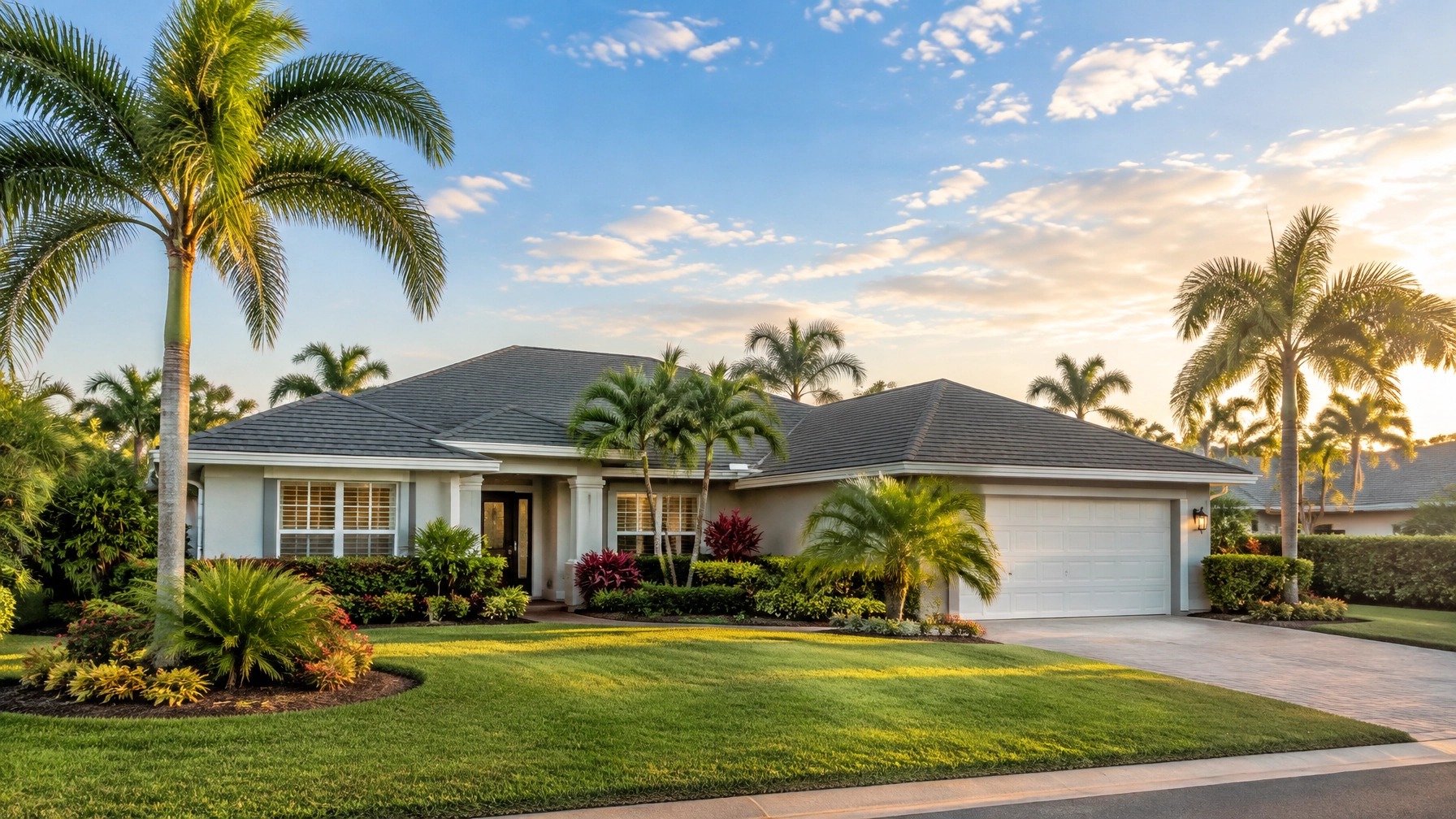
A new roof can improve Fort Myers resale appeal, insurance readiness, and buyer confidence, but the return depends on the material, installation quality, roof age, and neighborhood.
In 2026, Fort Myers home values generally fall within a broad range:
- City median sale price: approximately $319,900–$348,000, depending on the source and month
- Zillow typical home value: approximately $310,708
- Lehigh Acres median: approximately $309,000
- McGregor area: approximately $439,000–$481,000
- Gateway: approximately $450,000
- Typical market time: approximately 64 days
With homes taking longer to sell than during the peak Florida market, visible maintenance and storm readiness matter. A clean, recently replaced roof can help a listing compete while reducing one of the largest buyer concerns.
Fort Myers Roof Replacement Costs in 2026
For a typical 2,000- to 2,500-square-foot Fort Myers home, installed roof replacement costs commonly fall into these ranges:
| Roofing system | Typical installed cost | Cost per square foot | Best fit |
|---|---|---|---|
| Architectural asphalt shingles (Popular) | $10,750–$17,500 | $4.50–$8.50 | Budget-conscious owners and resale preparation |
| Standing-seam metal (Premium) | $22,000–$36,000+ | $8.00–$16.00 | Long-term ownership and higher wind durability |
Coastal labor demand, permitting, tear-off requirements, roof pitch, multiple elevations, decking repairs, and hurricane-rated components can push Fort Myers costs above statewide averages.
The Get My Roof Estimate Now roof cost calculator can provide a starting range based on roof size, material, pitch, region, and tear-off. A property-specific satellite estimate is more useful because it measures the actual roof rather than relying only on conditioned living area.
How Much Resale Value Does a New Roof Add?
National remodeling benchmarks provide a useful starting point, but they are not a guarantee for any specific Fort Myers property.
The 2025 Zonda Cost vs. Value Report estimates:
- Asphalt shingle replacement: approximately 68% cost recaptured
- Metal roof replacement: approximately 50% cost recaptured
A new roof may also contribute roughly 2%–4% to overall home value, especially when replacing a visibly worn, storm-damaged, or insurance-problematic roof. The actual impact depends on comparable listings, the roof’s remaining life, curb appeal, and whether buyers expect immediate replacement.
Do not treat these percentages as guaranteed profit. Roof replacement is usually a combination of:
- Value recovered at resale
- Faster buyer acceptance
- Fewer inspection objections
- Better insurance eligibility
- Lower near-term maintenance risk
- Improved appearance and curb appeal
The National Association of REALTORS® 2025 Remodeling Impact Report gives new roofing a Joy Score of 10 out of 10. That reflects homeowner satisfaction and peace of mind, not a promise that every dollar will be recovered, but it confirms that roofing is one of the projects owners value most after completion.

Worked ROI Example: Asphalt vs. Metal on a $320,000 Home
Assume a Fort Myers home is worth approximately $320,000 before replacement.
Option 1: Architectural asphalt shingles (Popular)
- Estimated project cost: $14,000
- National benchmark recovery at 68%: $9,520
- Implied unrecovered cost: approximately $4,480
- Potential 2%–4% value contribution: $6,400–$12,800
Option 2: Standing-seam metal (Premium)
- Estimated project cost: $29,000
- National benchmark recovery at 50%: $14,500
- Implied unrecovered cost: approximately $14,500
- Potential 2%–4% value contribution: $6,400–$12,800
These calculations should not be added together. The percentage-based benchmark and the estimated value lift are two different ways to view potential return.
The practical conclusion: asphalt usually offers the stronger short-term roof replacement ROI. Metal can make more financial sense for owners who plan to stay longer, want a 40- to 70-year service life, or place a high value on wind performance and lower replacement frequency.
See the roofing materials guide for additional comparisons.
Hurricane Ian Changed the Roof Conversation
Hurricane Ian made roof performance a major consideration across Lee County. According to IBHS research on Hurricane Ian, approximately half of older asphalt shingle roofs showed cover damage, while steep-slope metal roofs had damage rates near 11%–12%.
That does not mean every metal roof will outperform every shingle roof. Installation, attachment, product approval, roof geometry, and surrounding structures all matter. However, Ian reinforced several important lessons:
- Roof age is a significant storm-risk factor.
- Proper fastening matters as much as the visible roof covering.
- A sealed roof deck can limit water intrusion after cover damage.
- Hip roof designs may perform differently from complex roof shapes.
- Lanai, carport, and opening failures can damage an otherwise strong roof.
Fort Myers also experienced multiple 2026 weather events, including May 17 landspout tornadoes, a June 28 EF-0 tornado near North Fort Myers, a July 2 landspout, approximately 58 mph winds on July 10, and hail events reported on August 25 and August 29. These events are reminders that storm readiness is an ongoing ownership issue, not only a hurricane-season concern.

Florida Code, Insurance, and the 25% Reroof Rule
Fort Myers reroofing projects must account for the Florida Building Code 8th Edition (2023). The code includes current wind-design requirements based on ASCE 7-22 and requirements for roof assemblies, underlayment, fastening, and secondary water protection.
Florida’s 25% reroof rule is especially important. In general, if more than 25% of a roof section is repaired, replaced, or recovered within a 12-month period, the affected roof or section may need to meet current code requirements. The exact application depends on the roof’s permit history, construction date, code compliance, and local interpretation.
Ask the contractor about:
- Current Florida Building Code compliance
- Product approval numbers
- Enhanced nailing patterns
- Secondary water barrier or sealed roof deck options
- Roof-to-wall connections
- Deck condition and attachment
- Permit and inspection responsibilities
Insurance is another part of the roof replacement ROI calculation. Florida carriers increasingly evaluate roof age, condition, and documentation. Citizens Property Insurance has used a 25-year roof-age threshold in its eligibility rules, although requirements can vary by property and underwriting situation.
After April 1, 2026, wind mitigation inspections use OIR-B1-1802 (Rev. 04/26). The revised form references ASCE 7-22 wind regions and requires photographs or documentation supporting mitigation features. Keep permits, product approvals, invoices, installation records, and inspection reports.
Eligible homeowners should also review My Safe Florida Home. The program may provide a free mitigation inspection and grants of up to $10,000 for eligible homesteaded homes, generally including homes permitted before January 1, 2008 with an insured value under $700,000. Funding and eligibility rules can change, so confirm current requirements before planning around a grant.
Neighborhood-Specific ROI in Fort Myers
Roof replacement resale value varies by location.
- McGregor: Higher-value homes, mature landscaping, and stronger curb appeal expectations can support premium architectural shingles, tile, or metal when the material fits the home.
- Downtown River District: Buyers may focus on condition, inspection transparency, and insurance readiness. A documented replacement can reduce negotiation friction.
- Gateway: With home values around the mid-$400,000 range, buyers may expect clean, modern exterior finishes and strong storm-resistance documentation.
- Lehigh Acres: With a lower median near $309,000, architectural asphalt shingles may provide the best balance of cost, appearance, and resale practicality.
The best roof for home value is not always the most expensive roof. It is the system that matches the property, neighborhood, buyer expectations, storm exposure, and ownership timeline.

How to Estimate Your Roof Replacement ROI Before Selling
Before requesting contractor visits, gather the information that drives pricing:
- Enter the property address into a satellite-based estimator.
- Review measured roof size, pitch, and complexity.
- Compare architectural shingles and standing-seam metal.
- Add likely tear-off, decking, permit, and coastal premiums.
- Request written bids from licensed and insured contractors.
- Ask for code-compliance and wind-mitigation documentation.
- Compare the replacement cost with local comparable home prices.
Get My Roof Estimate Now uses satellite imagery to estimate roof dimensions and provides pricing ranges in about 60 seconds, without a credit card or an initial contractor visit. The estimate is a planning tool, not a substitute for a final inspection, but it gives Fort Myers homeowners a faster way to budget.
FAQ: Fort Myers New Roof ROI
Does a new roof increase Fort Myers home value?
Usually, yes: especially when the existing roof is old, visibly damaged, or difficult to insure. A new roof may contribute approximately 2%–4% in value, but the result depends on comparable sales, material, workmanship, and buyer demand.
Is asphalt or metal better for resale?
Architectural asphalt shingles generally provide stronger short-term roof replacement ROI because the upfront cost is lower. Metal may be better for long-term ownership, storm resistance, and reduced replacement frequency.
How much does a new roof cost in Fort Myers?
Architectural shingles commonly cost about $10,750–$17,500 on a 2,000- to 2,500-square-foot roof. Standing-seam metal commonly costs $22,000–$36,000 or more, depending on specifications and coastal conditions.
Will a new roof reduce Florida insurance costs?
It may. Wind-mitigation features and documented code compliance can support insurance credits, but savings depend on the carrier, inspection results, roof age, and the entire home’s mitigation profile.
Can I get a Fort Myers roof estimate without a contractor visit?
Yes. A satellite-based estimate can measure roof size and estimate costs based on material, pitch, complexity, and regional pricing. Use it to budget first, then have a licensed contractor verify the roof system before signing a contract.
Leave a Reply