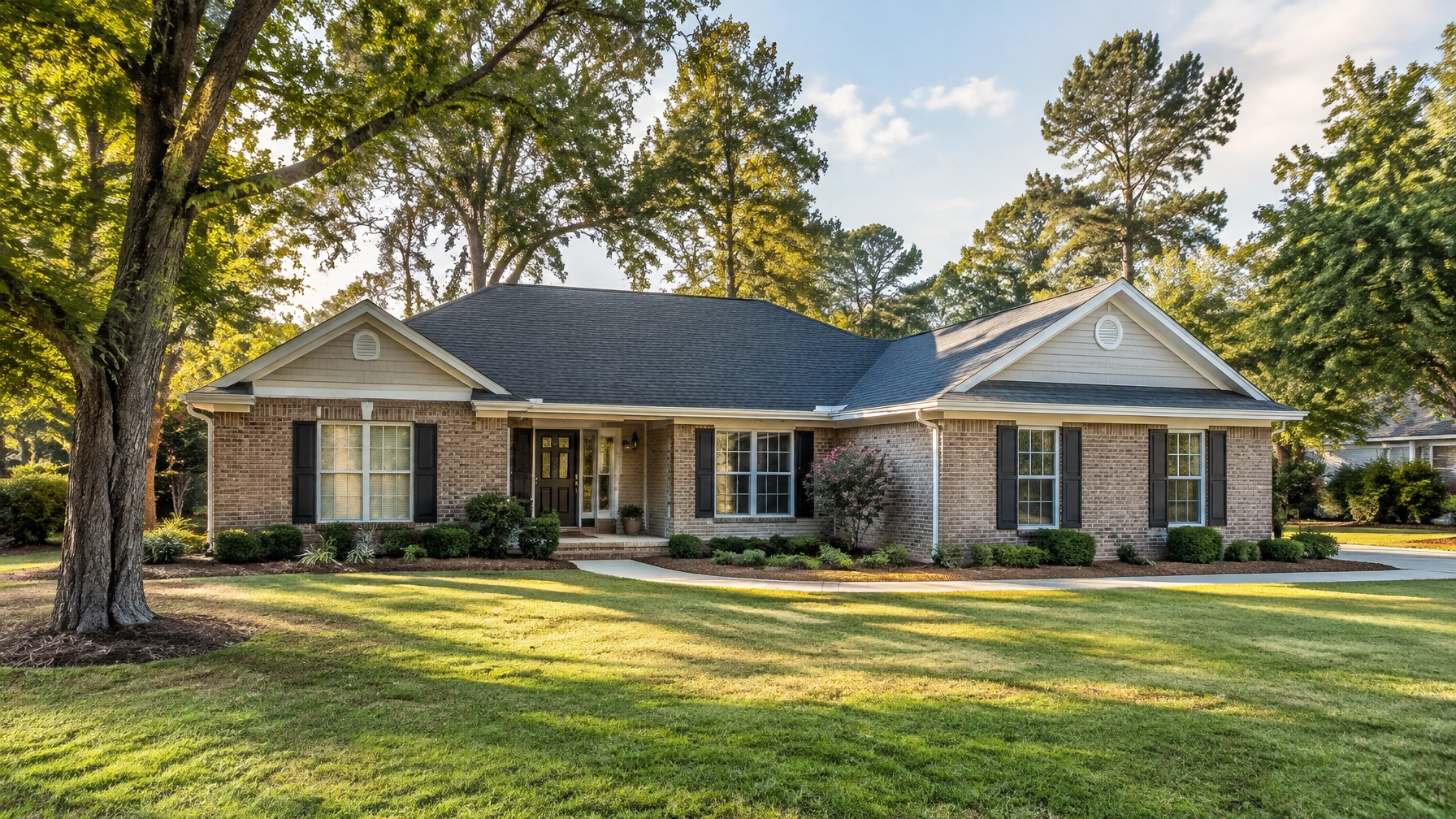
A typical 2,000-square-foot roof replacement in Warner Robins costs approximately $8,300–$16,100 in 2026, with an average near $12,400 for architectural asphalt shingles. Larger or more complex roofs commonly reach $9,000–$22,000.
The faster way to understand where your home fits in that range is satellite-powered measurement.
Enter your address at Get My Roof Estimate Now and receive a free planning estimate in about 60 seconds. The system analyzes roof size, pitch, complexity, material options, and regional pricing: without a contractor visit upfront.
That approach is especially relevant in Warner Robins, the “International City” and home of Robins Air Force Base, where local technology leaders are focused on converting massive amounts of sensor data into fast, useful decisions.
Warner Robins Is Building a Faster Data-to-Decision Culture
On September 11, 2026, the 116th Air Control Wing officially became the 116th Wing during a ceremony at the Museum of Aviation. The event also activated the 116th Battle Management Control Group and the 107th Battle Management Control Squadron.
The change follows the 2023 divestment of the E-8C JSTARS fleet. The wing’s evolving mission now combines:
- Battle management
- Communications
- Cyber operations
- Intelligence
- Sensor and satellite data
- Decision support
U.S. Air Force Col. Christopher Dunlap, commander of the 116th Wing, described the central challenge:
“The question facing our Air Force is no longer simply, ‘How much information can we collect?’ It is: ‘How quickly can we turn that information into action?’”
That same principle applies to roofing.
A satellite image by itself is only information. The homeowner needs a usable result: roof size, estimated replacement cost, material comparisons, and a realistic low-middle-high budget range.
The advantage is not merely access to imagery. It is the ability to interpret that imagery quickly.
The official DVIDS report on the 116th Wing redesignation describes this shift in detail.
The $109 Million Mission Behind the Technology Edge
Robins Air Force Base is also constructing a $109 million Battle Management Combined Operations Complex. The facility is designed to consolidate command-and-control missions supporting the Department of the Air Force Battle Network, formerly known as the Advanced Battle Management System, or ABMS.
The broader effort is built around fusing:
- Satellite feeds
- Radar data
- Sensors
- Communications
- Electronic warfare information
- Intelligence systems
The goal is a common operating picture that helps decision-makers act faster.
Other technology developments reinforce Warner Robins’ position as a Middle Georgia innovation hub:
- The 950th Spectrum Warfare Group was activated at Robins in October 2024, earlier than the projected 2027 timeline.
- The 17th Electronic Warfare Squadron evaluates electromagnetic-spectrum capabilities.
- The E-11A Battlefield Airborne Communications Node, operated by the 18th Airborne Command and Control Squadron, relays satellite and tactical communications so teams can share a common picture. The Air Force’s FY2028 divestment plan is a matter-of-fact reminder that missions and platforms continue to evolve.
- The Georgia Tech Research Institute Warner Robins Field Office supports electronic warfare, cybersecurity, systems engineering, and intelligence, surveillance, and reconnaissance work with approximately 60 researchers, staff, and interns.
- Atlanta-based Danti received a $2.1 million Space Force contract expansion under the Tactical Surveillance, Reconnaissance and Tracking program. Danti CEO Jesse Kallman has said that space-based intelligence is becoming “way more accessible to the common person, both commercially and in government.”
For homeowners, the practical lesson is straightforward: data access is no longer the main obstacle. Fast interpretation is.
The Same Imagery Pipeline Is Changing Roof Insurance
Middle Georgia insurers increasingly use aerial and satellite imagery, artificial intelligence, permit records, and weather history to evaluate roof age and condition.
Image-based systems may flag signs such as:
- Granule loss
- Discoloration
- Algae growth
- Missing or mismatched shingles
- Visible repairs
- Roof wear patterns
- Storm-related changes
In some cases, underwriting reviews can trigger repair requirements or non-renewal notices on roofs as young as 10–14 years old, depending on the insurer, policy, roof material, and observed condition.
This does not mean an image replaces a professional inspection. Satellite imagery cannot reliably identify every hidden leak, soft deck area, flashing defect, or interior moisture problem.
It does mean homeowners can use similar technology proactively.
Instead of waiting for an insurance letter: or scheduling several contractor visits just to get a starting number: you can first obtain a property-specific planning benchmark.
Warner Robins Storm Exposure Makes Early Planning Important
Houston County homeowners face recurring spring and summer thunderstorm activity, straight-line winds, hail, and occasional tornado threats.
Recent 2026 events include:
- March 12: A tornado near Lakewood, approximately six miles southwest of Warner Robins, caused downed trees and power lines.
- August 16: A severe thunderstorm warning covered northeast Houston County, with reported wind gusts up to 60 mph and penny-size hail.
- September 6: A Houston County hail event averaged approximately 1.3 inches, with maximum reports reaching 2.8 inches.
Hail does not always produce an immediate leak. It can fracture shingle mats, loosen granules, and reduce the remaining life of the roof. Wind can lift edges or damage ridge caps without creating an obvious ground-level warning.
After a storm, homeowners should:
- Photograph visible damage from the ground.
- Check gutters for unusual granule accumulation.
- Look for ceiling stains or attic moisture.
- Record the storm date.
- Avoid climbing onto the roof.
- Request a qualified inspection if damage is suspected.
- Review the policy’s wind and hail deductible before filing a claim.
A satellite estimate is useful for budget planning. It is not an insurance determination or a final contractor scope of work.
2026 Roof Replacement Costs in Warner Robins
For a typical Warner Robins property, current planning benchmarks look like this:
Architectural Asphalt Shingles (Popular)
- Installed range: Approximately $4.50–$8.10 per square foot
- Typical 2,000-square-foot roof: $8,300–$16,100
- Average planning figure: About $12,400
- Typical 1,800–2,400-square-foot projects: Roughly $9,000–$22,000
Standing-Seam Metal (Premium)
- Installed range: Approximately $8.80–$15.60 per square foot
- Typical use case: Long-term ownership, energy considerations, and enhanced durability
- Budget impact: Often substantially higher than asphalt, especially when tear-off, trim, ventilation, and complex roof geometry are included
Synthetic Slate or Shake (Premium)
- Installed range: Approximately $10–$20 or more per square foot
- Typical use case: Higher-end appearance without the weight of natural slate
- Budget impact: Material, labor, and specialty installation requirements can significantly increase the total
The roof is measured in squares, with one roofing square equal to 100 square feet. Roof size is not always the same as the home’s interior square footage. Pitch, overhangs, valleys, dormers, and attached garages all affect the final measurement.

Local Case Study: A 2,100-Square-Foot Bonaire Ranch
Consider a hypothetical 2,100-square-foot ranch in Bonaire, ZIP 31005, with architectural shingles and exposure to the September 6 hail event.
The homeowner’s planning profile might look like this:
- Roof type: Architectural asphalt shingles
- Estimated roof area: Approximately 2,100 square feet
- Storm exposure: Hail reports averaging 1.3 inches, with larger hail nearby
- Planning range: Approximately $9,500–$16,500
- Potential upgrades: Impact-rated shingles, improved ventilation, upgraded flashing, or high-wind-rated products
The range is not a contractor quote. It does not account for hidden deck damage, unusual access, multiple tear-off layers, or code-driven repairs.
It does give the homeowner a useful decision point: whether to investigate further, plan financing, compare materials, or contact a contractor before a small issue becomes an emergency.

Permits, Tear-Offs, and Georgia Roofing Requirements
Roof replacement in the Warner Robins and Houston County area generally requires a permit through the applicable city or county building department.
Homeowners should ask who will secure the permit and confirm that the contract includes:
- Permit fees
- Tear-off and disposal
- Decking replacement allowances
- Ice and water protection where required
- Flashing replacement
- Ridge and intake ventilation
- Manufacturer installation requirements
- Final inspection
Permit costs can range roughly from $85 to $850, depending on project scope and jurisdiction. Tear-off is generally required when a roof has three or more existing layers.
Work must follow Georgia’s State Minimum Standard One- and Two-Family Dwelling Code, which is based on the International Residential Code with Georgia amendments. In storm-prone areas, homeowners may also want to discuss:
- ASTM D7158 wind ratings
- Enhanced fastening patterns
- High-wind provisions for 110-mph-or-higher conditions
- Impact-resistant shingle options
- Georgia’s FORTIFIED Roof insurance discount provisions under HB 279 / Act 476
Discount eligibility depends on the insurer, roof system, documentation, and installation requirements. Confirm the details with your insurance carrier before selecting materials.
A Faster Starting Point for Homes Across Middle Georgia
Whether your home is in Warner Robins, Kathleen, Centerville, Perry, or a nearby neighborhood, the first step is knowing the roof’s actual size and likely replacement range.
Get My Roof Estimate Now uses satellite-powered analysis to estimate roof dimensions, pitch, complexity, and material pricing. Results are typically available in about 60 seconds.
The service is:
- Free for homeowners
- Available without a credit card
- Typically 90–95% accurate for planning
- Based on property-specific satellite imagery
- Transparent, with low-middle-high pricing ranges
- Available for architectural shingles, metal, synthetic materials, and coatings
- Connected to verified, licensed, and insured local contractors
Use the estimate as a planning benchmark: not a substitute for a final on-site inspection and written contractor proposal.
For a roof in ZIP 31088, 31093, 31005, or 31069, the process is simple: enter the address, review the satellite measurement, compare materials, and decide what action makes sense.
That is the real satellite tech edge coming out of Warner Robins: turning complex imagery into a clear number before the homeowner needs to make a rushed decision.

Leave a Reply