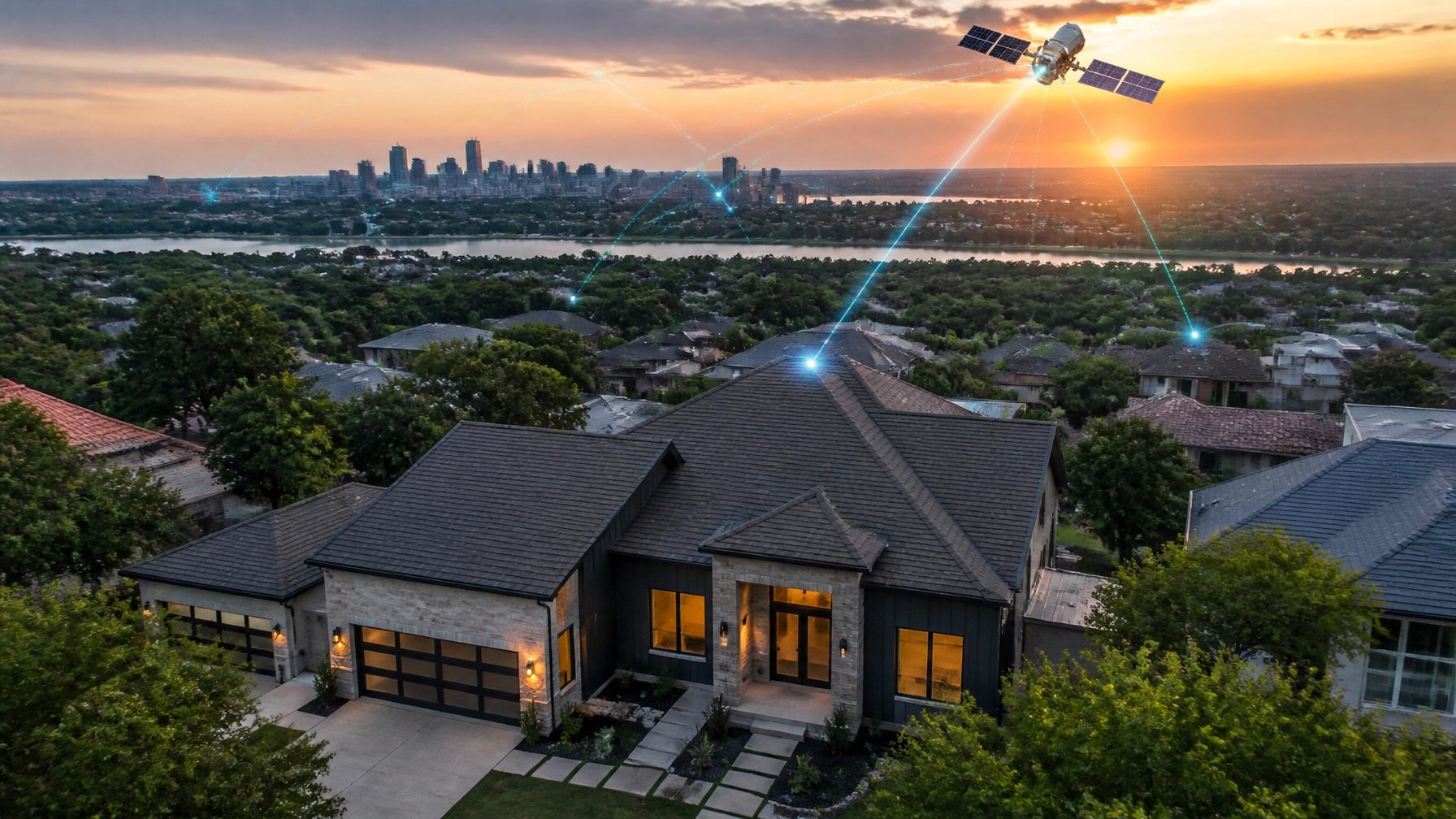
Austin has long been known as "Silicon Hills," but as of July 2026, a more accurate nickname might be "Satellite Hills." From the massive expansion of CesiumAstro in Bee Cave to SpaceX’s skyrocketing Gigasat campus in Bastrop, Central Texas is now the global epicenter of orbital intelligence.
For the average Austin homeowner, these billion-dollar investments might seem like high-level "space stuff" that doesn't affect daily life. However, the reality is the exact opposite. The same technology powering these aerospace giants is the very reason you no longer have to wait three days for a contractor to lean a ladder against your house just to get a quote.
At GetMyRoofEstimateNow.com, we leverage the same high-resolution satellite imagery and AI processing models being pioneered in our own backyard to provide instant Texas roof estimates in under 60 seconds.
Here is how the Austin satellite boom is fundamentally changing how you maintain, budget for, and protect your home.
The Bee Cave Giant: CesiumAstro’s $500M Headquarters
Just down Highway 71, CesiumAstro has recently completed its 270,000-square-foot advanced manufacturing campus in Bee Cave. This $500 million facility is more than just a job creator; it is a signal that high-precision hardware is being "American-made" right here in Travis County.
CesiumAstro specializes in active phased-array communication systems. In plain English: they build the "eyes and ears" of satellites that allow for massive data transfer without mechanical moving parts. When we measure a roof in Austin, we rely on the density of data provided by these modern satellite constellations. The clearer the signal and the faster the data, the more accurate your roof measurement becomes.
SpaceX Bastrop: The 11-Million-Square-Foot Gigasat Factory
If you head east toward Bastrop, the scale of innovation becomes even more staggering. SpaceX’s new Gigasat factory: an 11-million-square-foot behemoth: is now producing satellites designed for orbital AI computing.
Why does this matter for a homeowner in Round Rock or West Lake Hills?
- Edge Computing: By processing data in orbit, these satellites can deliver high-resolution imagery to ground servers faster than ever.
- Solar Integration: The Gigasat campus also includes a massive solar cell factory, highlighting the shift toward energy-efficient roofing solutions like solar shingles and high-reflectivity coatings.
As SpaceX expands its presence along FM 1209, the infrastructure supporting satellite technology in Central Texas becomes more robust. This directly translates to lower costs and higher accuracy for homeowners using digital estimation tools.

SkyFi MCP: The July 2026 AI Breakthrough
The most recent leap forward happened this month. SkyFi officially launched its new Model Context Protocol (MCP) platform. This technology allows AI assistants: like the ones we use to power our internal calculation engines: to directly "talk" to satellites in real-time.
Previously, accessing high-resolution geospatial data required a specialized engineering degree. Now, SkyFi’s MCP enables our system to request a "cloud-free, high-resolution view" of a specific address in Austin and receive a data-backed response instantly. This is how we achieve 90-95% measurement accuracy without ever stepping foot on your property.
DIY vs. Pro: The End of the Ladder Era
For decades, the "Standard" (Traditional) way to get a roof estimate involved:
- Calling 3-4 contractors.
- Waiting for them to show up (often in a 4-hour window).
- Watching a technician climb a ladder with a physical tape measure.
- Waiting 24-48 hours for a handwritten or emailed quote.
In 2026, this process is obsolete. Climbing a ladder to measure a 2,500-square-foot roof with a 30-degree pitch is not just slow; it’s dangerous and prone to human error.
By using our online roof cost calculator, you bypass the physical risk and the scheduling headache. We use satellite-powered measurements to calculate your roof's "squares" (the 10×10 foot areas used by the industry) and provide a transparent price range based on current Austin market rates for labor and materials.
Understanding Your Estimate: The Material Breakdown
When you receive your instant estimate, you will see three primary categories. Each is influenced by the current tech-driven manufacturing landscape in Texas:
1. Architectural Shingles (Popular)
These are the most common choice for Austin homes. They offer a great balance of durability and cost.
- Best for: Standard suburban homes, storm protection, and 20-30 year lifespans.
- Typical Austin Price: $8,000 – $15,000 for a standard 2,000 sq. ft. home.
2. Standing Seam Metal (Premium)
With the rise of modern farmhouse designs in areas like Dripping Springs and Cedar Park, metal roofs have become a top-tier choice.
- Best for: High energy efficiency (reflecting Texas heat), fire resistance, and 50+ year lifespans.
- Typical Austin Price: $18,000 – $35,000+ depending on complexity.
3. Synthetic & Designer (Luxury)
For homeowners in Tarrytown or Pemberton Heights, synthetic slate or shake offers a high-end look without the extreme weight of real stone.
- Best for: Custom aesthetics and maximum curb appeal.
- Typical Austin Price: $25,000 – $50,000.

Why Accuracy Matters: The "95% Factor"
In the roofing industry, a "ballpark" estimate is usually a guess. A satellite-powered estimate is a measurement.
Because the technology from companies like CesiumAstro and SkyFi allows us to see the exact pitch (slope) and complexity of your roof from orbit, we can factor in:
- Waste Factor: How much extra material is needed for hips and valleys.
- Linear Feet: Precise measurements for drip edges and ridge caps.
- Regional Pricing: Our database tracks real-time material costs in Texas, factoring in everything from local supply chain shifts to labor availability.
When we say our estimates are 90-95% accurate, we mean that when a vetted, local contractor arrives to do the final walk-through, the price change is typically negligible. You start the conversation with the power of data on your side.
Protecting Your Investment in the "Storm Belt"
Central Texas is notorious for "hail alley" storm events. In the past, assessing damage and getting a budget for a replacement after a storm took weeks. Now, with the density of satellites currently orbiting Earth: many of which were built or are managed right here in Austin: we can provide post-storm assessments almost immediately.
If a storm hits your neighborhood tonight, you don't have to wait for the insurance adjuster to tell you what a roof should cost. You can run your own satellite estimate and have a professional, data-backed benchmark ready for your claim.

Summary: The Future is Overhead
The massive investments by SpaceX, CesiumAstro, and SkyFi are turning Austin into a global leader in space technology. But for you, the homeowner, the benefit is much closer to home.
You no longer need to be a roofing expert or a satellite engineer to get an accurate price for your home improvement project. You just need an address.
Ready to see the technology in action?
Get your free, instant roof replacement estimate using our satellite-powered system. No credit card, no waiting, and no ladders required.
Get Your Instant Estimate in 60 Seconds →
Leave a Reply